29 low skin fade styles that are clean, sharp and actually wearable
A low skin fade is the quietest way to look sharp. The fade starts low — just above the ears and the neckline — and blends down to bare skin, while the top keeps its length. That low placement is the whole point: you get the clean, skin-tight finish of a skin fade without the high contrast of a mid or high fade, so the cut works in an office, at a wedding, and on a night out. This guide has 29 of them — textured tops, buzz cuts, quiffs, curls, waves, beards and braids — each with a real photo, the exact words to say to your barber, and honest notes on which hair types and face shapes each style suits. Every style here is a real, wearable cut for men, and every one is chosen to still look like a haircut two weeks after the appointment.
Before the list, one honest note: a low skin fade is not a set-and-forget cut. Bare skin grows back visibly within a week, so the crispest version of any style in this guide needs a tidy-up every ten to fourteen days. What you get in return is the cleanest neckline of any fade — no stubble shadow, no fuzzy edges, just a smooth blend into skin. If that maintenance sounds like too much, a regular low taper is the easier cousin; our low fade haircut guide covers it in full. But if you want the sharpest finish a fade can give, start with the version in this guide that matches your hair, bring the photo on your phone, and tell your barber the length in plain words — because with skin fades, a photo beats a description every time.
What’s in this guide
Classic and clean (1–10): textured tops, buzz cuts, comb overs, quiffs, slick backs and the everyday favourites. Crops, curls and texture (11–20): crew cuts, Ivy League, side parts, hard parts, beards, waves, afros and spiky tops. Longer tops and statement cuts (21–29): Caesar cuts, brush ups, line-ups, high tops, undercuts, fringes, mullets, braids and design lines.
What is a low skin fade?
A low skin fade is a men’s haircut where the sides and back are faded down to bare skin, but the fade line sits low on the head — just above the ears and around the nape — instead of climbing halfway up the skull. Above that low line, the hair keeps most of its length, so the contrast between the top and the sides is gentle rather than dramatic. The “skin” part means the shortest point is shaved to the skin with a foil shaver or a zero-guard trimmer, not just cut very short. The result is a smooth gradient: skin at the bottom, stubble, then short hair, then the full length on top, with no visible lines between the steps. If you want the full family explained — low, mid, high and drop skin fades — our skin fade haircut guide covers every variation and which face shapes each one suits.
The low placement is what makes this fade different from its louder cousins. A high skin fade shouts; a low skin fade speaks quietly. Because most of the side keeps its hair, the cut grows out gracefully — after two weeks it reads as a tidy taper rather than a grown-out fade — and it flatters almost every face shape, including rounder faces that a high fade can make look longer. It also works with every hair type: straight, wavy, curly, coily and thinning hair all take a low skin fade well, because the fade itself does the shaping and the top can be as long or as short as you like. That versatility is why barbers call it the safest first skin fade: if you have never had your sides taken to skin before, start low.
How to choose the right low skin fade
Start with your hair. Straight hair shows every line of the blend, so it suits the sharpest versions — a slick back, a side part, a hard part — where the clean fade line is the feature. Wavy hair adds natural movement, so textured tops, quiffs and brush ups look effortless on it. Curly and coily hair should keep length on top; the curls are the style, and the low skin fade simply frames them, so ask the barber to shape the curls rather than thin them out. Thinning hair benefits most of all: a low skin fade removes bulk from the sides, which makes the top look fuller by comparison, and a short textured top or a buzz cut hides a receding hairline better than longer styles. If you are still deciding between fade heights, our fade haircut guide for men compares low, mid and high fades side by side.
Next, think about your life. An office job or a formal dress code points to the quiet end of this guide — a comb over, an Ivy League, a side part, a crew cut — where the fade is neat but never the loudest thing in the room. A creative job or a weekend look can take the bolder end: a faux hawk, a design line, a disconnected undercut, a high top. Then think about upkeep honestly. A low skin fade needs a touch-up every ten to fourteen days to stay crisp; if your barber visits are monthly, pick a style with a longer top, because the top carries the look while the fade softens. And think about your beard: a low skin fade blends beautifully into a faded beard, but the blend needs the same regular touch-ups, so factor in the extra five minutes at the chair.
What to tell your barber
The words that work best are simple and specific: say the height first, then the skin, then the top. For example: “A low skin fade, please — bare to the skin at the bottom, blend up through a zero and a one, and keep the top about two inches, textured.” Bring a photo from this guide on your phone; barbers cut better from a picture than from a description. Three things to always say: “low, not mid” if you have had a fade climb too high before; “foil shaver at the bottom” if you want a true skin finish rather than a close clipper cut; and “blend it soft, no hard line” if you want the gentle version. Ask the barber to show you the blend in the mirror before he moves on to the top — once the top is cut, the fade is already set.
Classic and clean cuts
These ten are the safest place to start. They are the cuts barbers know by heart, they photograph beautifully, and they are the reason the low skin fade became the default smart haircut of the 2020s.
1. Classic Textured Top
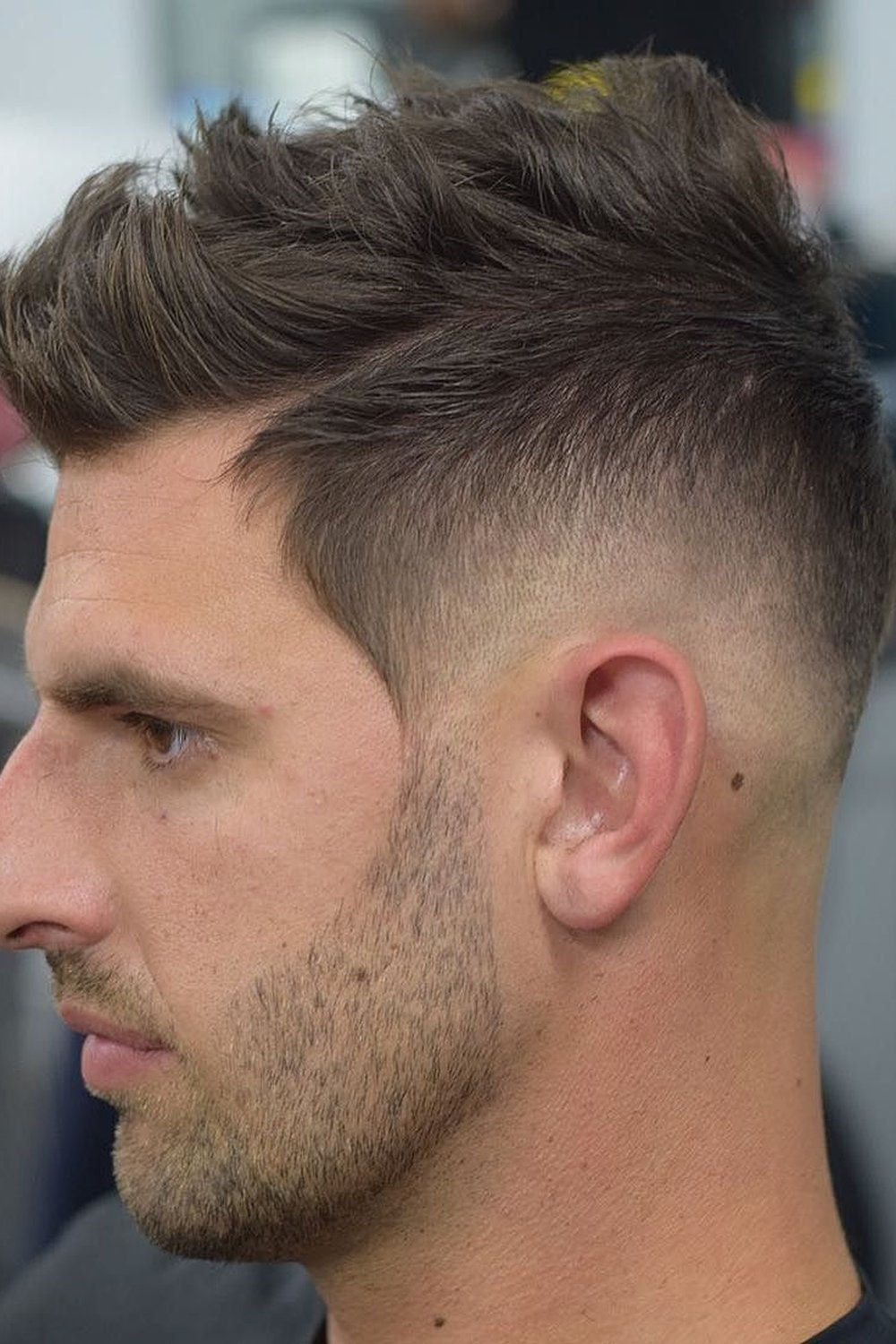
Photo via Pinterest — source
The classic textured top is the low skin fade in its purest form, and this close side-profile photo shows exactly why it works: the top is left long enough to sweep forward and to the side in choppy, separated layers, while the sides melt from dark hair into bare skin just above the ear. The texture does the styling — no comb, no parting, just a bit of matte clay worked through with the fingers. It suits almost every man, especially those with straight or slightly wavy hair, and it is the best first low skin fade because it is forgiving: if the blend is a touch soft or the top grows out a little, the cut still reads as finished. The stubble in the photo is no accident either — a short, neat beard balances the clean fade and keeps the whole look masculine rather than boyish.
Ask for: “Textured top, about two inches, choppy on top, low skin fade on the sides.” Best for: straight and wavy hair, first skin fades, every face shape. Upkeep: a pea-sized amount of matte clay each morning; tidy the fade every two weeks.
2. Buzz Cut
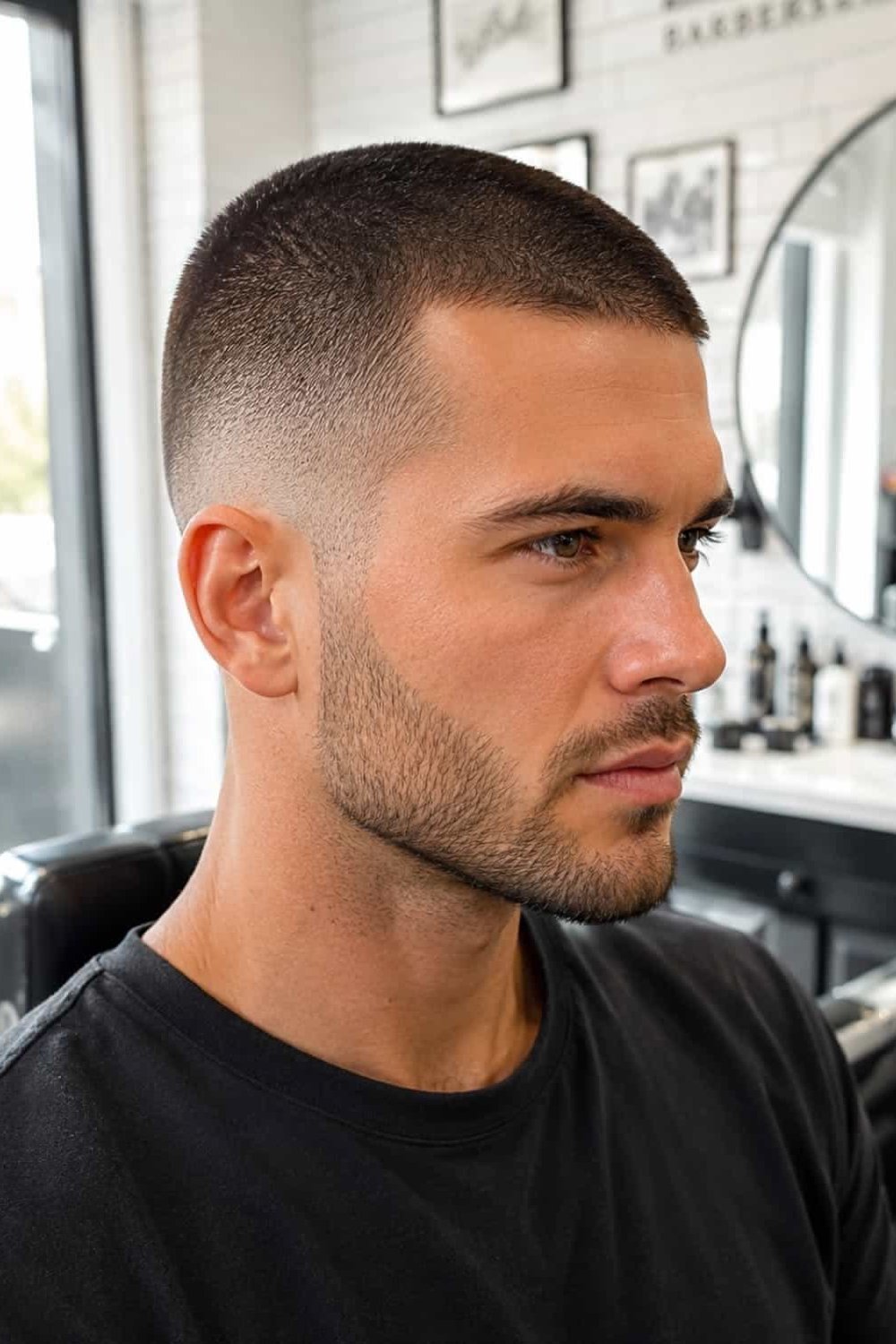
Photo via Pinterest — source
The buzz cut with a low skin fade is the lowest-maintenance haircut in this guide, and in this photo you can see why men who hate styling love it: one even length all over the top, a sharp skin fade at the sides, and nothing left to comb, part or worry about. A number 2 or 3 guard on top leaves enough length to look like a haircut rather than a shave, and the low skin fade gives it a finish a plain buzz cut never has — the sides go to bare skin, so the whole head looks deliberately shaped instead of simply short. It suits every hair type and every face shape, it is the easiest cut to keep clean in hot weather or at the gym, and it is the best choice for a man whose hairline is starting to move, because the short top makes thinning far less visible. The light stubble in the photo keeps it from looking severe.
Ask for: “Number 2 on top, low skin fade on the sides, foil shaver at the bottom.” Best for: every hair type, gym and hot weather, thinning hair. Upkeep: almost none; re-cut every two to three weeks to keep the skin part crisp.
3. Comb Over

Photo: Lovelyish — source
The comb over with a low skin fade is the boardroom version of this cut — timeless, tidy and quietly confident. In this photo the top is left long enough to sweep neatly to one side from a soft side part, while the low skin fade keeps the sides immaculate without drawing attention to itself. That restraint is the point: the fade is there, but the comb over is the star, which makes this the most office-friendly style in the guide. It suits men with straight or slightly wavy hair and a medium to long top, and it is especially flattering on men with a strong jawline, because the swept top and the clean sides frame the face rather than competing with it. A little pomade and a comb is all the styling it needs, and it holds its shape all day.
Ask for: “Comb over, three inches on top, side part, low skin fade, soft blend.” Best for: straight hair, office and formal settings, strong jawlines. Upkeep: comb and a small amount of pomade each morning; tidy every two to three weeks.
4. Quiff
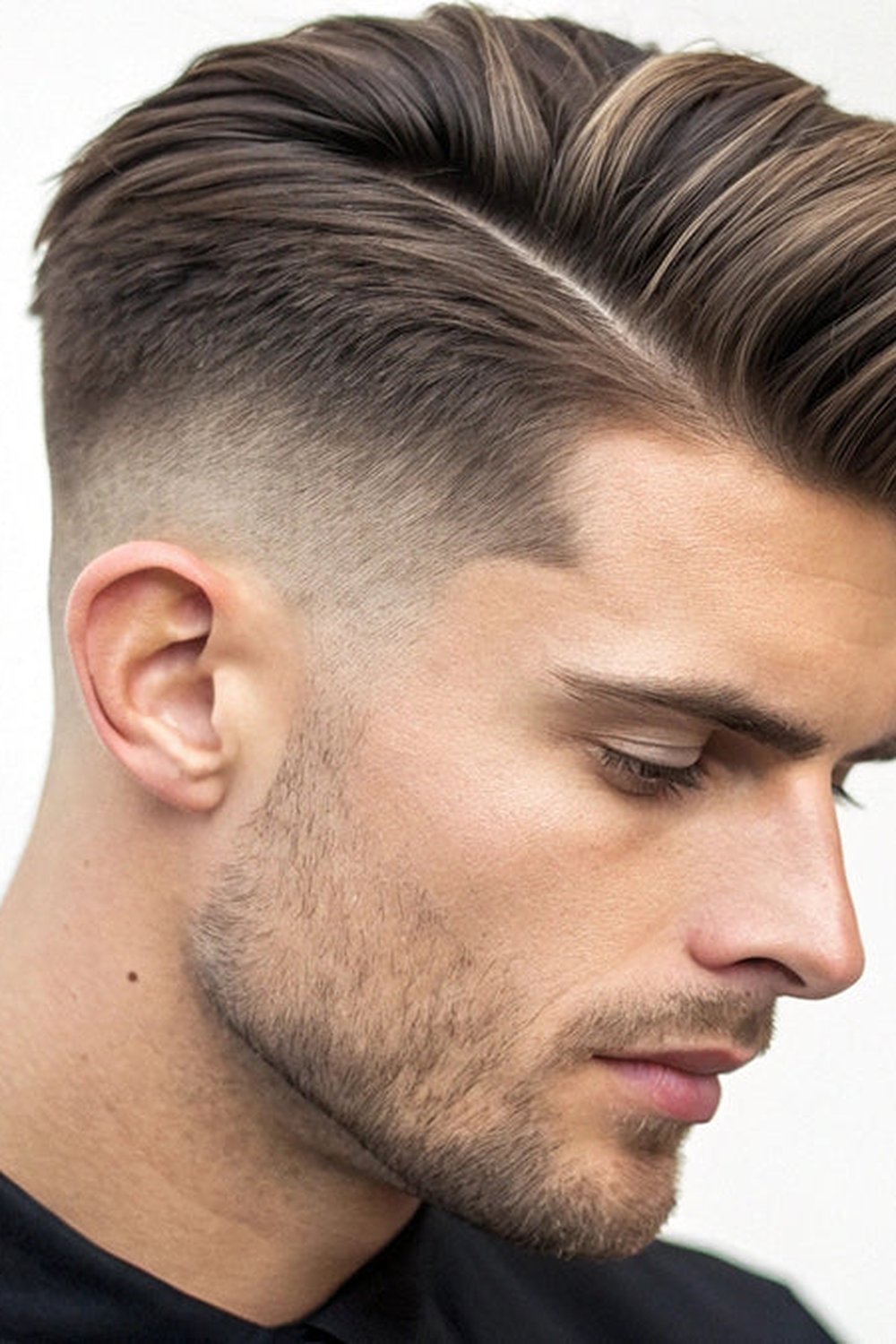
Photo: EB Grooming — source
The quiff with a low skin fade is the cut for a man who wants height. In this photo the front sweeps up and back with real lift, while the low skin fade keeps the sides tight so all the volume sits exactly where it should — on top. The height is doing two jobs: it lengthens the face, which flatters rounder face shapes, and it gives the whole cut a confident, styled energy that a flat top never has. It needs a little work in the morning — a blow dryer and a matte product, about two minutes — but the payoff is a style that looks deliberate from every angle. It suits straight and wavy hair best; very curly hair can carry a quiff too, but it needs more length and more product to hold the shape.
Ask for: “Quiff, longer at the front, swept up and back, low skin fade on the sides.” Best for: straight and wavy hair, rounder faces, men who like height. Upkeep: blow-dry up and back with matte clay; tidy the fade every two weeks.
5. Slick Back
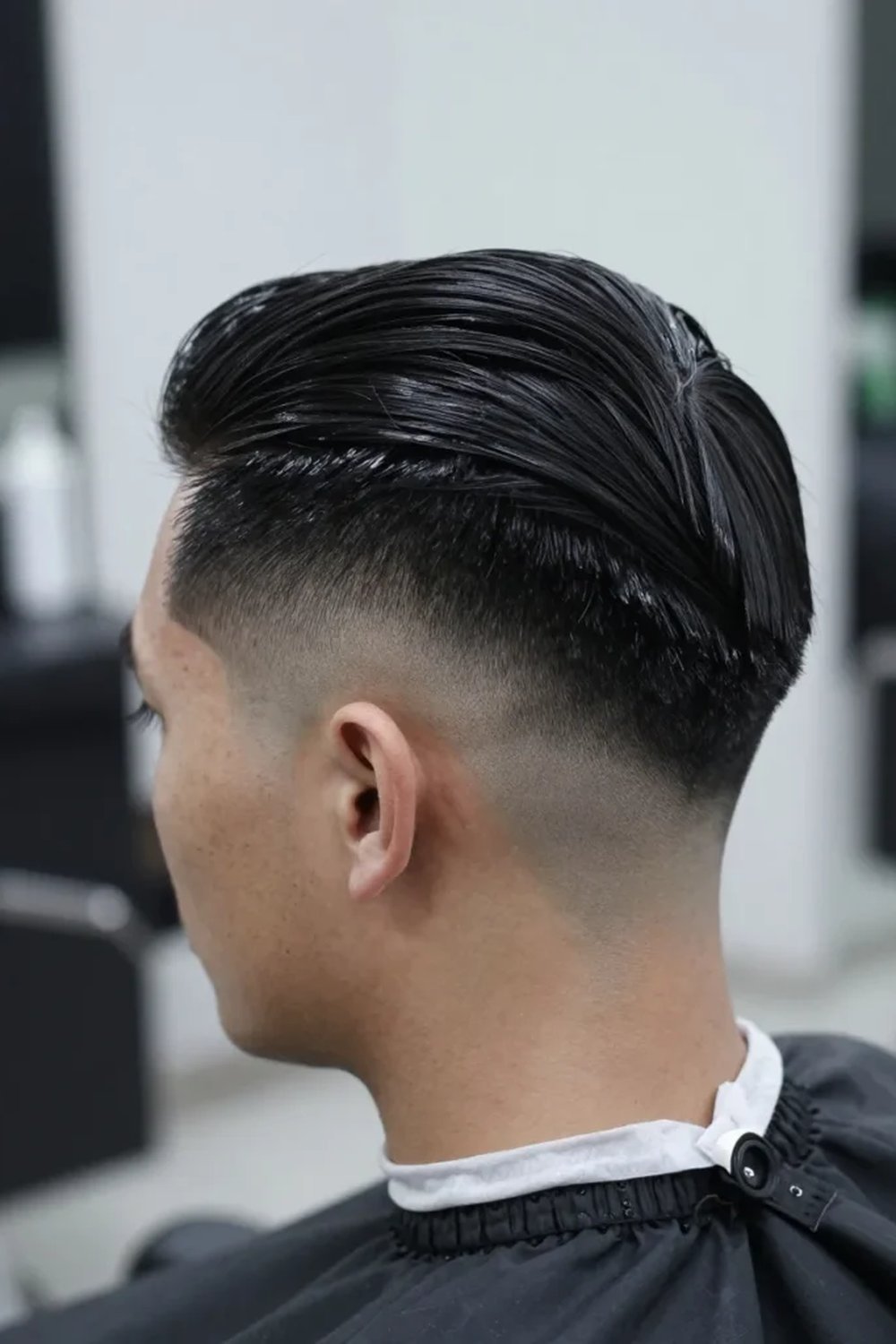
Photo: Crave Looks — source
The slick back with a low skin fade is the smoothest cut in this guide, and this back view shows why: the top is combed straight back in one clean sheet of hair, and the low skin fade wraps around the head in a smooth gradient with no lines and no bulk. Seen from behind, the blend is the whole story — skin at the nape, fading up into the longer top — and it is the view your barber judges most carefully. It suits men with straight or wavy hair and at least three to four inches on top, and it is the most grown-up style here: part Mad Men, part modern barbershop, it works at a wedding, in a meeting, and anywhere a neat silhouette matters. It needs a stronger product than the textured styles — a pomade with hold — and a comb, but once it is set it stays put all day.
Ask for: “Slick back, four inches on top, combed straight back, low skin fade.” Best for: straight and wavy hair, formal occasions, men who like a polished finish. Upkeep: pomade and a comb each morning; tidy every two to three weeks.
6. Pompadour
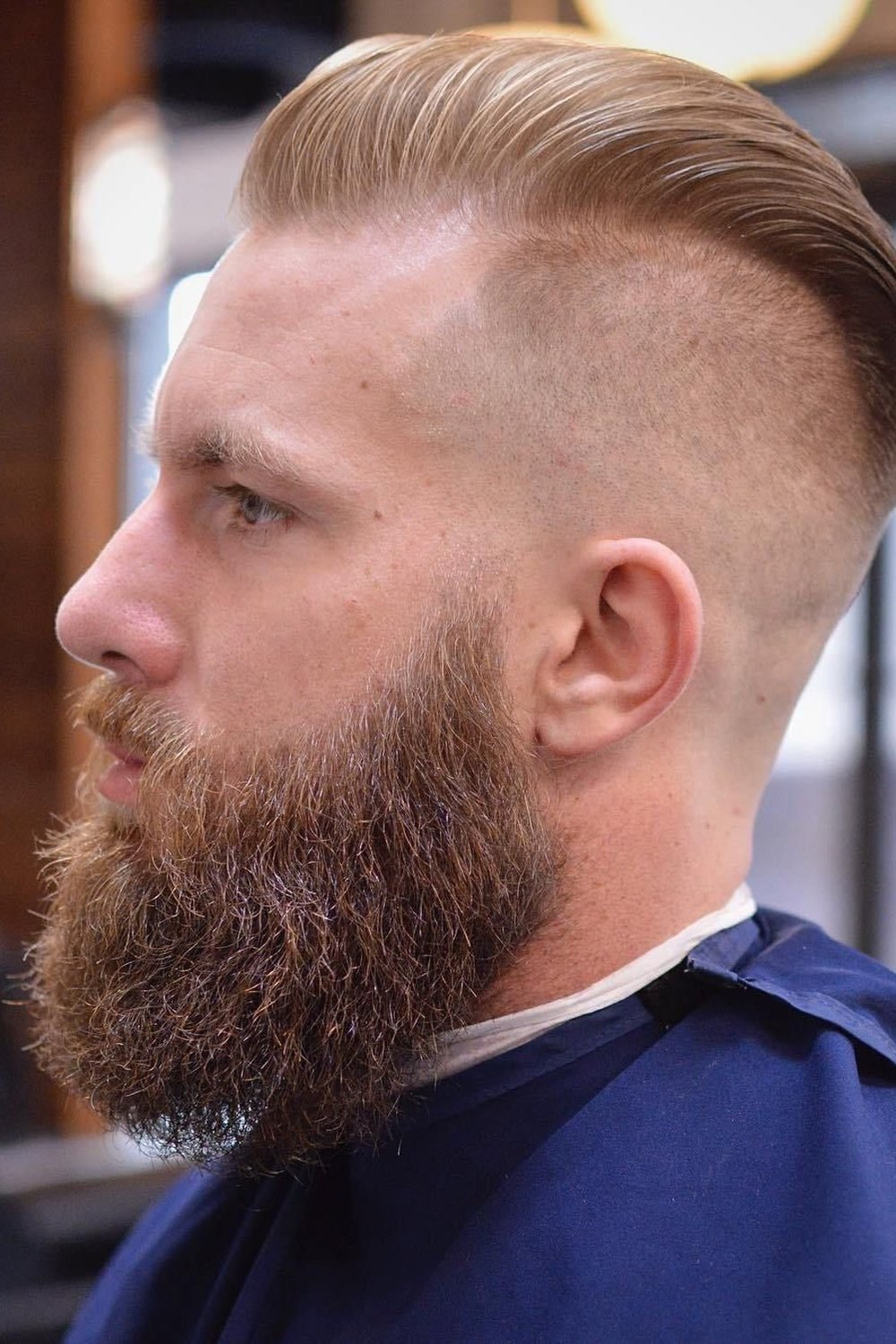
Photo via Pinterest — source
The pompadour with a low skin fade is the boldest classic in this guide, and this photo shows it at full strength: a tall, swept-up blond pompadour with real volume, a full beard, and a low skin fade holding the sides tight. The pompadour is the quiff’s bigger brother — more height, more sweep, more presence — and the beard is doing important work here, balancing the volume on top so the face does not disappear under the hair. It suits men with thick, straight or wavy hair who are happy to spend three minutes styling in the morning, and it flatters longer faces best, because the height adds drama without adding length to the face itself. It is a statement cut, and it knows it — wear it when you want to be noticed.
Ask for: “Pompadour, long on top, swept up and back, low skin fade, keep the beard full.” Best for: thick hair, longer faces, statement looks. Upkeep: blow-dry with volume and a strong-hold pomade; tidy every two weeks.
7. French Crop
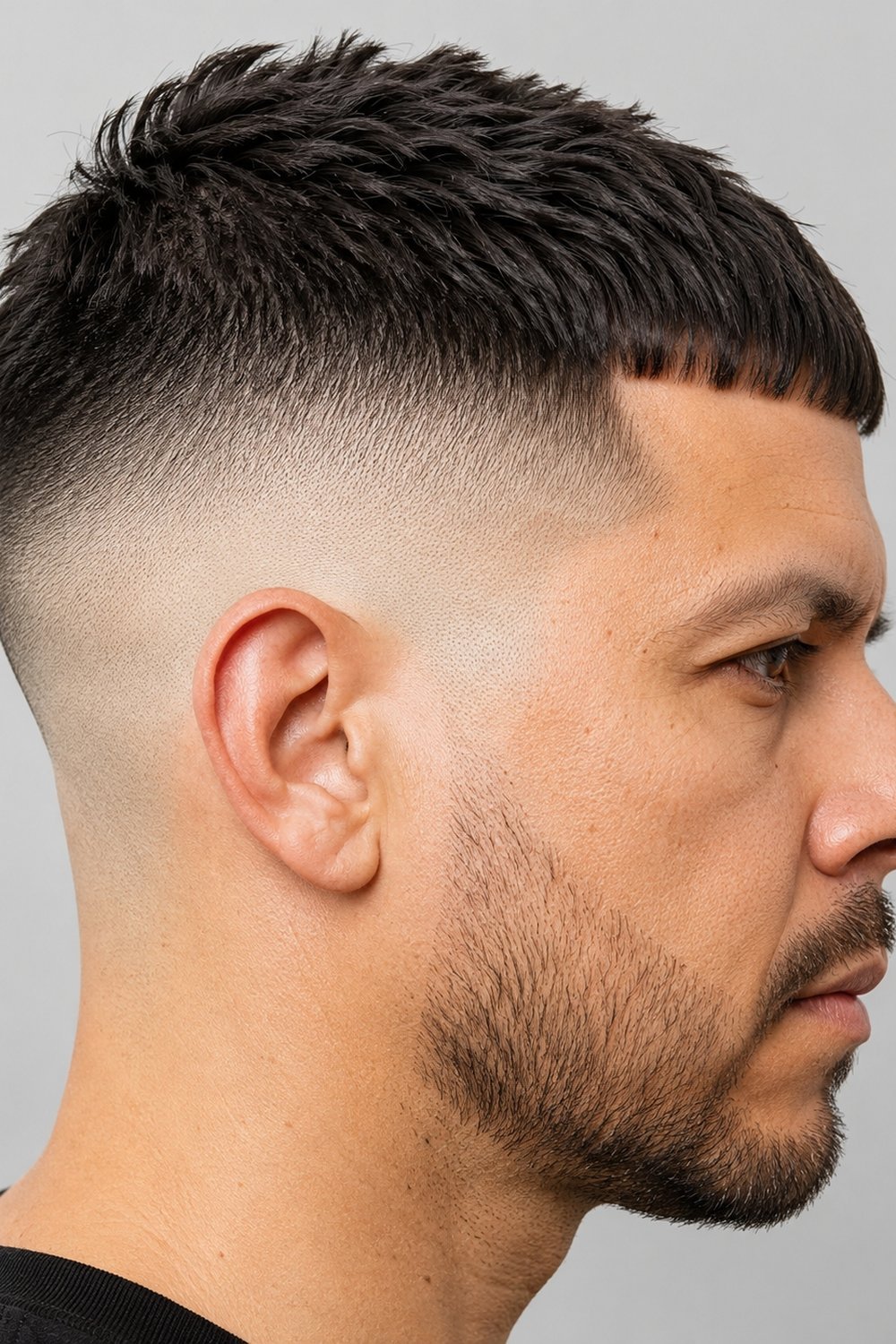
Photo: Vagazine — source
The French crop with a low skin fade is the easiest stylish haircut a man can own. In this photo the top is short and textured with a straight fringe sitting just above the eyebrows, and the low skin fade keeps the sides razor-clean. There is nothing to style — the fringe falls where it falls, the texture does the work, and the whole cut takes thirty seconds in the morning, most of which is deciding whether to bother at all. It suits almost every face shape, and it is the best choice in this guide for a man with a high forehead or a hairline that is starting to move, because the fringe covers the hairline completely. It also suits men who have never had a skin fade before: the short top makes the fade feel like a detail, not a commitment.
Ask for: “French crop, short textured top, fringe just above the eyebrows, low skin fade.” Best for: every hair type, high foreheads, zero-styling mornings. Upkeep: nothing to style; tidy the fade and the fringe every two to three weeks.
8. Curly Top
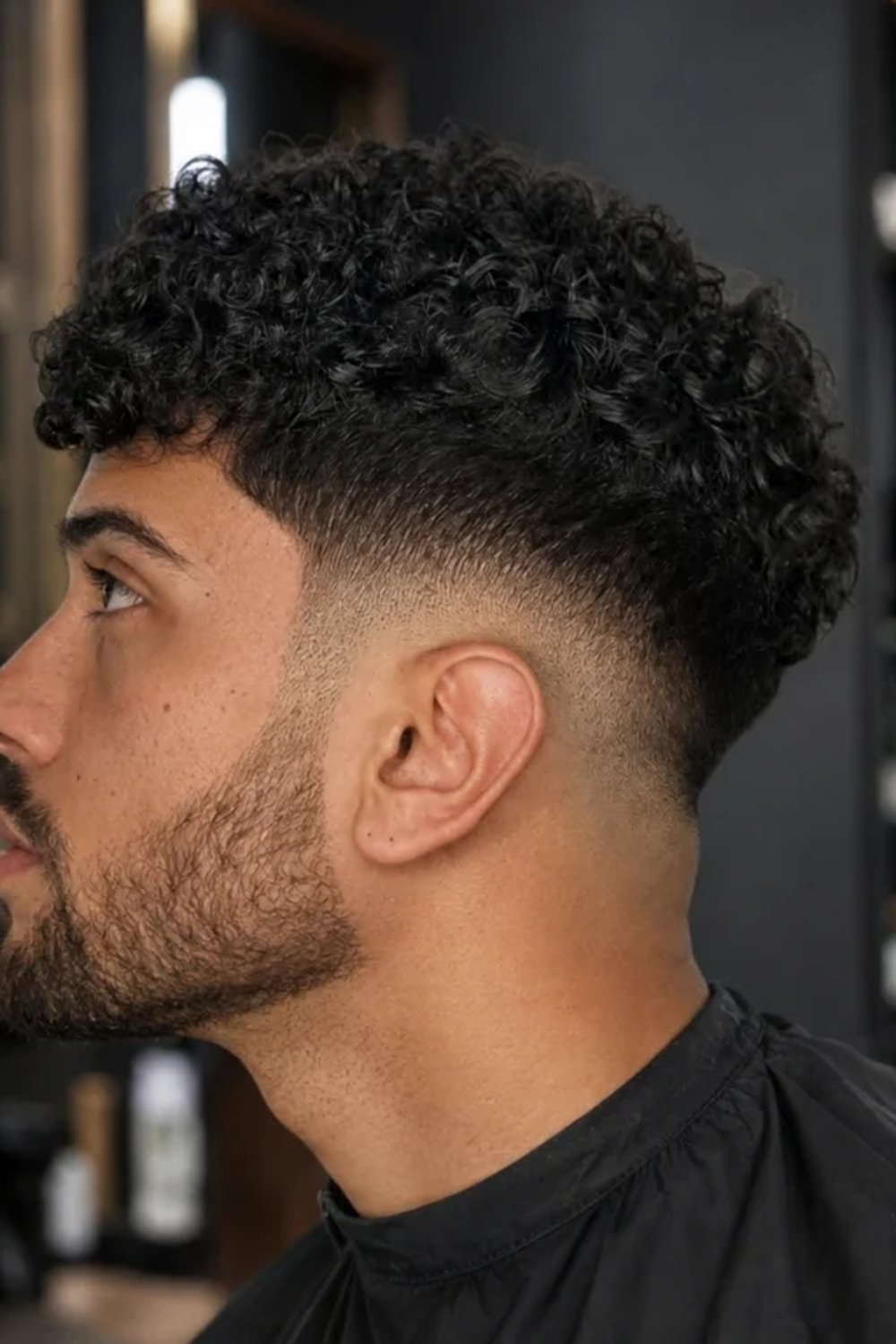
Photo: Beard Beasts — source
The curly top with a low skin fade celebrates natural curls instead of fighting them. In this side-profile photo the curls are kept generous and springy on top while the sides are faded to skin, so the shape stays neat and controlled without losing any of the curl’s character. The secret is length: cut the curls too short and they lose their spring, so the barber keeps the top long enough for the curls to form their own shape, and only the sides and back are taken short. It suits men with naturally curly or coily hair of any density, and it is one of the most low-effort cuts in this guide — the curls do all the styling by themselves. A little curl cream or leave-in conditioner keeps them soft and defined, and you should never brush curls dry.
Ask for: “Keep the curls long on top, shape the sides with a low skin fade, no thinning — just tidy the edges.” Best for: curly and coily hair, men who hate combs. Upkeep: curl cream after washing; trim the sides every two to three weeks.
9. Wavy Top

Photo via Pinterest — source
The wavy top with a low skin fade is the most relaxed cut in the classic group, and this photo — the man looking down, waves falling naturally over the forehead — shows why wavy hair is the easiest hair to cut well. The waves give the top movement without any product, the low skin fade gives the sides structure, and the combination looks styled even when nothing has been done to it. It suits men with naturally wavy hair of any thickness, and it is the most forgiving style here for growing out: as the top gets longer, the waves just get more relaxed, and the fade softens into a taper rather than looking overgrown. If your hair has a natural wave and you have been straightening it or fighting it, stop — this is the cut that lets it do what it wants.
Ask for: “Wavy top, keep the natural wave, low skin fade on the sides, soft blend.” Best for: wavy hair, low-effort styling, growing out gracefully. Upkeep: a little sea-salt spray or nothing at all; tidy every three weeks.
10. Faux Hawk
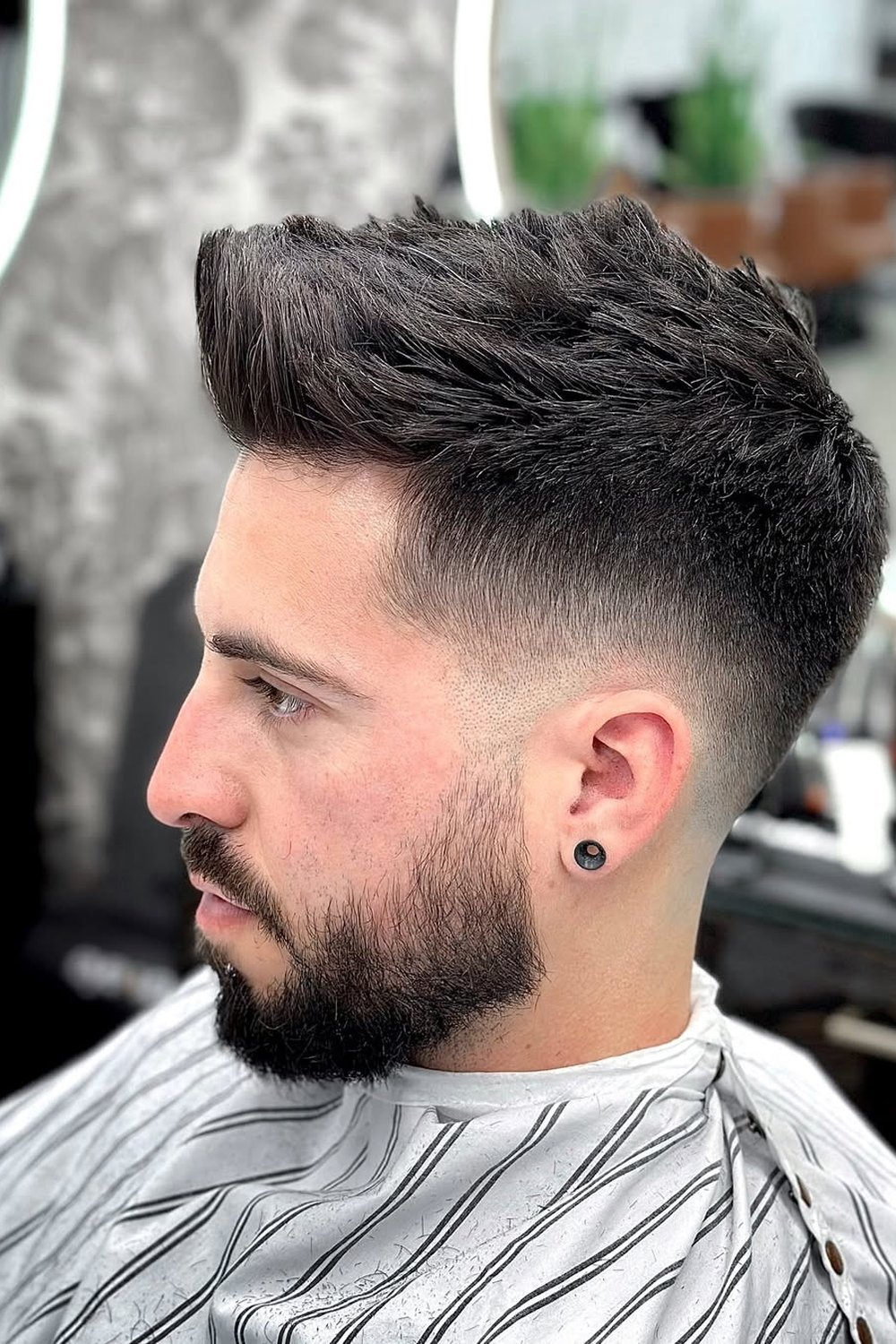
Photo: Favorite Hairstyles — source
The faux hawk with a low skin fade is the playful end of the classic group — a mohawk’s attitude with a haircut’s manners. In this photo a spiky strip runs down the centre of the head, pushed up with texture, while the sides are faded to skin so the hawk stands out without looking harsh. The spikes are soft, not stiff — the hair is pushed up with fingers and a little matte product rather than gelled into points — so it reads as fun rather than fierce. It suits men with straight or slightly wavy hair who want something with energy, and it is a brilliant choice for a night out or a holiday, because the height photographs wonderfully. On normal days, wear it flatter and it passes as a textured top; push it up and it becomes the faux hawk.
Ask for: “A soft faux hawk — longer strip down the middle, short on the sides, spikes pushed up soft, not stiff.” Best for: straight hair, nights out, men who like a bit of edge. Upkeep: finger-style with matte clay; trim every two to three weeks.
Crops, curls and texture
These ten are where the low skin fade earns its reputation for versatility. Short crops, curls, waves, afros and beards — the fade stays low and clean while the top does something different in every case.
11. Crew Cut
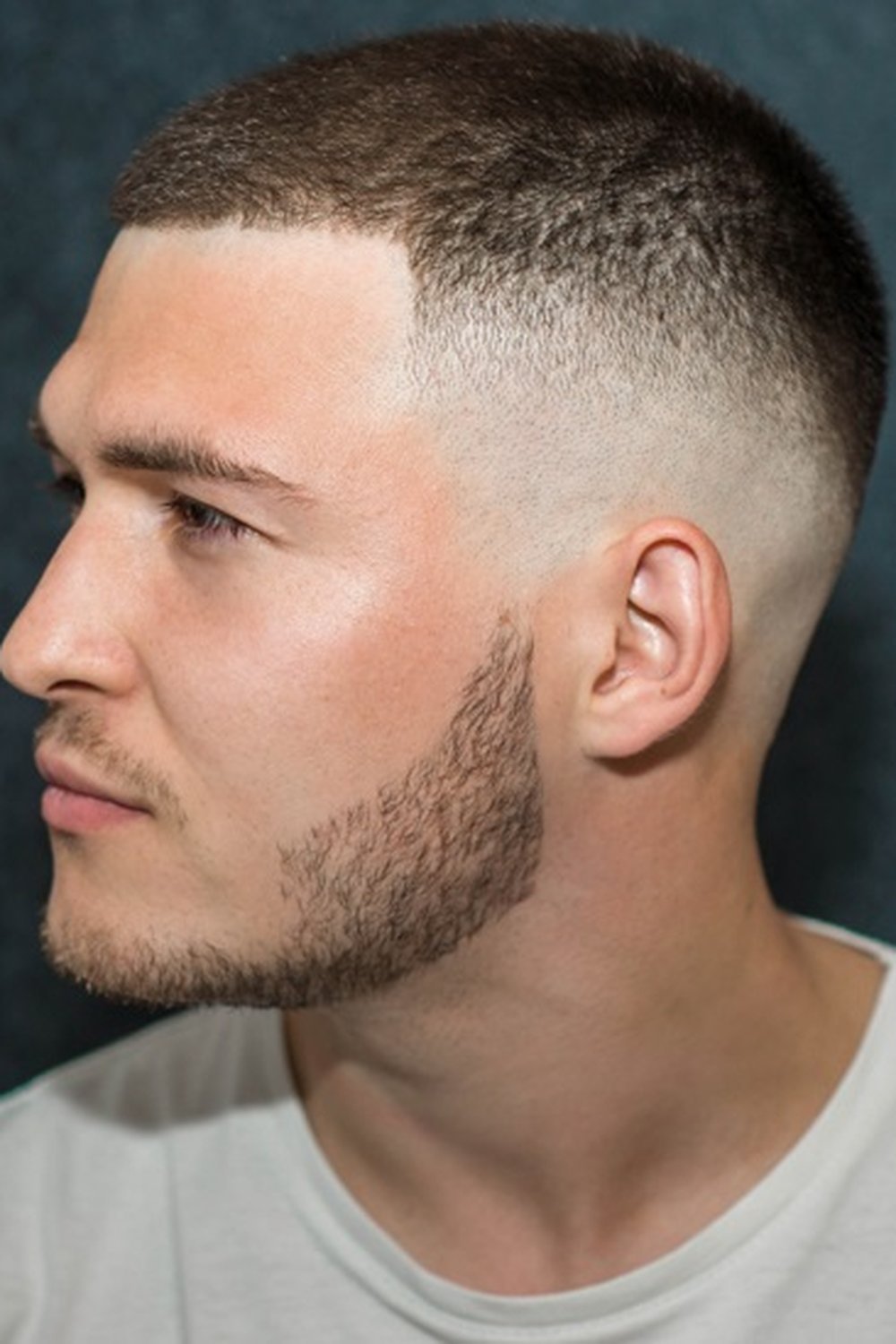
Photo: Styles at Life — source
The crew cut with a low skin fade is the short, smart, all-purpose haircut that has been a favourite for generations. In this side-profile photo the top is short and even, the sides are faded to skin, and the whole shape is clean and tidy from every angle. It is slightly longer on top than a buzz cut, which gives it a little more shape, but it is still short enough that it needs nothing in the morning — no comb, no product, no battle. It suits men of every hair type, it grows out evenly, and it is the cut barbers reach for when a man says “short, neat, and easy.” One honest note: the source photo for this one was small, so the image is a little softer than the others in this guide — the cut itself, though, is exactly as shown. For a first low skin fade it is one of the safest choices there is, because it is quick, it cannot go wrong, and it looks good on everyone.
Ask for: “A classic crew cut — short on top, tapered into a low skin fade on the sides.” Best for: every hair type, zero-styling mornings, first skin fades. Upkeep: re-cut every three to four weeks; nothing to style.
12. Ivy League
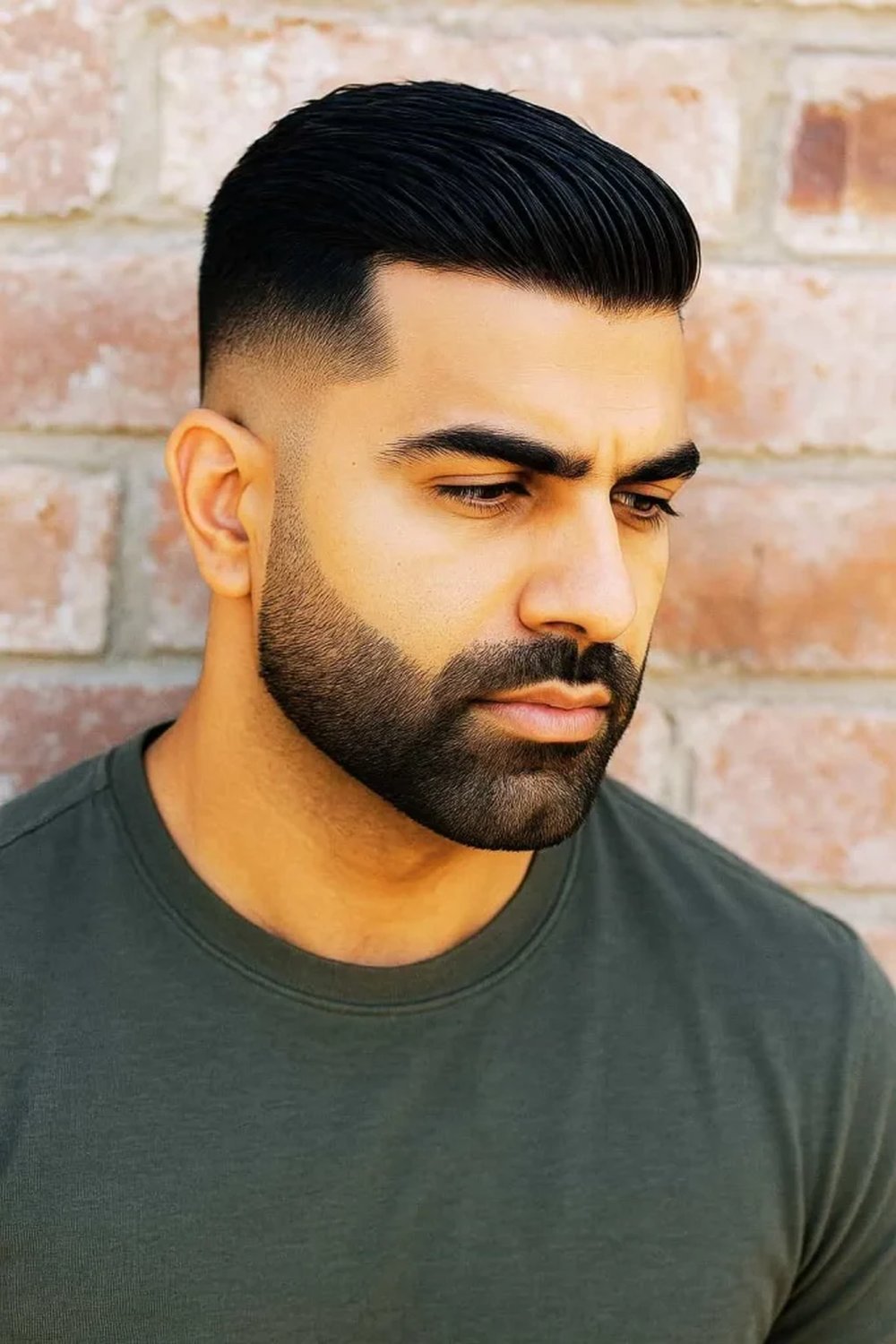
Photo: Mid Fade — source
The Ivy League with a low skin fade is the crew cut’s smarter older brother — a little longer on top, side-parted, and polished enough for any room. In this photo the top is swept neatly to one side with a soft part, the beard is kept full and shaped, and the low skin fade ties the whole look together with a clean edge. It is the cut for a man who wants to look put-together without looking styled: it reads as classic and confident, it works with a suit or a t-shirt, and it flatters men with a strong jawline because the side part and the beard frame the face. It suits straight and slightly wavy hair best, and it is one of the few styles in this guide that looks just as good on a man in his forties as on a man in his twenties.
Ask for: “Ivy League — longer on top, side-parted, low skin fade, keep the beard shaped.” Best for: straight hair, professional settings, strong jawlines. Upkeep: comb to the side each morning; tidy every two to three weeks.
13. Side Part

Photo via Pinterest — source
The side part with a low skin fade is the simplest idea in this guide, and one of the best. In this side-profile photo the top is swept to one side in a clean, natural part, and the low skin fade keeps the sides so tidy that the part is the only line on the whole head. There is no product-heavy styling, no height to maintain, no fringe to manage — just a neat part and a clean fade. It suits men with straight or wavy hair and a medium top, and it is the most versatile style here: wear it neat for work, push it back for the evening, let it fall naturally on a day off. If you are unsure which low skin fade to get first, get this one — it is the cut that other cuts are measured against.
Ask for: “Side part, medium length on top, swept to one side, low skin fade.” Best for: straight and wavy hair, any occasion, first-timers. Upkeep: a comb and a little product; tidy every two to three weeks.
14. Hard Part
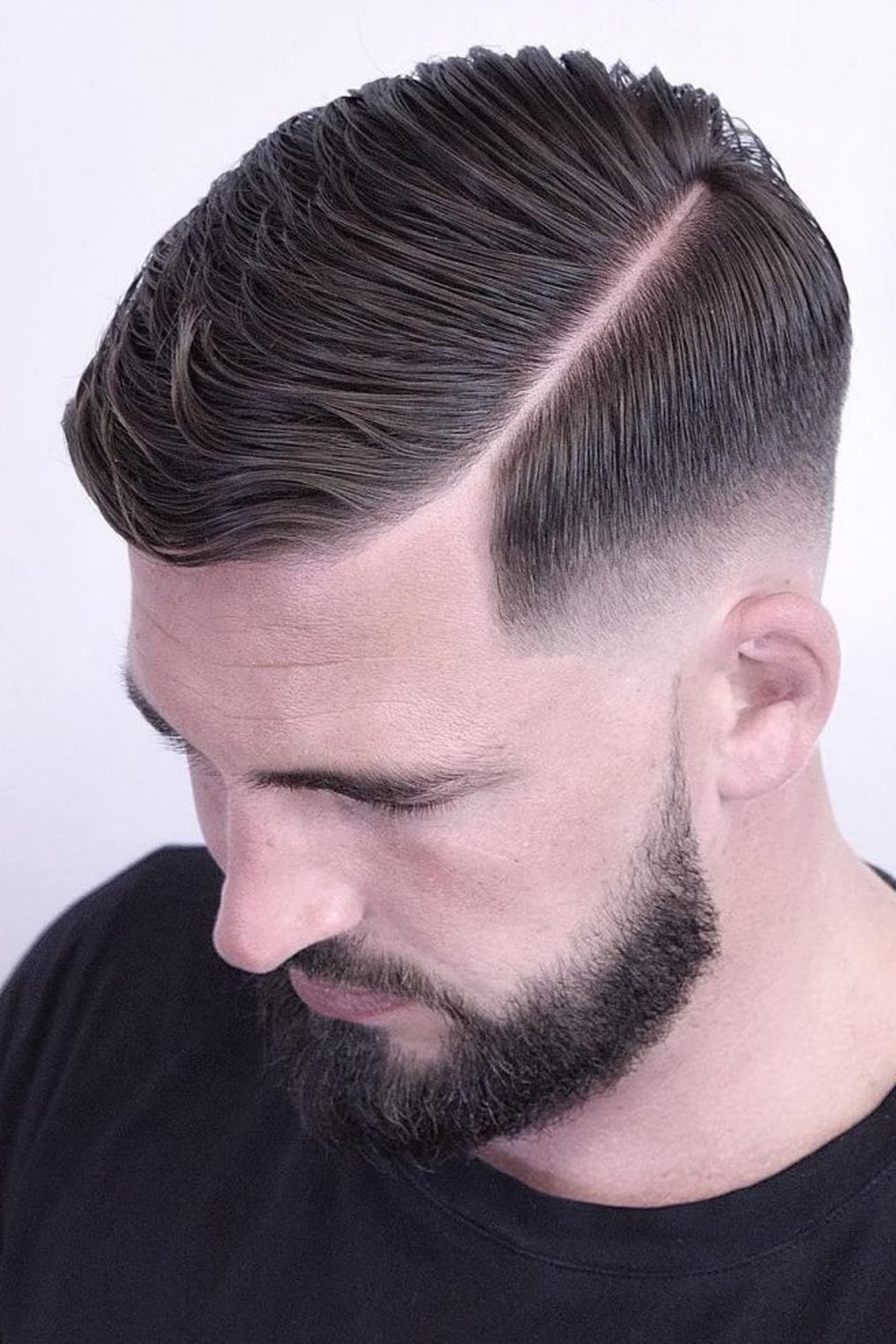
Photo: Men’s Hairstyles Web — source
The hard part with a low skin fade is the side part with the volume turned up. In this photo a shaved line runs cleanly from the front hairline back through the part, the top is slicked to one side, the beard is full, and the low skin fade finishes the sides with surgical precision. The shaved line is what makes it: it turns a neat side part into a sharp, graphic haircut that looks deliberate from across the room. It suits men with straight hair and a top long enough to sweep, and it is the best choice in this guide for a special occasion — a wedding, a photoshoot, a big night — because it photographs like a barbershop poster. The line needs upkeep, though: it grows out in about a week, so this is a cut for a man who visits his barber regularly.
Ask for: “Side part with a shaved hard-part line, slicked top, low skin fade.” Best for: straight hair, special occasions, men who like sharp lines. Upkeep: the line needs re-shaving weekly; tidy the fade every ten to fourteen days.
15. Beard Pairing
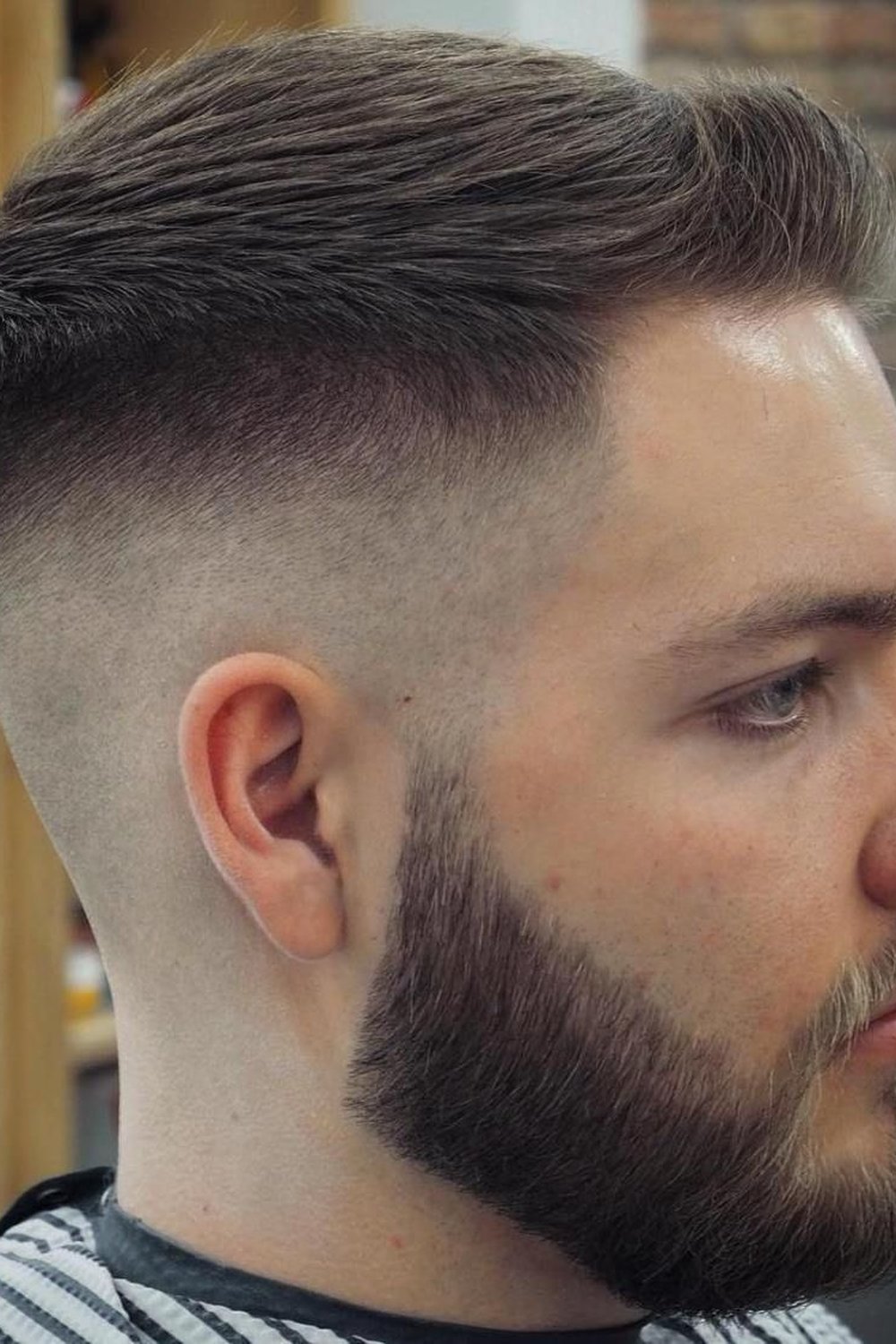
Photo via Pinterest — source
The low skin fade with a beard is the combination that made this fade famous — and this photo shows why it works so well. The top is brushed up with texture, the sides fade to skin, and the fade flows straight into a full, shaped beard with no visible join. That seamless blend is the whole trick: the barber fades the sideburns into the beard so the haircut and the beard read as one continuous shape, which makes the jaw look stronger and the whole face look more defined. It suits men who can grow a decent beard, and it is the most masculine style in this guide. The catch is maintenance: the blend between fade and beard is the first thing to grow out, so it needs a touch-up every ten days or so, and the beard itself needs oil and a regular shape-up.
Ask for: “Low skin fade blended into the beard — fade the sideburns, keep the beard full and shaped.” Best for: men with a good beard, stronger jawlines. Upkeep: beard oil daily; blend touch-up every ten days.
16. 360 Waves
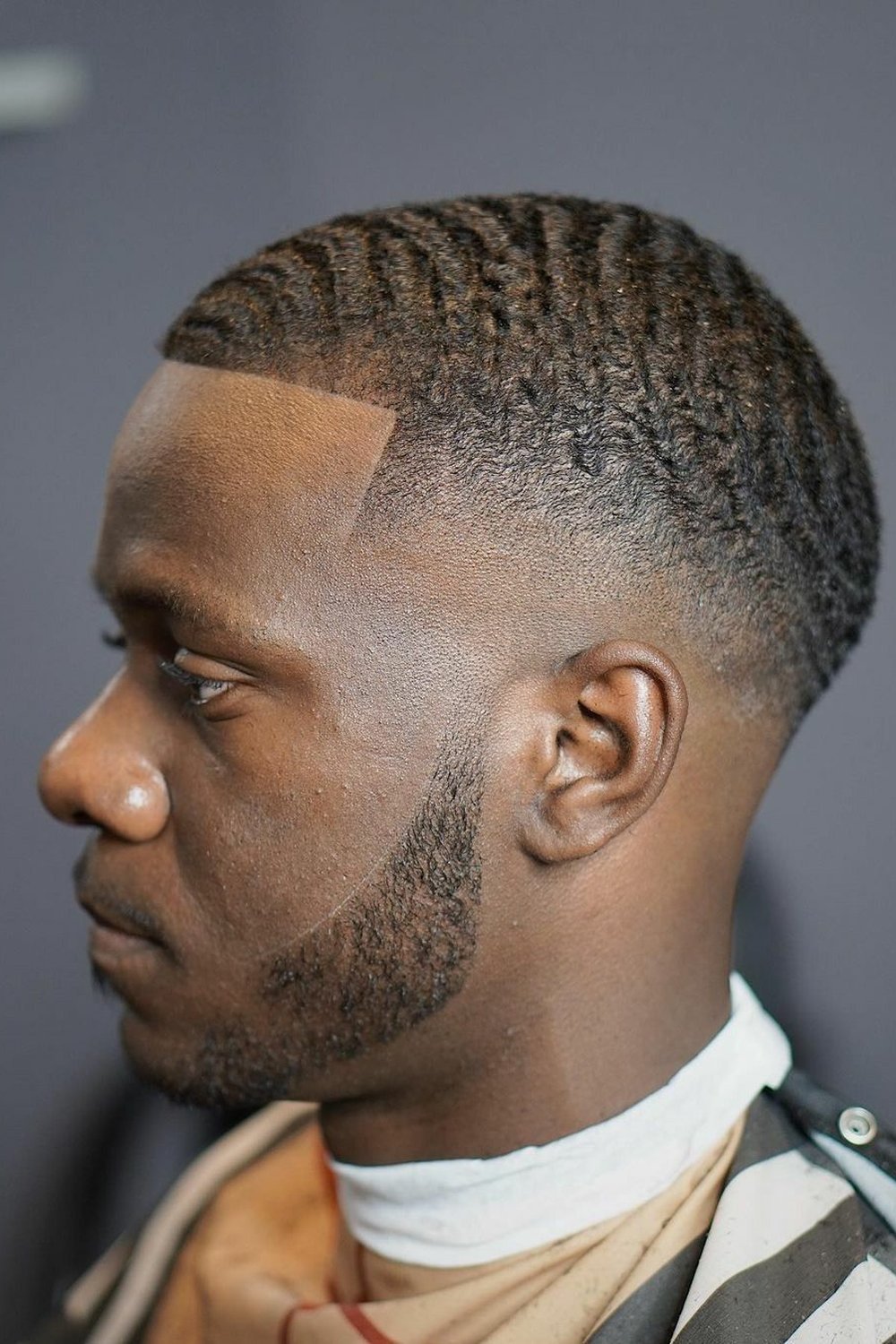
Photo via Pinterest — source
360 waves with a low skin fade is a Black men’s classic, and this side-profile photo shows the pattern at its best: concentric waves rippling across the top, a crisp hairline, and a low skin fade keeping the sides immaculate. The waves are the style — they take brushing, a durag at night, and patience to train — and the low skin fade is the frame that makes them pop, because the bare skin at the sides throws all the attention onto the wave pattern. It suits men with coily or wavy hair who are willing to put in the brushing routine, and it is one of the sharpest looks in this guide when it is maintained. If you want more styles for this hair type, our low taper fade guide for Black men has 25 more.
Ask for: “360 waves on top, low skin fade on the sides, sharp lineup.” Best for: coily and wavy hair, men who brush daily. Upkeep: brush daily, durag at night, wave pomade; tidy the fade every two weeks.
17. Short Afro

Photo: Haircut Trends — source
The short afro with a low skin fade is the cleanest way to wear natural volume. In this side-profile photo the afro is kept short and rounded on top — a neat, even shape — while the low skin fade takes the sides down to bare skin, so the afro’s silhouette stands out in sharp relief. The contrast is the point: the soft, rounded top against the hard, clean fade makes both look better. It suits men with coily or curly hair who want their natural texture on show without the length of a full afro, and it is wonderfully low-maintenance — a pick comb and a little moisturiser is all it needs. Keep the afro shaped regularly, because as it grows it loses its round silhouette and starts to look uneven.
Ask for: “Short afro, rounded on top, low skin fade on the sides, shape it even.” Best for: coily and curly hair, natural texture. Upkeep: pick comb and moisturiser; shape every two to three weeks.
18. Spiky Top
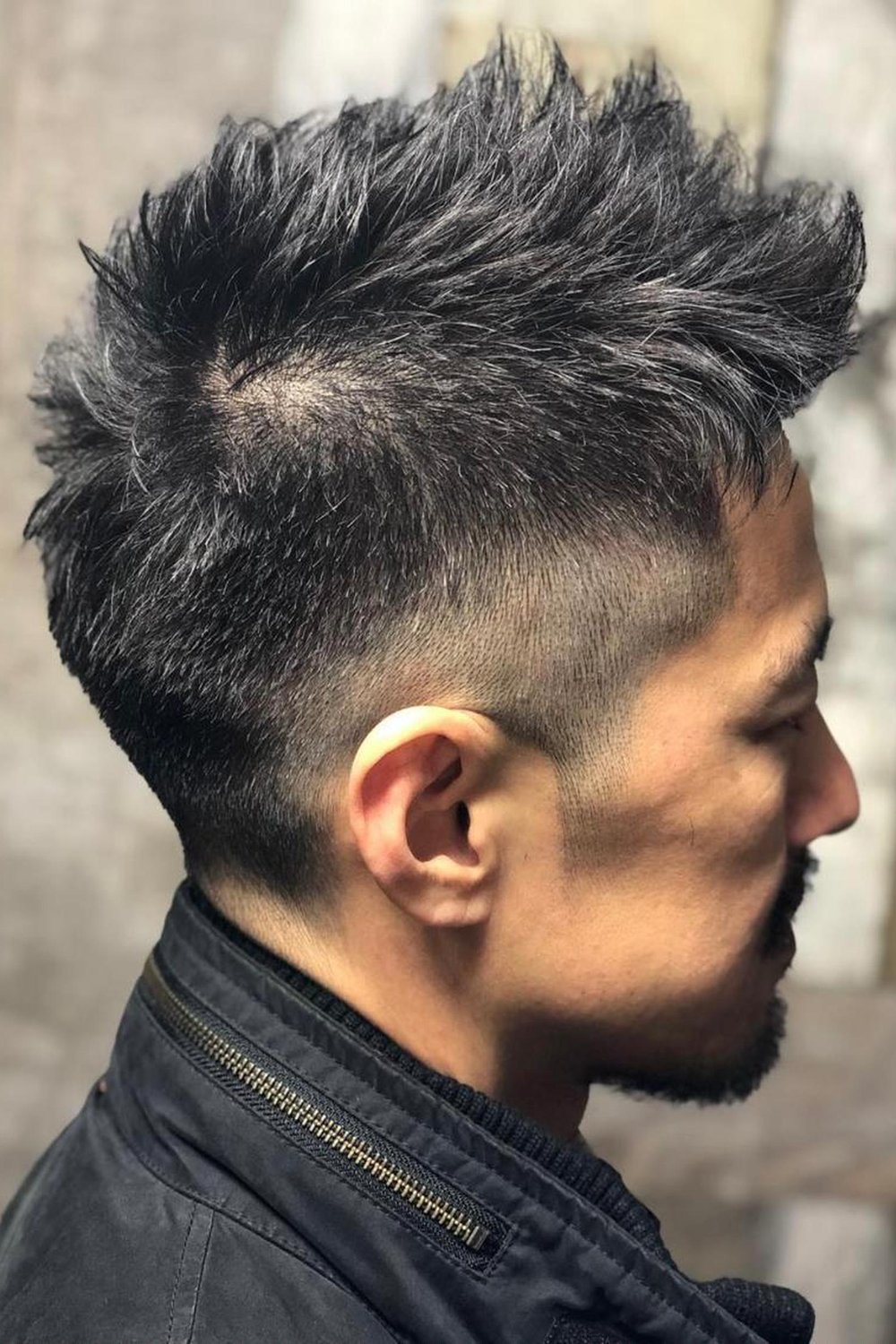
Photo: Minimodel — source
The spiky top with a low skin fade is the faux hawk’s calmer cousin — texture pushed up all over, not just down the middle. In this side-profile photo the top is full of short, separated spikes pointing up and forward, and the low skin fade keeps the sides so clean that the texture gets all the attention. It suits men with straight or slightly wavy hair who like a bit of energy in their cut, and it is the best choice here for fine hair, because the spikes create the illusion of thickness. Styling takes thirty seconds: a little matte clay, pushed up with the fingers, and it holds all day. Wear it spiky for the weekend, flatter for work — the same cut does both.
Ask for: “Spiky textured top, short choppy layers, low skin fade on the sides.” Best for: fine or straight hair, energetic looks. Upkeep: matte clay, finger-styled; tidy every two to three weeks.
19. Messy Textured Top
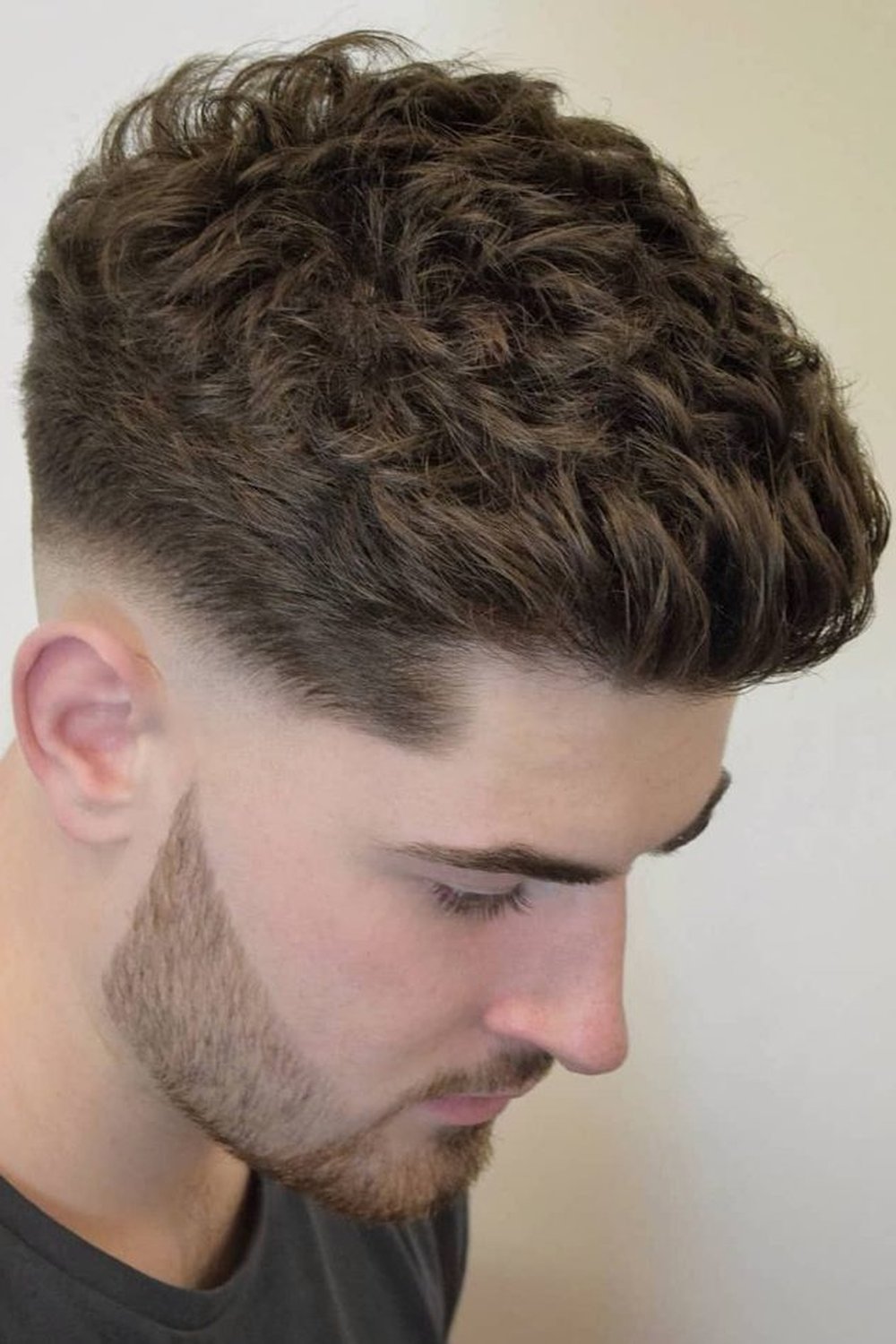
Photo: Men’s Hairstyles Web — source
The messy textured top with a low skin fade is the “I woke up like this” haircut — except a barber made it look that way on purpose. In this photo the man is looking down, and you can see the top in all its deliberately undone glory: choppy, tousled layers falling in different directions, no parting, no neatness, just texture. The low skin fade is what stops it looking scruffy — the sides are so clean that the mess on top reads as a choice, not an accident. It suits men with thick, wavy or slightly curly hair, because the texture needs some natural movement to work with, and it is the most forgiving style here for bad hair days: the messier it gets, the better it looks. A little sea-salt spray helps; a comb would ruin it.
Ask for: “Messy textured top, choppy layers, no parting, low skin fade.” Best for: thick or wavy hair, relaxed looks. Upkeep: sea-salt spray or nothing; never comb it neat.
20. Long Top
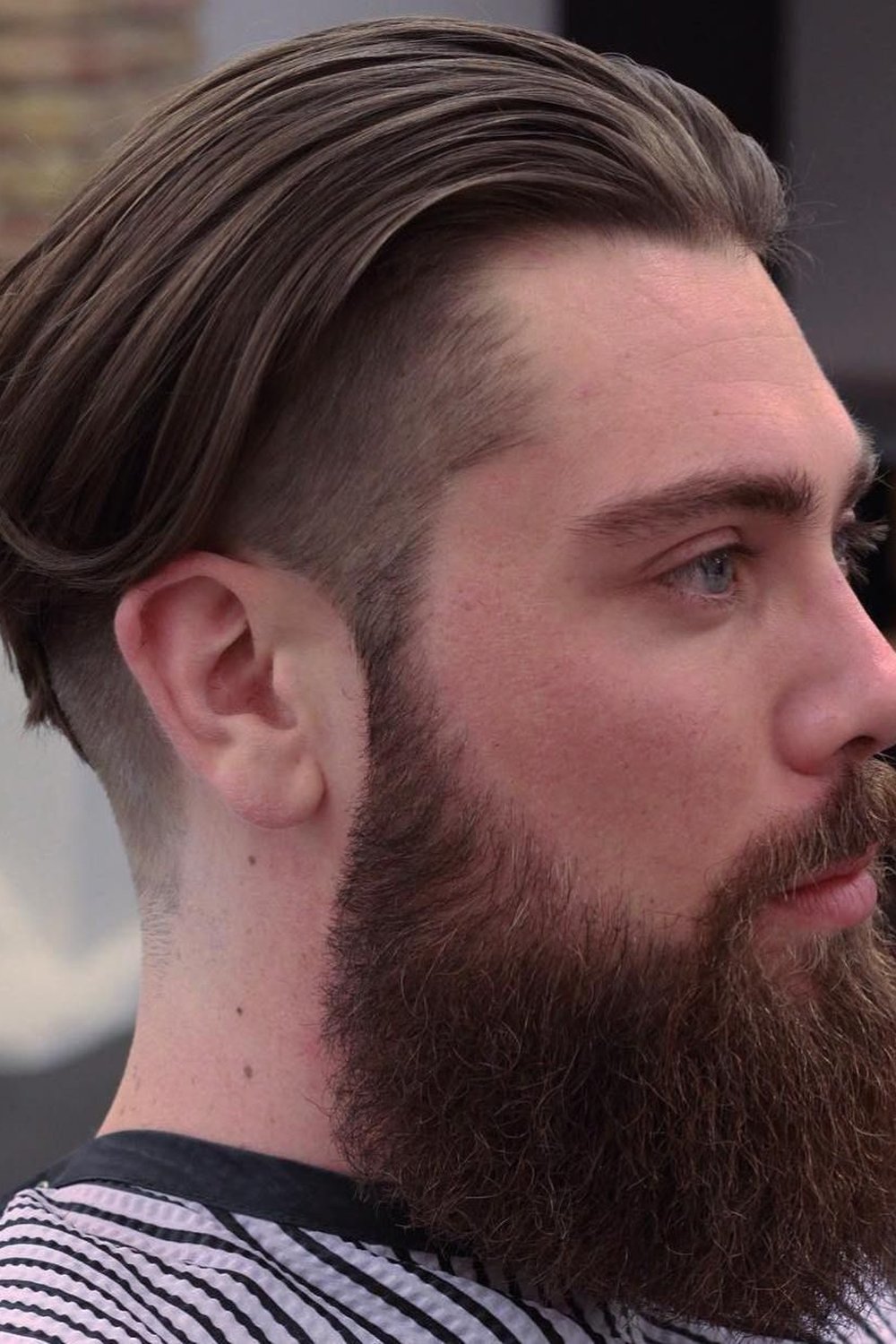
Photo via Pinterest — source
The long top with a low skin fade is for the man who refuses to choose between long hair and a clean cut. In this side-profile photo the top is long enough to slick back past the crown, the beard is long and full, and the low skin fade keeps the sides razor-clean so the length never looks unkempt. The contrast is dramatic — long on top, bare skin at the sides — and it works because the fade is low: the length stays the star, and the fade is just the frame. It suits men with thick, straight or wavy hair who are growing their top out, and it is the best style in this guide for a man with a beard, because the long top and the long beard balance each other. It needs the most patience of any cut here — months of growing — but the result is the most distinctive look in the guide.
Ask for: “Keep the top long, slick it back, low skin fade on the sides, blend into the beard.” Best for: thick hair, growing the top out, bearded men. Upkeep: pomade to slick back; beard oil; tidy the fade every two weeks.
Longer tops and statement cuts
These nine are for the man who wants his low skin fade to say something. Longer tops, sharp lines, and the cuts that turn heads — all still built on the same low, clean fade.
21. Caesar Cut

Photo: Lovelyish — source
The Caesar cut with a low skin fade is the shortest, sharpest haircut in this guide — a straight fringe, an even top, and sides faded to skin. In this photo the fringe sits in a clean horizontal line across the forehead, the top is short and uniform, and the low skin fade gives the whole shape a crisp edge that a plain Caesar never has. It suits men with straight hair and a strong hairline, and it is the best choice here for a man who wants a cut that looks the same on day one and day fourteen: there is so little length that nothing can go out of shape. It also suits men with a rounder face, because the straight fringe and the clean sides add structure. Two minutes in the morning, a little product pushed forward, and it is done.
Ask for: “Caesar cut — short straight fringe, even top, low skin fade.” Best for: straight hair, strong hairlines, rounder faces. Upkeep: almost none; tidy every two to three weeks.
22. Brush Up
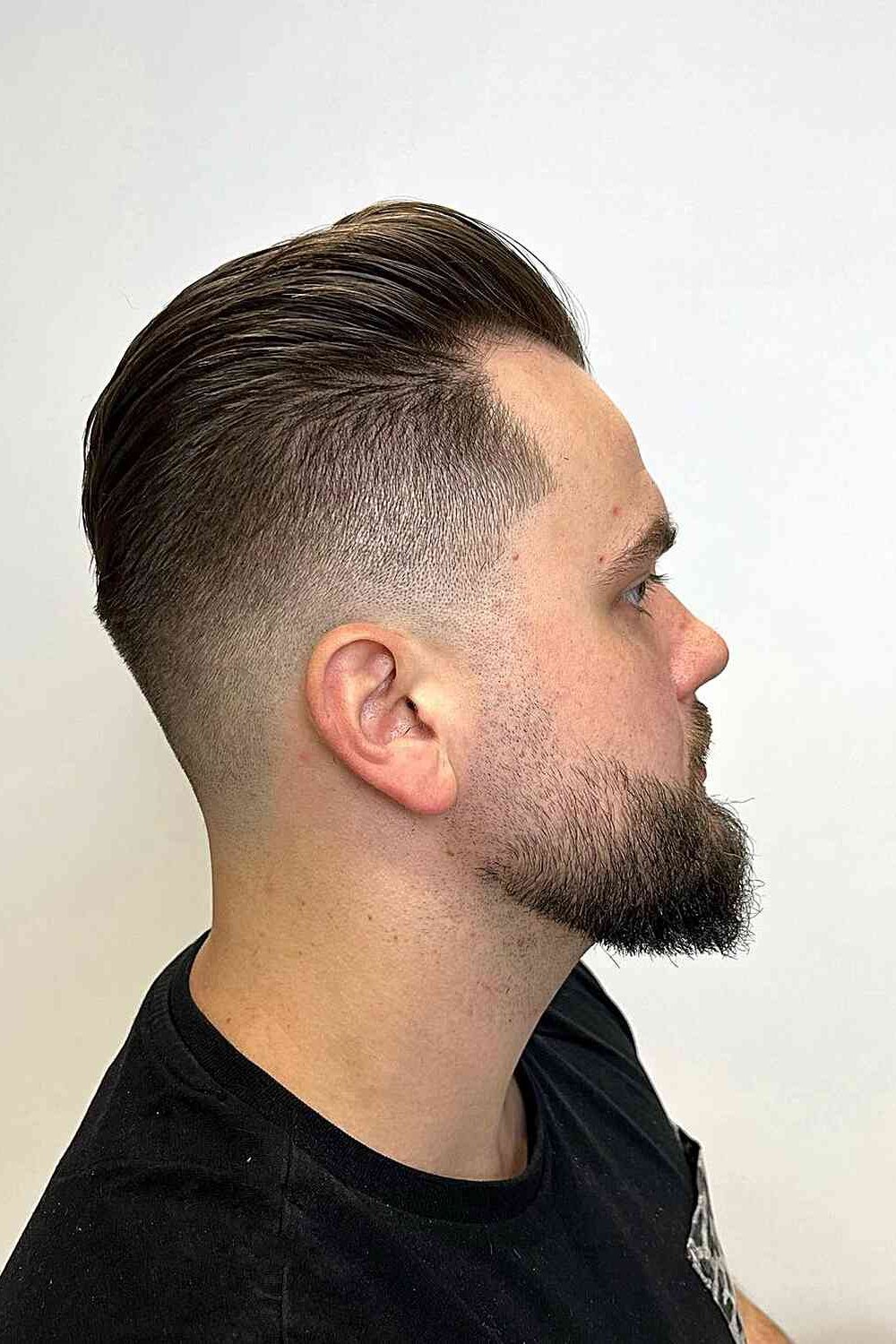
Photo: Latest Hairstyles — source
The brush up with a low skin fade is the quiff for men who do not want to admit they style their hair. In this side-profile photo the top is brushed up and slightly back with natural volume — no stiff spikes, no dramatic sweep, just hair pushed up the way it wants to go — and the low skin fade keeps the sides tight so the height reads as deliberate. It suits men with thick, straight or wavy hair, and it is the best choice in this guide for adding height without looking like you tried: the brush up looks effortless even though it takes a blow dryer and thirty seconds. It flatters longer faces by adding width at the top, and it works in every setting, from the office to a night out.
Ask for: “Brush up — top pushed up and slightly back, textured, low skin fade.” Best for: thick hair, men who want height without the fuss. Upkeep: blow-dry up with matte clay; tidy every two weeks.
23. Line-Up
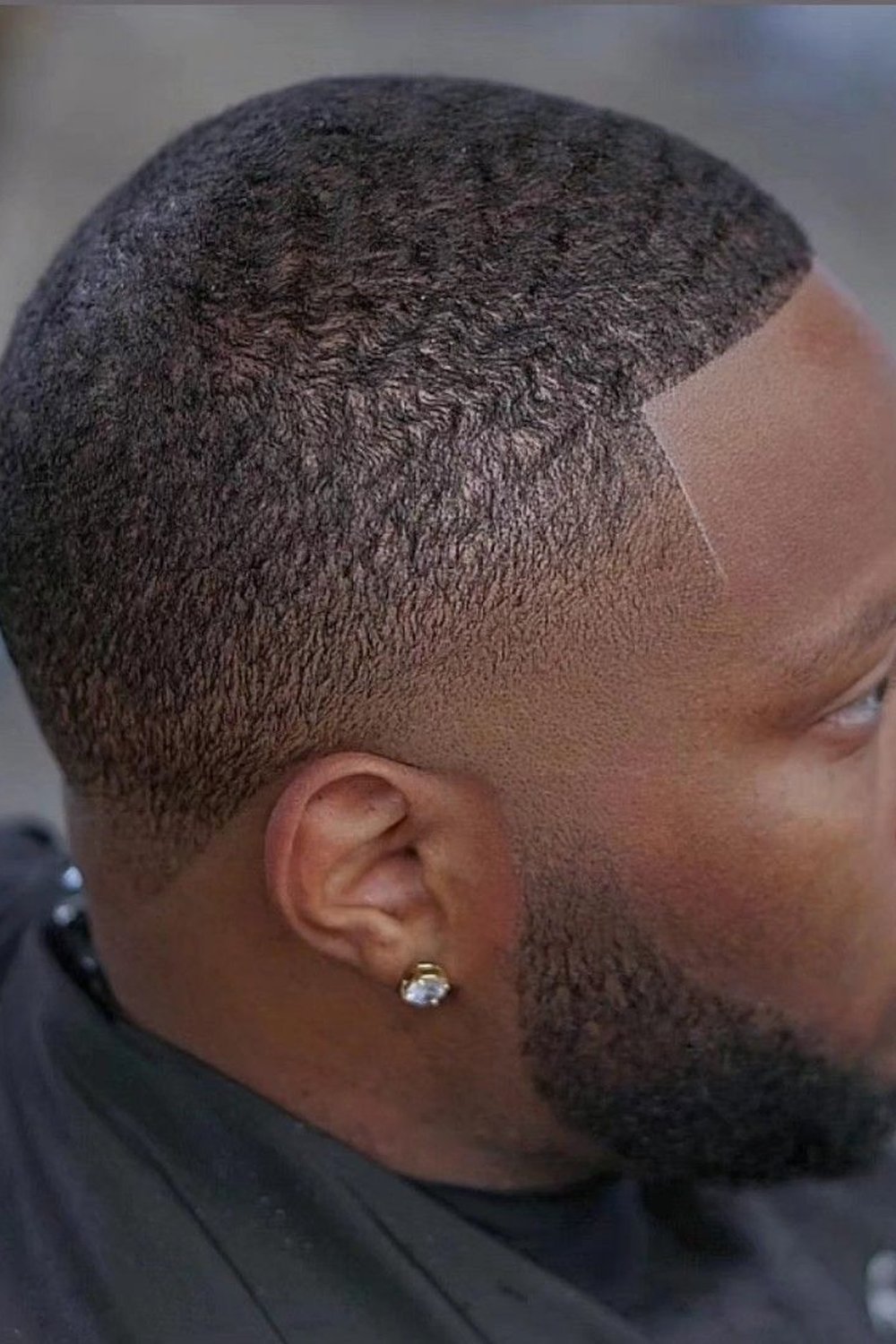
Photo via Booksy — source
The line-up with a low skin fade is precision made visible. This back-and-side view shows what the cut is really about: a razor-sharp hairline, a clean neckline, and a low skin fade blending up into a short, even top. From the front, the lineup is the star — a crisp, straight edge across the forehead and sharp corners at the temples — and the low skin fade is the frame that makes those lines pop. It suits men with dark, straight or coily hair, because the line shows best against darker hair, and it is the best choice here for a man who wants the sharpest possible finish. The catch is that a lineup grows out faster than any other detail in this guide: the edge softens within a week, so this is a cut for a man who sees his barber every ten days.
Ask for: “Sharp lineup at the forehead and temples, low skin fade, clean neckline.” Best for: dark hair, men who want the sharpest finish. Upkeep: lineup touch-up weekly; fade tidy every ten to fourteen days.
24. High Top
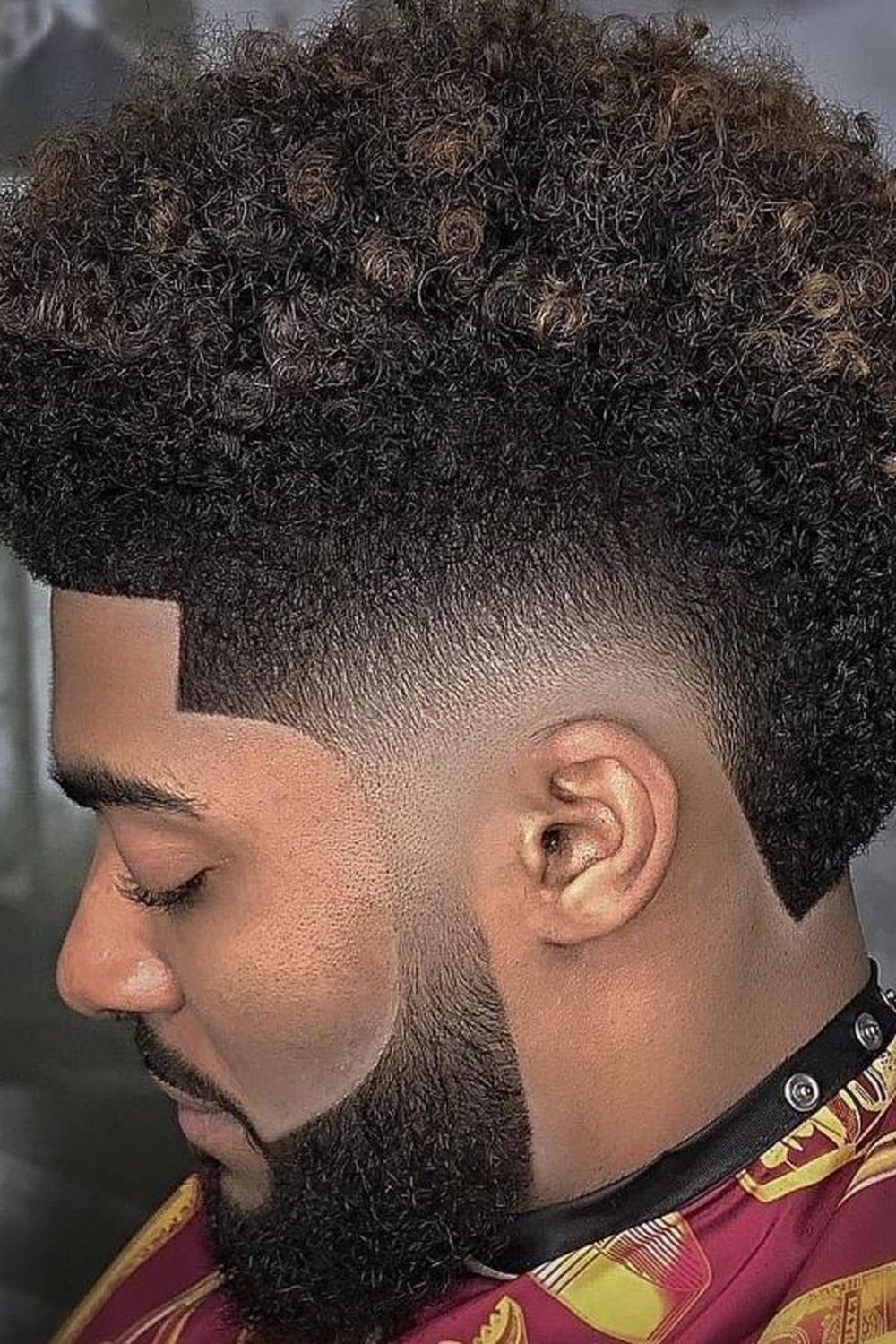
Photo via Pinterest — source
The high top with a low skin fade is the tallest cut in this guide, and this photo shows it in its classic form: a curly high top rising well above the forehead, a full beard below, and a low skin fade keeping the sides immaculate. The height is the statement — it adds inches, it adds presence, and it turns a haircut into a silhouette. It suits men with curly or coily hair who can grow the height, and it is the most iconic style here, with roots in hip-hop and Black barbershop culture. It needs the most shaping of any cut in this guide: the top must be cut level and even, which takes a skilled barber and regular visits, and the curls need moisturiser to stay defined. But when it is fresh, nothing else in this guide touches it for impact.
Ask for: “High top, level on top, curly, low skin fade on the sides.” Best for: curly and coily hair, statement looks. Upkeep: moisturise the curls; shape every two weeks.
25. Disconnected Undercut
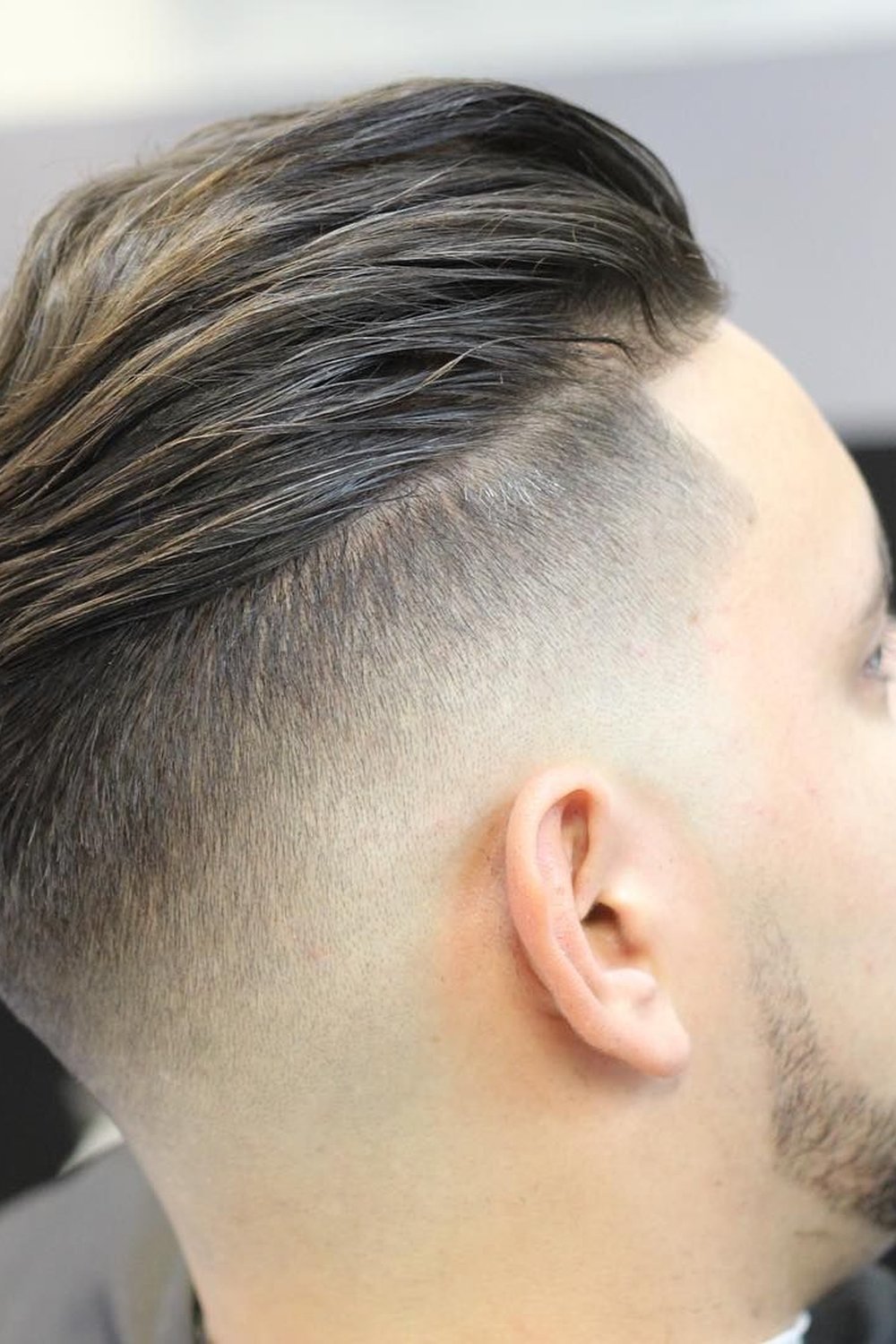
Photo: Hairstyles To Try — source
The disconnected undercut with a low skin fade is the boldest contrast in this guide. In this side-profile photo the top is long and swept to one side, and where it meets the faded side there is no blend at all — a hard, visible line where long hair meets bare skin. That disconnection is the whole design: instead of a smooth gradient, you get two lengths living side by side, which makes the top look longer and the fade look sharper. It suits men with thick, straight or wavy hair and a top long enough to sweep, and it is the best choice here for a man who wants a modern, fashion-forward cut. It needs confidence and a little styling — the top has to be swept, or the disconnection looks accidental — but when it is worn well, it is the most striking style in this guide.
Ask for: “Disconnected undercut — long top swept to one side, hard line, low skin fade.” Best for: thick hair, modern looks, confident wearers. Upkeep: sweep the top daily with pomade; tidy the fade every two weeks.
26. Textured Fringe
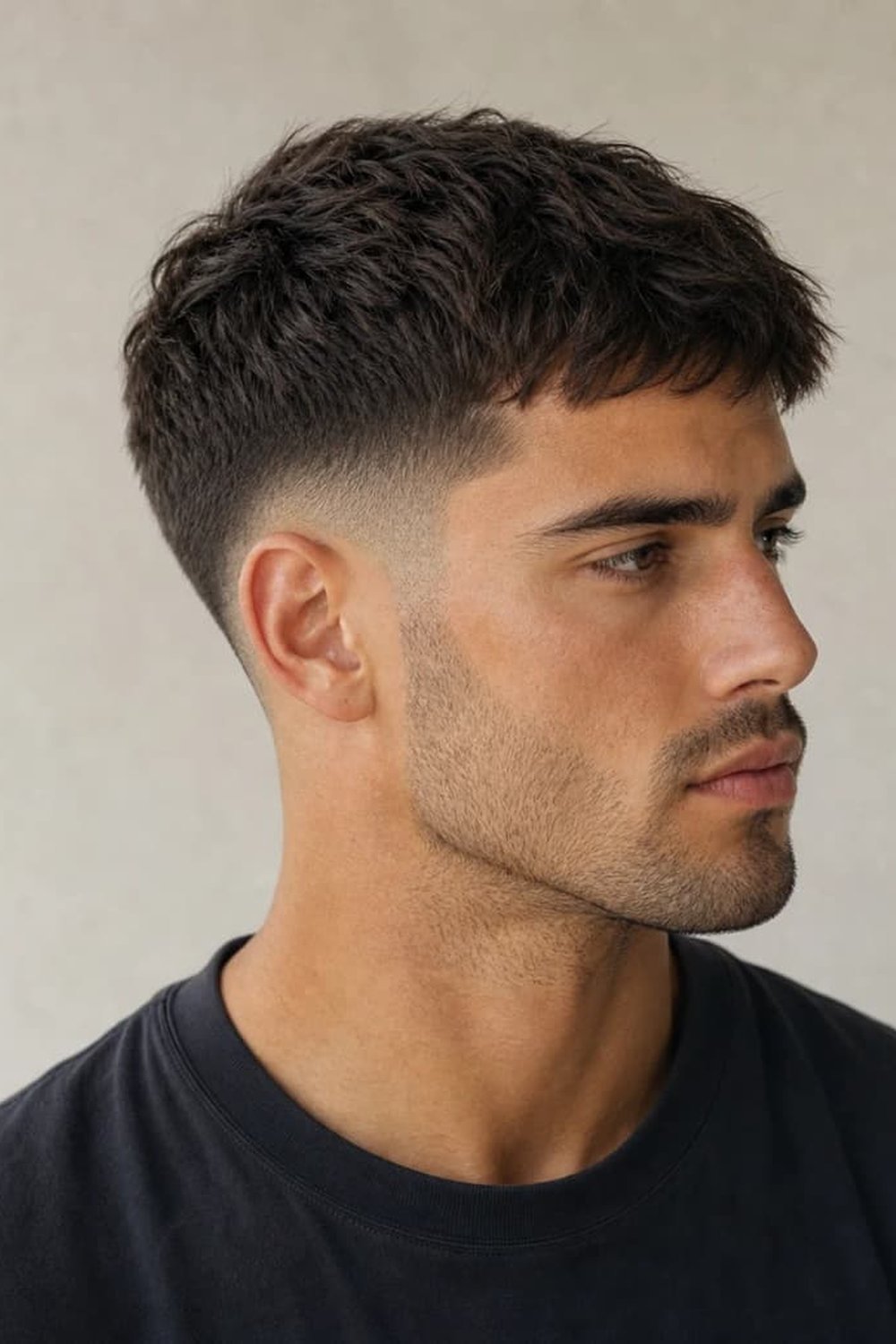
Photo: Corte de Pelo — source
The textured fringe with a low skin fade is the Gen-Z favourite of this guide — a straight, choppy fringe falling over the forehead, with a low skin fade keeping everything else clean. In this photo the fringe is the feature: textured, slightly messy, sitting just above the eyebrows, with the sides faded to skin so the fringe gets all the attention. It suits men with straight or wavy hair, and it is the best choice here for a younger man, or any man who wants a modern, street-style look. It also suits men with a high forehead, because the fringe covers it completely. The fringe needs a trim every couple of weeks — it grows into the eyes fast — but the styling is nothing: push it forward with your fingers and go.
Ask for: “Textured fringe, choppy, just above the eyebrows, low skin fade.” Best for: straight and wavy hair, younger men, high foreheads. Upkeep: finger-style forward; trim the fringe every two weeks.
27. Modern Mullet

Photo: Pedro’s Barbershop — source
The modern mullet with a low skin fade is the comeback cut of 2026, and this side-profile photo shows why it works now: a textured fringe in front, longer length flowing at the back, and a low skin fade on the sides that keeps the whole thing from looking like the 1980s version. The fade is doing the modernising — it replaces the old mullet’s shaggy sides with a clean, skin-tight edge, so the length at the back reads as a choice rather than neglect. It suits men with wavy or straight hair who are happy to grow the back out, and it is the most fun cut in this guide: it is a conversation starter, it photographs brilliantly, and it suits a man with a bit of personality. It needs the most growing time here, and the back needs regular shaping so it flows rather than frizzes.
Ask for: “Modern mullet — textured fringe in front, length at the back, low skin fade on the sides.” Best for: wavy and straight hair, bold personalities. Upkeep: shape the back every three weeks; tidy the fade every two weeks.
28. Braids
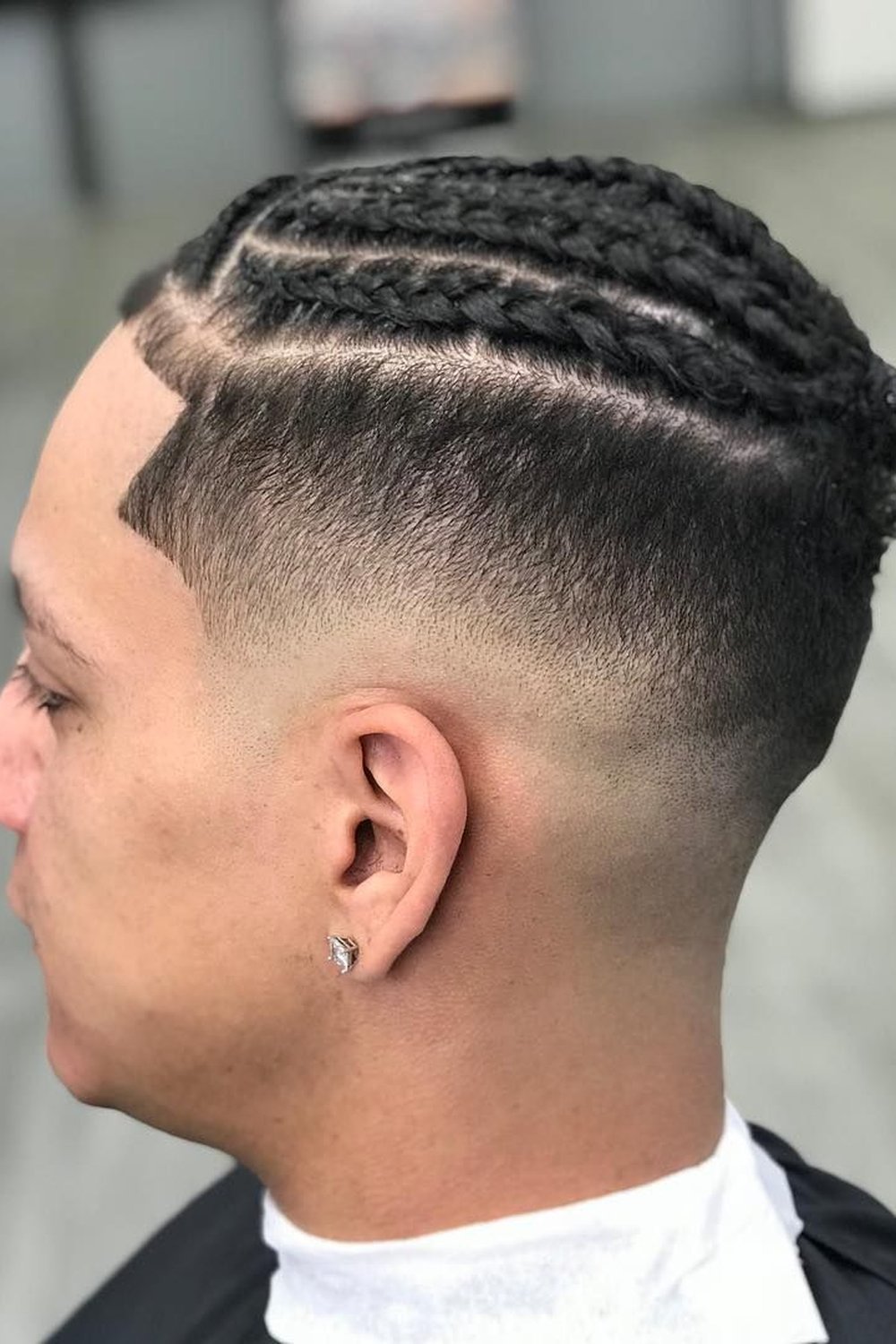
Photo via Pinterest — source
Braids with a low skin fade is the most intricate cut in this guide, and this side-profile photo shows the craft: neat cornrows running back across the top, each one clean and even, with a low skin fade keeping the sides razor-sharp. The braids are the style and the fade is the frame — together they make a look that is both protective and sharp, because the braids keep the hair tidy for weeks while the fade keeps the edges clean. It suits men with coily or curly hair long enough to braid, and it is the longest-lasting style here: the braids hold for two to four weeks, and only the fade needs touching up. It takes the longest in the chair — braiding is slow, skilled work — so book a longer appointment, and moisturise the scalp while the braids are in.
Ask for: “Cornrows on top, neat and even, low skin fade on the sides.” Best for: coily and curly hair, protective styling. Upkeep: moisturise the scalp; re-braid every two to four weeks; tidy the fade every two weeks.
29. Design Line
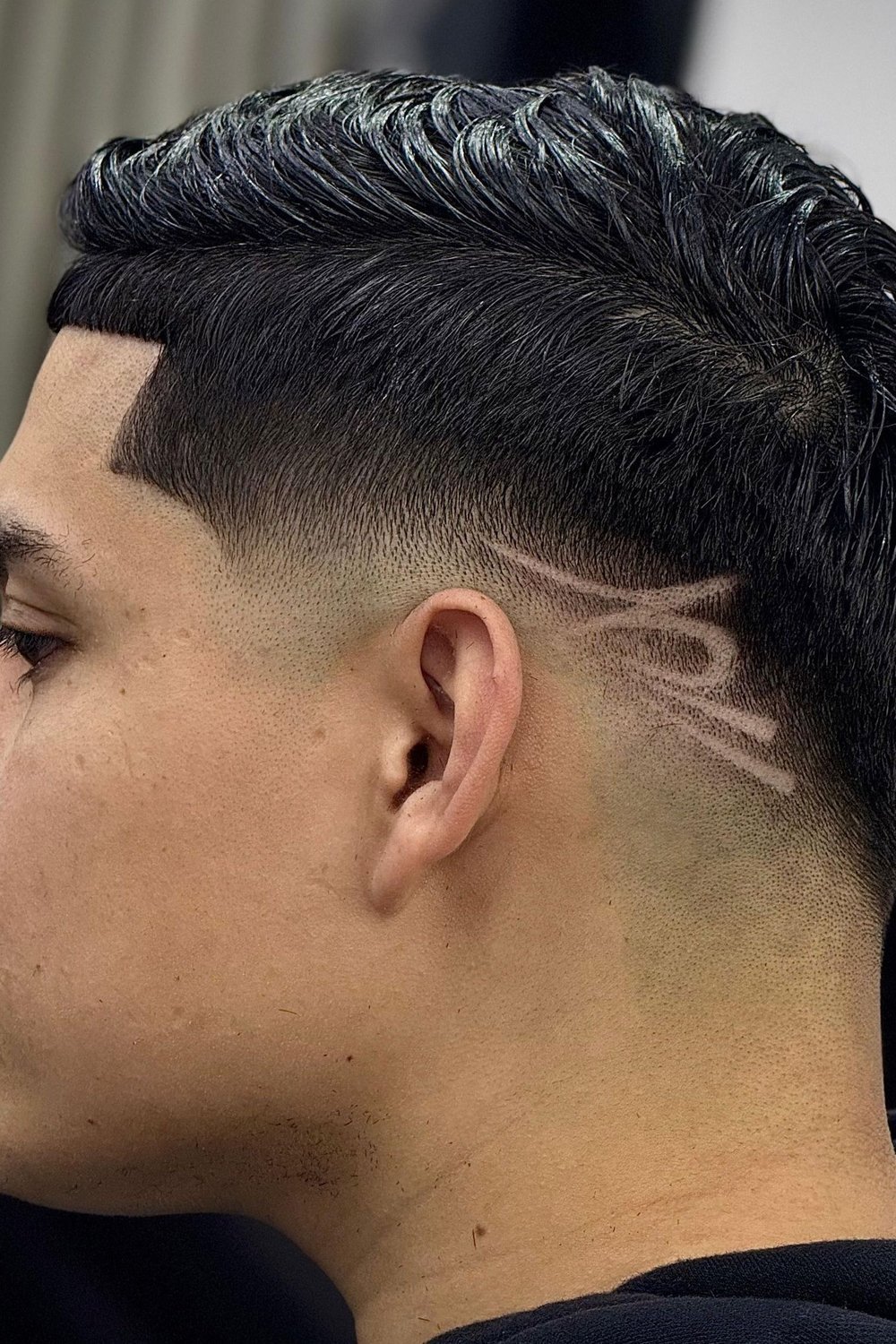
Photo via Booksy — source
The design line with a low skin fade is the artist’s cut — and the last style in this guide because it is the one that needs the most skill. In this side-profile photo a curved shaved line sweeps through the fade above the ear, turning the gradient into a canvas: the line is crisp, the curve is clean, and the low skin fade underneath makes the design stand out like ink on skin. Designs can be simple — one curved line, like this — or elaborate, with geometric patterns and freestyle shapes. They suit any man who wants his haircut to be a statement, and they are the best choice for a special occasion, because a design photographs like nothing else. The catch is time: a design grows out in about a week, so this is a cut for a man who visits his barber often, and it needs a barber who is genuinely good with a trimmer.
Ask for: “Low skin fade with a curved design line above the ear — keep it simple and crisp.” Best for: any hair type, special occasions, statement looks. Upkeep: the design needs re-shaving weekly; tidy the fade every ten days.
Low skin fade upkeep: keeping it sharp
A low skin fade looks its best for about ten days. After that, the bare skin starts to shadow over, the blend softens, and the cut slowly turns into a regular low taper — which still looks fine, just less sharp. To keep it crisp, book a tidy-up every ten to fourteen days: most barbers will do a quick fade refresh for less than a full cut, and it takes fifteen minutes. Between visits, keep the neckline clean with a trimmer if you own one, and wash the top with a gentle shampoo — product build-up makes the top look dull and the fade look dirty by comparison. If your fade grows out and you cannot get to the barber, a little matte clay on the top carries the look: the top is what people notice first, and a styled top makes a soft fade look intentional.
Product-wise, keep it simple. Matte clay or paste for textured tops, pomade for slick backs and comb overs, curl cream for curly tops, sea-salt spray for wavy and messy styles. Avoid heavy gel — it makes the top look wet and the fade look greasy — and avoid over-washing, which dries the scalp and makes the skin part of the fade flake. If you want the full maintenance routine, our high taper fade guide covers upkeep schedules in detail, and the principles are the same for any fade.
Low skin fade FAQs
What is the difference between a low skin fade and a low taper fade?
A low skin fade goes down to bare skin at its shortest point, while a low taper fade stops at a very short clipper length and never reaches skin. The skin fade is sharper, cleaner and higher-contrast; the taper is softer, grows out more gracefully, and needs less upkeep. If you want the sharpest finish, pick the skin fade; if you visit the barber monthly, pick the taper.
Is a low skin fade good for work?
Yes — it is one of the most office-friendly fades there is. The fade sits low, so most of the side keeps its hair, and styles like the comb over, the Ivy League, the side part and the crew cut all pass a formal dress code easily. Avoid the design line, the faux hawk and the disconnected undercut for strict workplaces, and keep the beard neat if you pair the fade with one.
How long does a low skin fade last?
It looks its sharpest for about ten days. After two weeks the skin part starts to shadow over, and after three to four weeks it reads as a low taper rather than a skin fade. Book a tidy-up every ten to fourteen days to keep it crisp, or let it grow out gracefully — the low placement means it never looks messy, just softer.
Does a low skin fade suit a round face?
Yes — better than a high fade. The low placement keeps hair on the sides, which balances a round face instead of lengthening it, and styles with height on top, like the quiff, the pompadour and the brush up, add length to the face. Avoid very flat tops, which can make a round face look wider.
Can I get a low skin fade with curly hair?
Absolutely — curly hair takes a low skin fade beautifully. Keep the curls long on top so they keep their shape, and let the fade frame them. Ask your barber to shape the curls rather than thin them, use a curl cream after washing, and never brush the curls dry.
What should I ask my barber for a low skin fade?
Say the height, the skin, and the top, in that order: “A low skin fade, bare to the skin at the bottom, blended up through a zero and a one, with [your top style] on top.” Bring a photo from this guide on your phone — barbers cut better from a picture than from a description — and ask to see the blend in the mirror before the top is cut.
How much does a low skin fade cost?
Prices vary by city and barbershop, but a low skin fade typically costs the same as any other fade at your barber — the skin finish takes a little longer because of the foil shaver, so some shops charge a few dollars more. A quick fade tidy-up between full cuts is usually cheaper and takes about fifteen minutes.
Is a low skin fade better than a mid skin fade?
Neither is better — they suit different men. A low skin fade is subtler, more office-friendly, and grows out more gracefully. A mid skin fade is bolder, shows more contrast, and suits men who want the fade to be the feature. If this is your first skin fade, start low; you can always go higher next time.
Conclusion
The low skin fade is the quietest way to look sharp — bare skin at the bottom, a soft blend above it, and a top that can be anything from a buzz cut to a pompadour. These 29 styles cover every version of that idea, from the office-safe comb over to the statement design line, and every one of them is built on the same low, clean fade. Pick the one that matches your hair and your life, bring its photo to your barber, and say the height, the skin and the top in plain words. If you want more ideas in the same family, our taper fade styles guide has 36 more — and if you try one of these 29, the low skin fade will do the rest.
By Derek Nolan. All photos are real photographs with credit lines and source links under each image.