31 high skin fade styles that demand attention
A high skin fade is the loudest way to wear a fade. The bare skin starts high — up near the temples and the crown — and blends down into nothing, while the top keeps its length. That high placement is the whole point: you get maximum contrast, a sharp silhouette, and a cut that people notice from across the room. This guide has 31 of them — textured tops, buzz cuts, quiffs, curls, waves, beards, braids, a mohawk and a military high and tight — each with a real photo, the exact words to say to your barber, and honest notes on which hair types and face shapes each style suits. Every style here is a real, wearable cut for men, and every one is chosen to still look deliberate a week after the appointment, not just on day one.
Before the list, one honest note: a high skin fade is not a low-maintenance cut. Bare skin shows stubble within days, and because so much of the side is shaved, the crispest version of any style in this guide needs a tidy-up every seven to ten days. What you get in return is the sharpest, highest-contrast fade there is — clean lines, a strong jawline, and a top that looks taller and more defined against the bare sides. If that upkeep sounds like too much, the quieter cousin is the low skin fade, which keeps the same skin finish but starts low near the ear. But if you want the boldest finish a fade can give, start with the version in this guide that matches your hair, bring the photo on your phone, and tell your barber the height, the skin and the top in plain words — because with skin fades, a photo beats a description every time.
What’s in this guide
Classic and clean (1–10): textured tops, buzz cuts, French crops, crew cuts, quiffs, pompadours, slick backs, comb overs, side parts and hard parts. Crops, curls and texture (11–20): faux hawks, spiky tops, curls, waves, 360 waves, afros, high tops, Caesar cuts, Ivy League cuts and brush ups. Longer tops and statement cuts (21–31): messy textured tops, fringes, mullets, beard pairings, line-ups, design lines, long tops, braids, disconnected undercuts, military high and tights and a mohawk.
What is a high skin fade?
A high skin fade is a men’s haircut where the sides and back are faded down to bare skin, but the fade line sits high on the head — up near the temples and the parietal ridge, where the side of the skull curves into the top — instead of staying low near the ears. Above that high line, the hair keeps its length, so the contrast between the top and the sides is as strong as a fade can get. The “skin” part means the shortest point is shaved to the skin with a foil shaver or a zero-guard trimmer, not just cut very short. The result is a smooth gradient: bare skin at the bottom, stubble, then short hair, then the full length on top, with no visible lines between the steps. If you want the full family explained — low, mid, high and drop skin fades — our skin fade haircut guide covers every variation and which face shapes each one suits.
The high placement is what makes this fade different from its quieter cousins. A low skin fade whispers; a high skin fade announces itself. Because most of the side is shaved, the cut puts the top on display — height, texture and shape all read stronger — and it flatters round and square faces best, because the short sides take width away from the cheeks and jaw and make the face look longer. It also shows regrowth fastest, so it suits men who are happy to see their barber often, and it works with every hair type: straight hair shows the blend at its sharpest, curly and coily hair gains height and definition, and thick hair gets its bulk removed so the top can move. The one thing to know before you commit: a high fade leaves nowhere to hide a scar, a dent or an uneven patch, so mention anything you would rather keep covered before the clippers start.
How to choose the right high skin fade
Start with your face shape. Round and square faces gain the most from a high skin fade, because the bare sides narrow the cheeks and the height on top lengthens the face — the quiff, the pompadour, the brush up and the high top are the strongest choices here. Oval faces can wear any height, so pick by hair type instead. Long or oblong faces should keep the top lower or add a fringe, since tight sides plus a tall top can stretch the face further; the French crop, the Caesar cut and the textured fringe balance a long face well. Then look at your hair: thick, dense hair gives the crispest contrast against bare skin; fine or light hair can make the blend look patchy where scalp shows through, so keep the top textured rather than flat. Curly and coily hair loves a high skin fade, because the bare sides make the curls on top look taller — the curly top and the short afro both work beautifully. Finally, be honest about upkeep: if you cannot get to the barber every week or so, pick a style with a longer top, which still looks good as the fade softens, rather than a buzz cut or a high and tight, which loses its edge in days.
What to tell your barber
Say the height, the skin and the top, in that order: “A high skin fade — take it bare to the skin high up the sides, up near the temples, blended up through a zero and a one, with [your top style] on top.” Bring a photo from this guide on your phone, because barbers cut better from a picture than from a description. Then settle the details before the clippers start: how high the bare section should climb, whether the neckline is tapered or blocked, whether you want a lineup at the front, and what stays on top — the length in inches, not just “short” or “long”. Ask to see the blend in the mirror before the top is cut, and if you are unsure about the height, start a touch lower: a barber can always take a fade higher next time, but cannot put hair back. For the full list of fade heights and how they compare, our fade haircut guide for men walks through low, mid and high side by side.
Classic and clean cuts
1. Classic Textured Top
The classic textured top is the safest way into a high skin fade, and the most versatile style in this guide. The top is cut to about an inch and point-cut so it falls into loose, piecey texture, while the sides go bare high up near the temples. The contrast does the work: the bare skin makes even a simple textured top look deliberate and sharp, and because the top is neither long nor fussy, it suits straight, wavy and thick hair alike. In the photo the swept texture sits naturally to one side with light stubble underneath, which is exactly how this cut looks on a normal day — no product heroics needed.
Ask your barber for a high skin fade with an inch of textured length on top, point-cut for movement. Style it with a small amount of matte clay, pushing the front up and to the side with your fingers, and it holds all day without looking stiff. Best for: oval and square faces; straight, wavy or thick hair. Upkeep: tidy the fade every seven to ten days; the top needs a trim every three to four weeks.
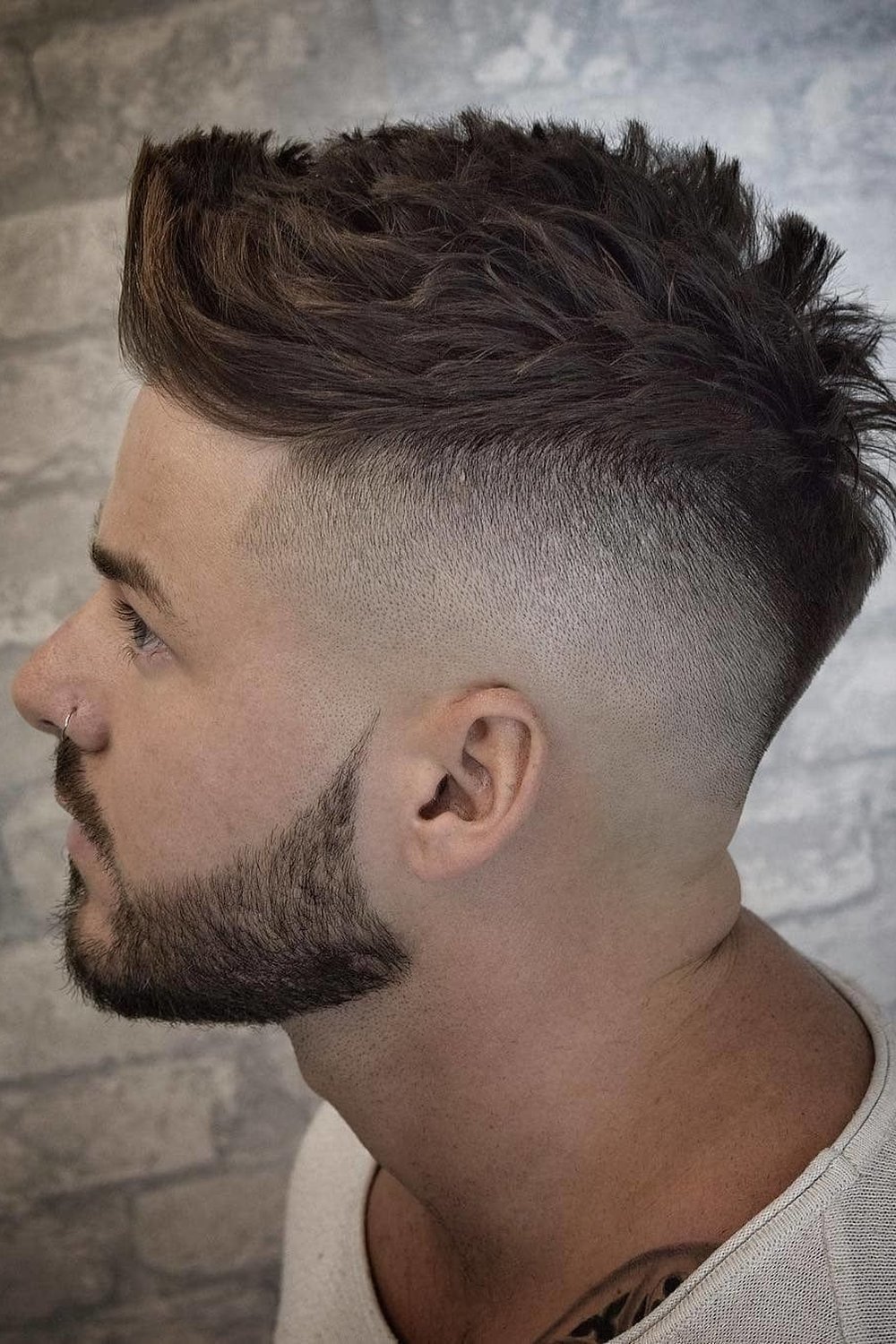
Photo via Pinterest — source
2. Buzz Cut
A buzz cut with a high skin fade is the boldest short cut a man can wear, because there is almost nothing left to hide behind. The top is clipped to a uniform short length, the sides are taken to bare skin high up, and the line between them is blended so smoothly that the head reads as one clean shape. The sharp lineup at the front finishes it: without length on top, the edges are the style. In the photo the buzz is tight, the lineup is razor straight, and the high fade gives the whole head a sculpted look that a low buzz simply cannot match.
Ask your barber for a buzz cut on top — a number one or two, your choice — with a high skin fade and a crisp lineup. There is almost no styling: a little moisturiser on the scalp keeps the skin from looking dry, and sunscreen matters, because the bare sides burn easily. Best for: oval and square faces; men with a strong jaw and even head shape. Upkeep: the fade needs a tidy-up every five to seven days to stay sharp.
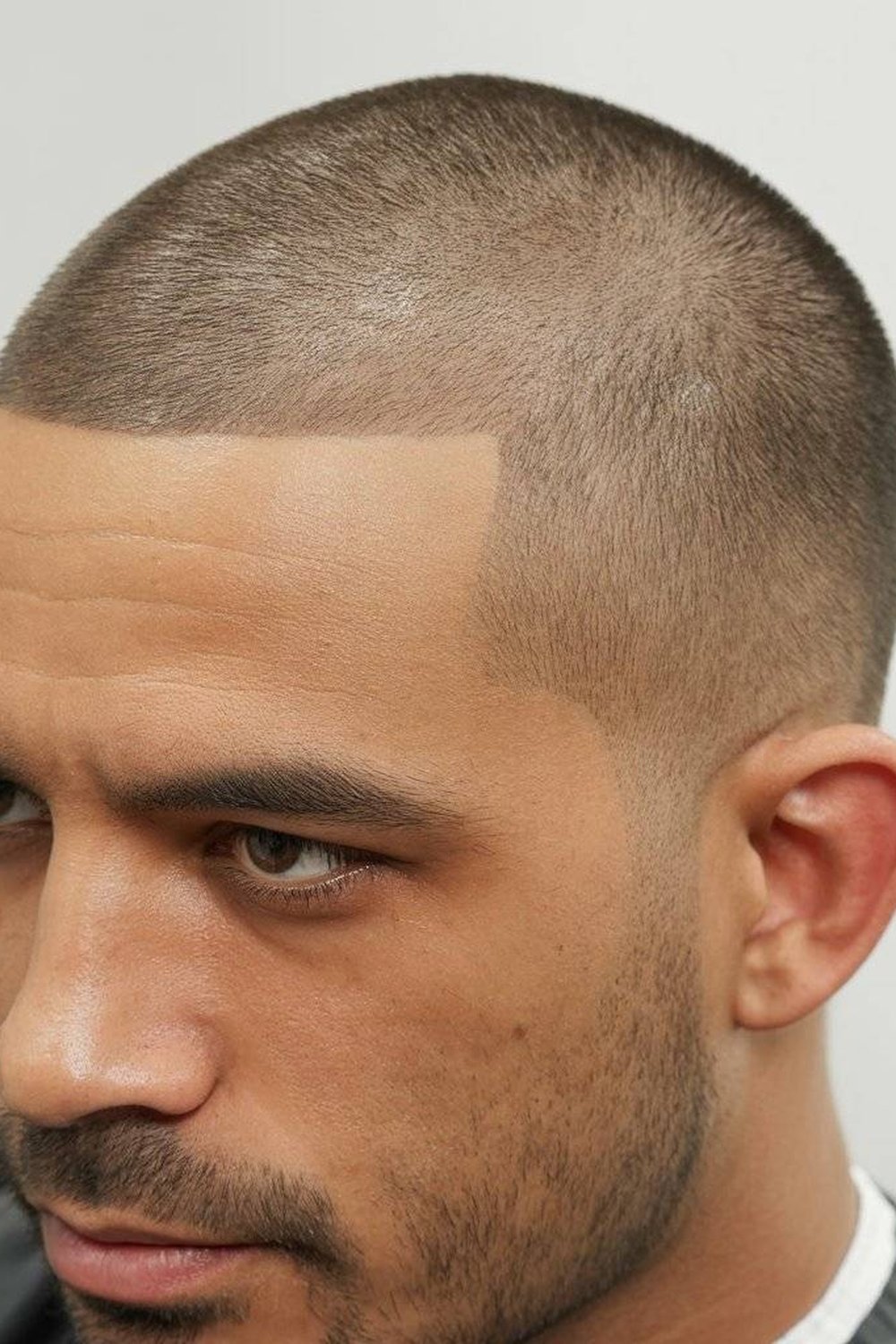
Photo: Inforeasyhome — source
3. French Crop
The French crop is the cleanest pairing in this guide: a short, straight fringe across the forehead, a textured top, and bare skin climbing high on the sides. The fringe gives the cut its structure — it frames the face and hides a high forehead — while the high fade keeps the sides brutally tidy. It is a short cut that still looks styled, which is why it works as well in an office as it does on a night out. In the photo the fringe sits straight and blunt with a soft texture on top, and the high skin fade makes the whole shape look carved rather than cut.
Ask your barber for a French crop with a high skin fade, the fringe cut straight across at the length you want, and the top textured with the clippers or scissors. Style it forward with a dab of matte paste and leave the fringe alone — the cut does the work. Best for: long and oblong faces, high foreheads, and straight or wavy hair. Upkeep: fade tidy-up every seven to ten days; fringe trim every two to three weeks.
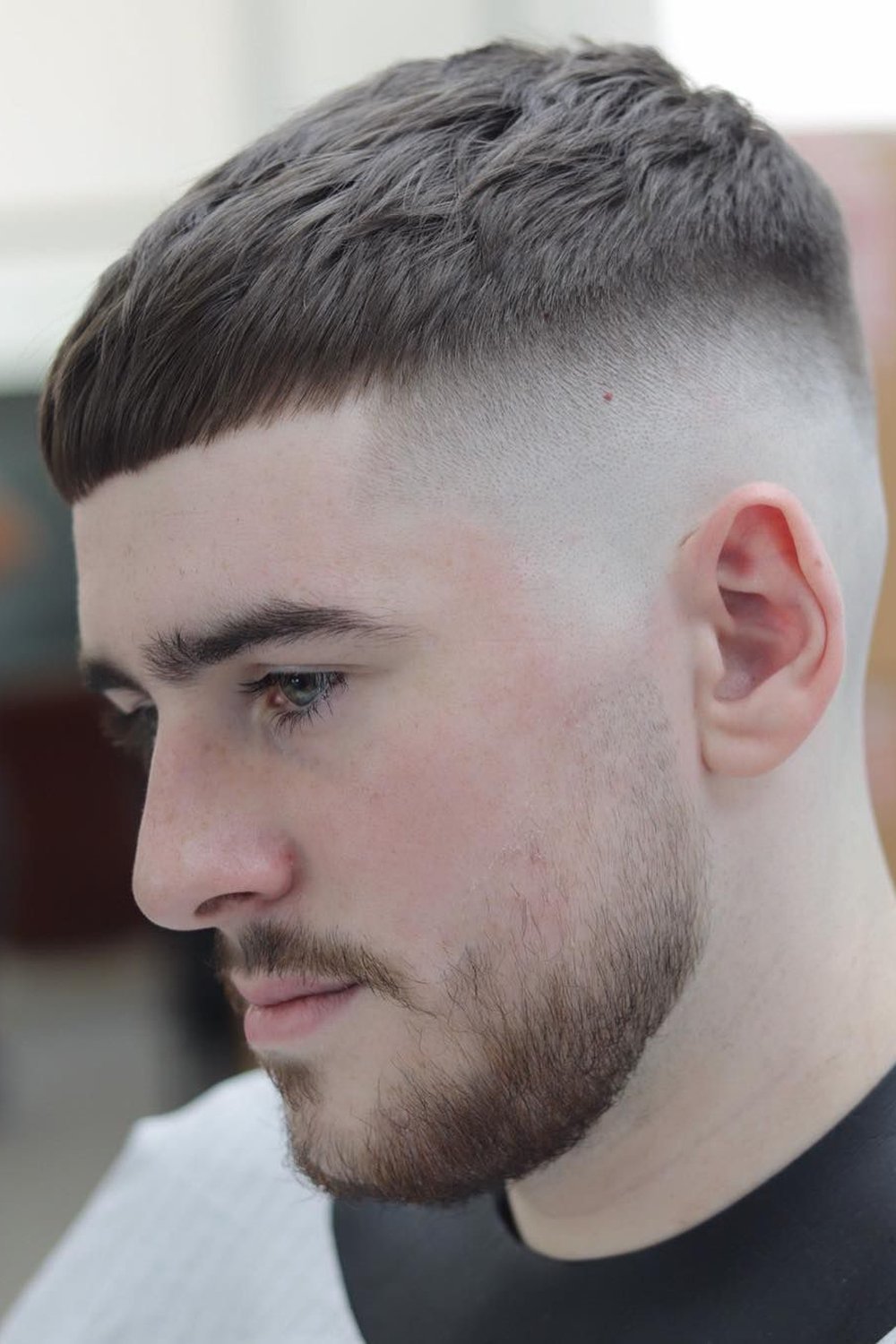
Photo via Pinterest — source
4. Crew Cut
The crew cut is the short, honest classic, and the high skin fade turns it into a statement. The top stays short — a textured crew with a slightly spiky finish in the photo — while the sides go bare high up, so the cut reads neat from the front and sharp from the side. It is one of the easiest cuts to live with: it needs no styling skill, it survives helmets and gym sessions, and it grows out tidily. The blond, textured finish in the photo shows how well a crew cut takes a high fade — the light hair against bare skin makes the blend look even cleaner.
Ask your barber for a short textured crew cut on top with a high skin fade, keeping the front a touch longer than the crown so it can be pushed up. A pea-sized amount of clay gives the spiky texture hold without weight. Best for: oval and square faces; straight or thick hair; men who want a no-fuss cut. Upkeep: fade every seven to ten days; the top holds its shape for three weeks.
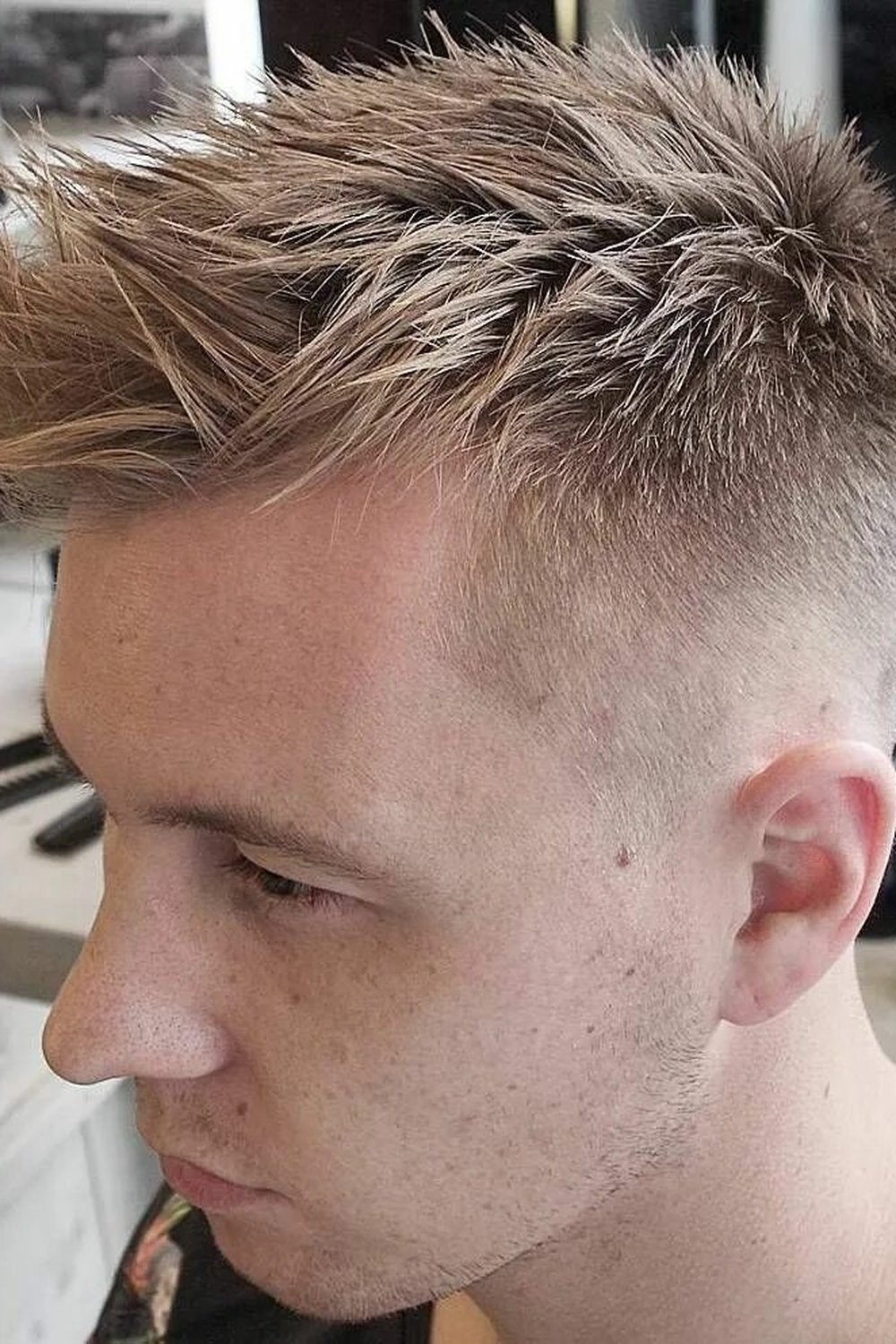
Photo via Yandex Images — source
5. Quiff
The quiff is where a high skin fade earns its reputation. The front sweeps up and back into a tall, voluminous wave, and the bare sides underneath make that height look even taller — the contrast is the whole point. In the photo the quiff rises high off the forehead with a full beard below, and the high skin fade runs clean up the side, so the cut has three clear layers: beard, bare skin, and height. It is a confident cut, and it suits men who do not mind spending five minutes with a dryer in the morning.
Ask your barber for a high skin fade with three to four inches left at the front for the quiff, shorter toward the crown. Blow-dry the front up and back with a round brush, finish with a strong-hold matte clay, and keep the beard shaped so the fade and the beard meet cleanly. Best for: round and square faces, thick hair, and men who like volume. Upkeep: the fade needs weekly attention; the quiff needs a trim every three weeks to hold its shape.
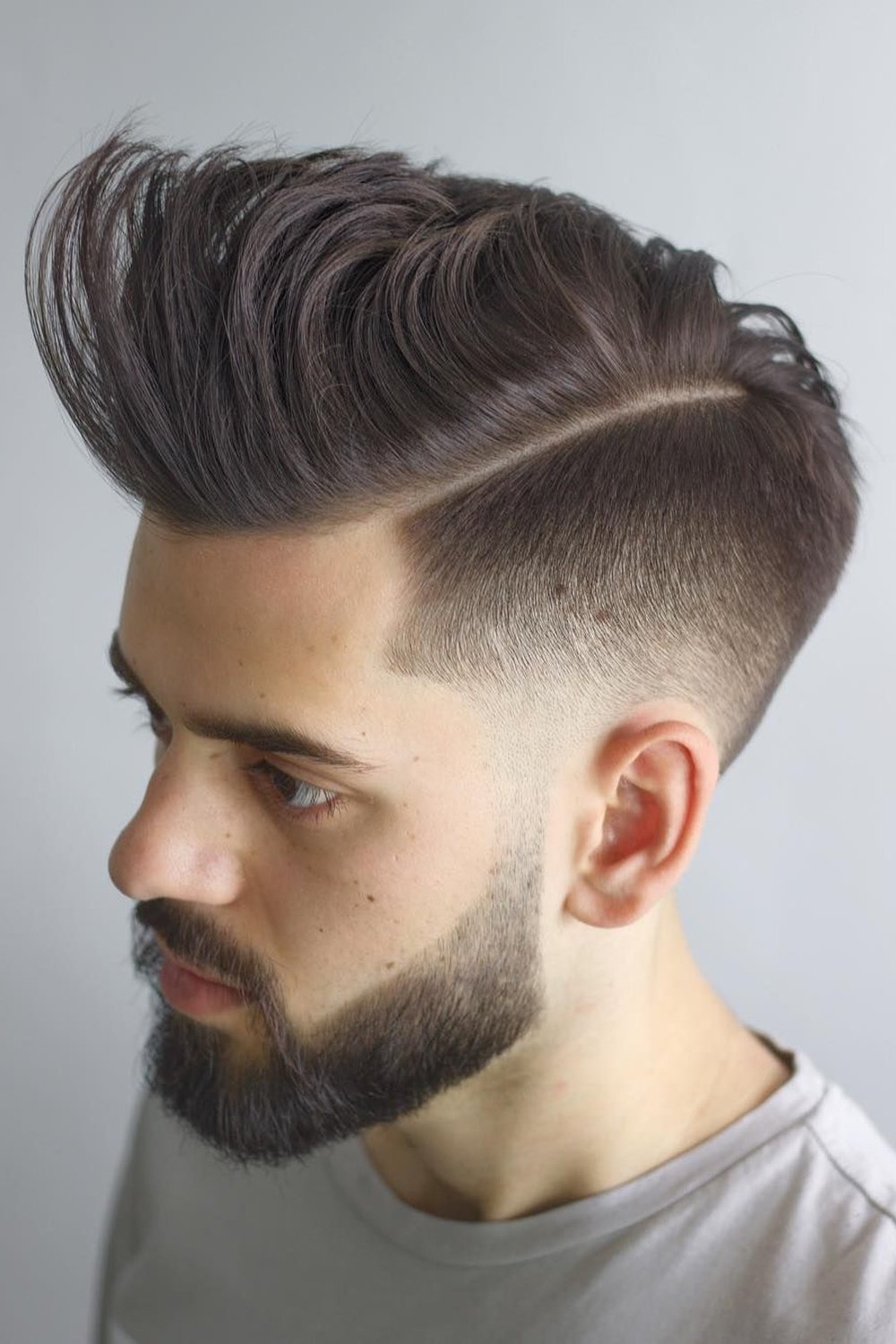
Photo via Pinterest — source
6. Pompadour
The pompadour is the tallest, most dramatic top in this guide, and the high skin fade is its perfect base. The hair sweeps up and back into a big, rounded wave, while the sides are shaved bare almost to the top of the head, so the pompadour looks like it is floating above clean skin. In the photo the pompadour is full and swept back with a beard underneath, and the contrast between the volume on top and the bare sides is what makes the cut look expensive. It is a vintage cut with a modern edge, and it turns heads in a way a low fade never will.
Ask your barber for a high skin fade with four to five inches on top for the pompadour, graduated shorter toward the back. Blow-dry up and back with a round brush, work pomade through from the roots, and comb the front into place. Best for: thick, straight or wavy hair; oval and square faces; men who enjoy styling. Upkeep: fade every seven days; the pompadour needs a trim every two to three weeks.
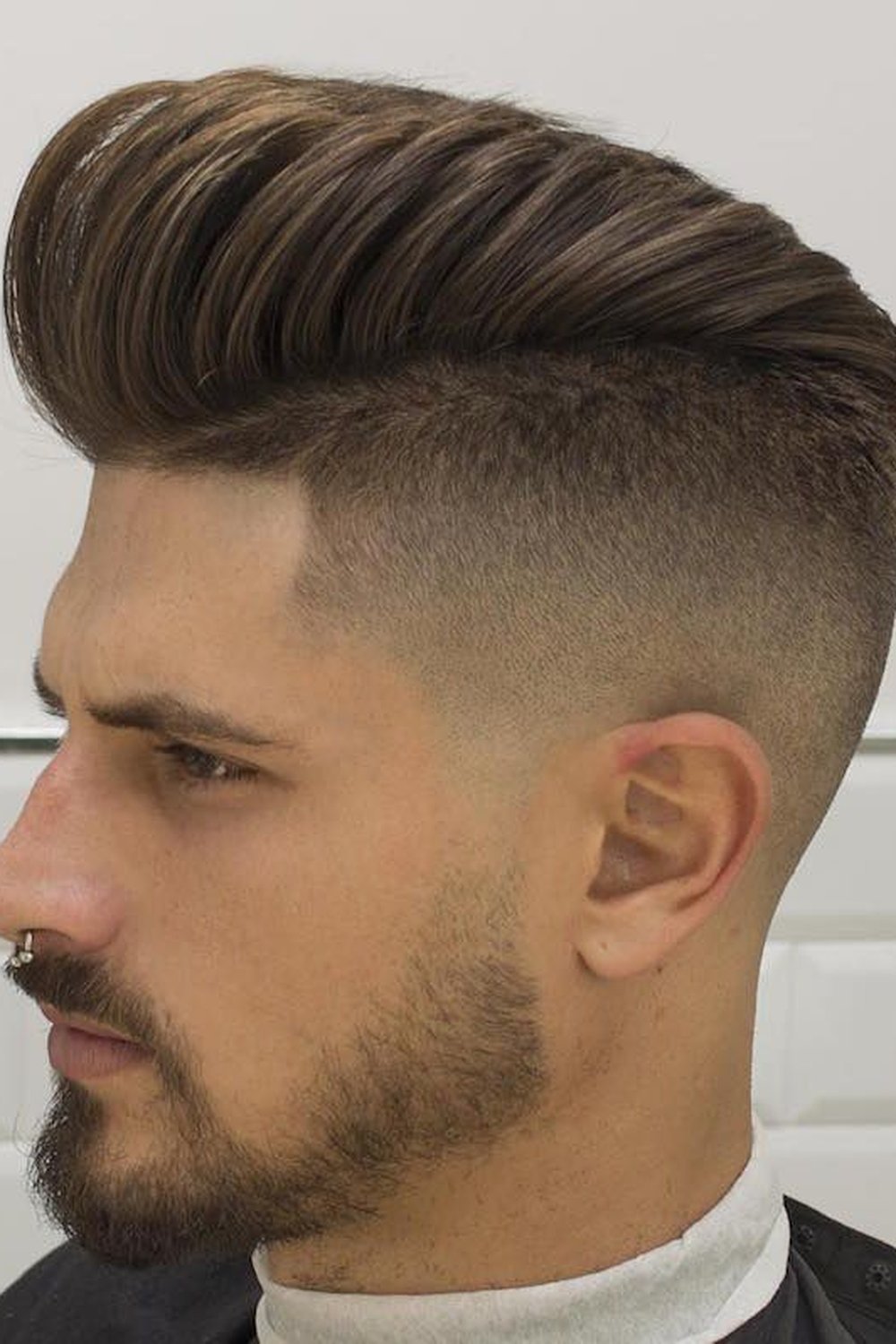
Photo via Pinterest — source
7. Slick Back
The slick back is the sharpest office-to-evening cut a high skin fade can carry. The top is combed straight back with a clean shine, and the bare sides frame it like a picture — no stray hair, no softness, just a smooth gradient into skin. In the photo the slick back runs in one clean sheet from the front to the crown, with a faint part line on the side and the high fade climbing to the temple. It is the cut for men who like their hair to look finished, and it pairs naturally with a suit.
Ask your barber for a high skin fade with three to four inches on top, combed back. Work a medium-hold pomade through damp hair and comb it straight back, letting the sides dry naturally against the fade. Best for: straight or wavy hair; oval and square faces; formal settings. Upkeep: fade every seven to ten days; the top holds for three to four weeks between trims.

Photo: Elite Private Barber — source
8. Comb Over
The comb over is the neat, grown-up version of the high skin fade — and the fade keeps it from looking old-fashioned. The top is parted to one side and combed across, while the bare skin high on the sides adds a modern sharpness that a classic side part never had. In the photo the comb over sits smooth and tidy with a beard below, and the high fade gives the cut a clean frame that makes it look intentional rather than safe. It is the best choice in this guide for a man who wants maximum contrast with minimum fuss.
Ask your barber for a high skin fade with a side part and two to three inches on top, combed to your natural part. A little pomade keeps it in place all day, and the part can be cut in as a soft line if your natural part is faint. Best for: straight hair; oval faces; office and formal wear. Upkeep: fade every seven to ten days; comb over trims every three weeks.
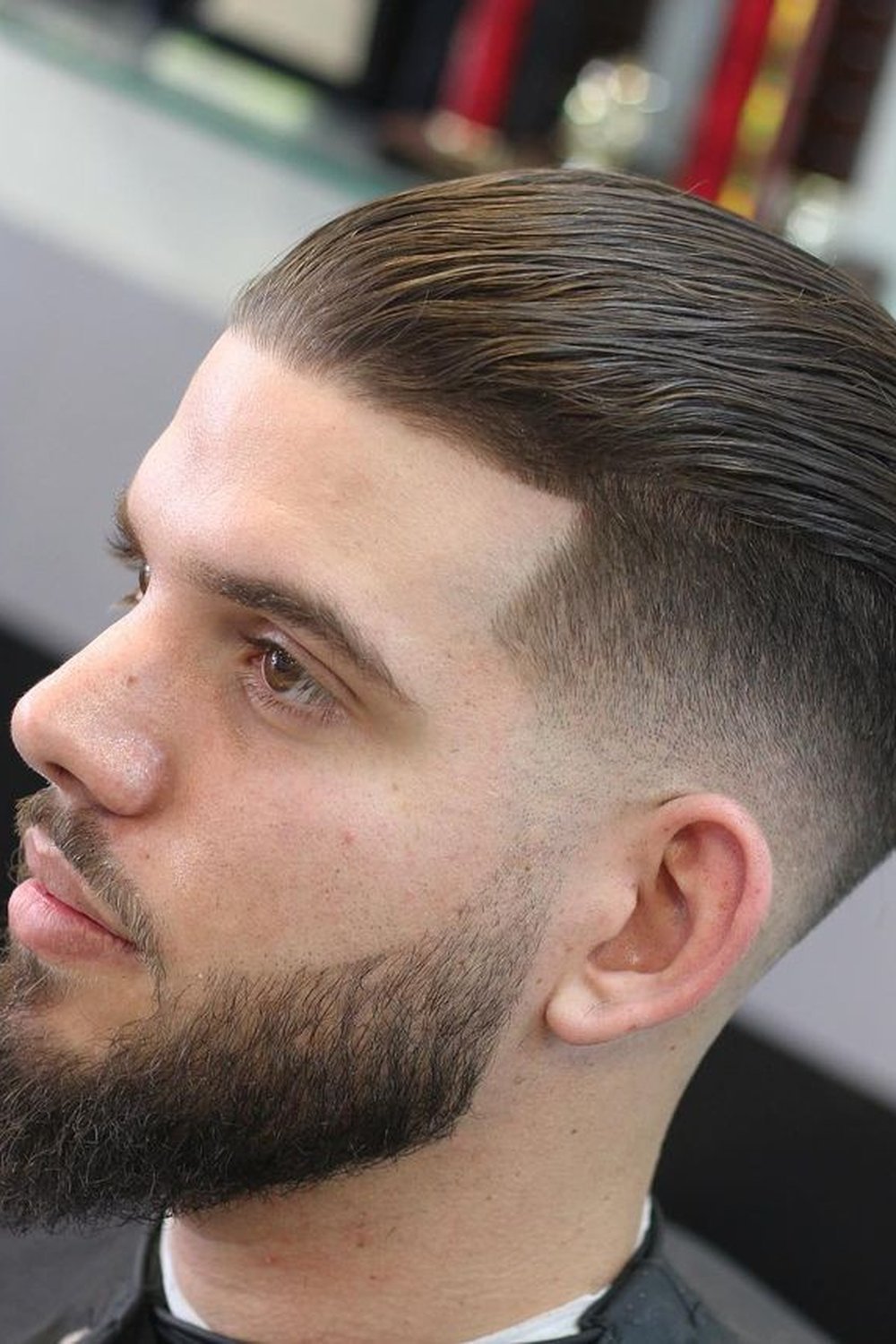
Photo via Pinterest — source
9. Side Part
The side part is the comb over’s sharper cousin: the part is defined, the top sweeps cleanly to one side, and the high skin fade strips the sides down to bare skin so the parting line reads like a design. In the photo the side part is crisp, the top has a smooth sweep with a light shine, and the beard underneath is shaped to meet the fade — the whole cut looks considered from every angle. It suits men who like structure, and it is one of the few high fades that passes a strict dress code without softening the cut.
Ask your barber for a high skin fade with a defined side part and two to three inches on top, swept to the side. Find your natural part first — comb the hair forward and see where it splits — and have the barber cut the part in, not just comb it. Best for: straight or wavy hair; oval and square faces; professional settings. Upkeep: fade every seven to ten days; the part stays clean for two to three weeks.
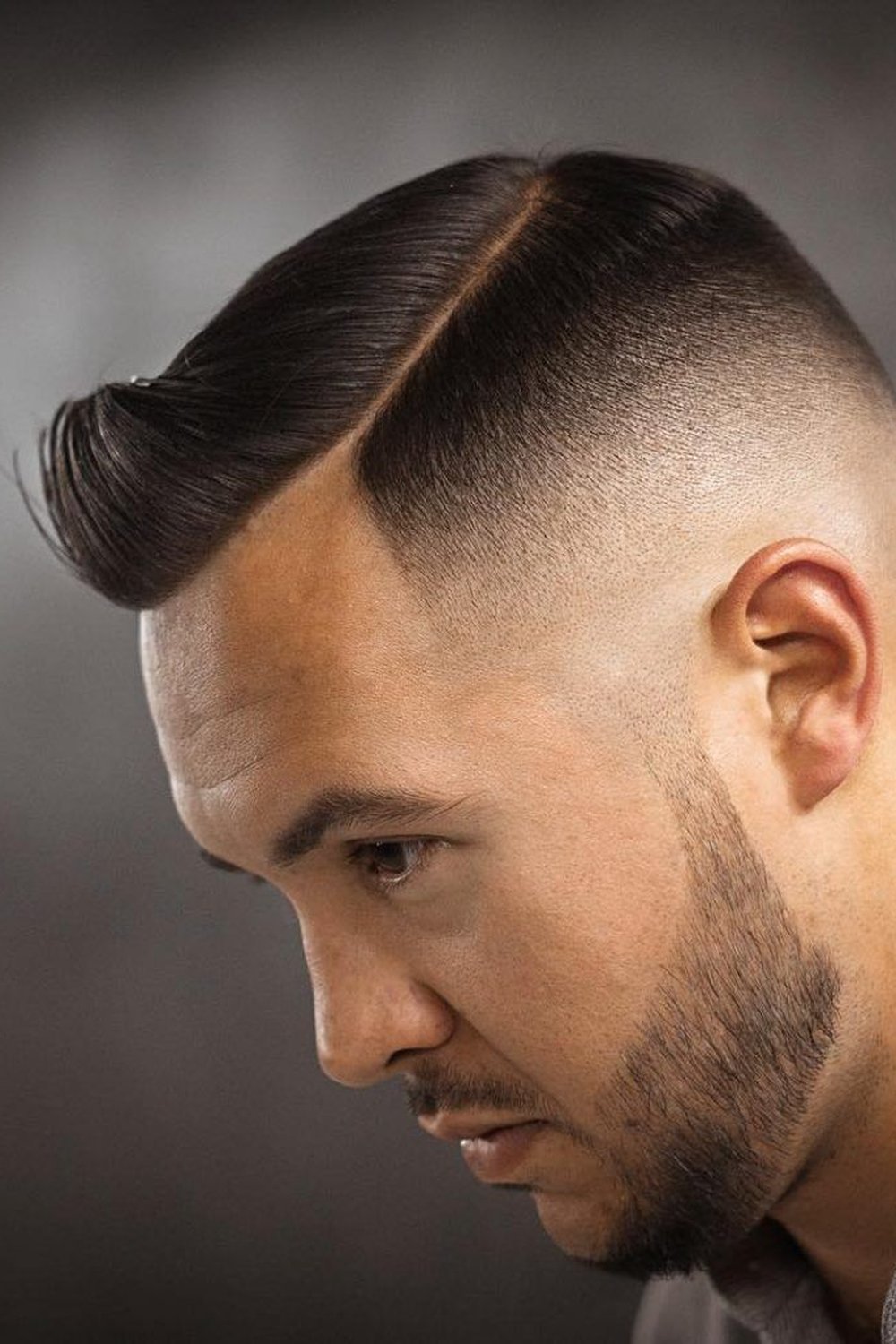
Photo via Pinterest — source
10. Hard Part
The hard part takes the side part one step further: the parting line is shaved in with a trimmer, a thin, razor-clean groove that runs from the front to the crown. Against a high skin fade the effect is striking — two sharp lines, the shaved part above and the bare fade below, framing a smooth swept top. In the photo the hard part line is precise and the top is slicked to the side with a beard underneath, and the whole cut looks like it was drawn with a ruler. It is a detail that costs nothing extra at the barber and changes the whole cut.
Ask your barber for a high skin fade with a shaved hard part on your natural part line, the top slicked to the side. The line grows out in about a week, so it needs re-cutting at every fade tidy-up — tell your barber to refresh it, not just the fade. Best for: straight hair; men who like sharp detail; oval and square faces. Upkeep: hard part re-cut every seven days with the fade.
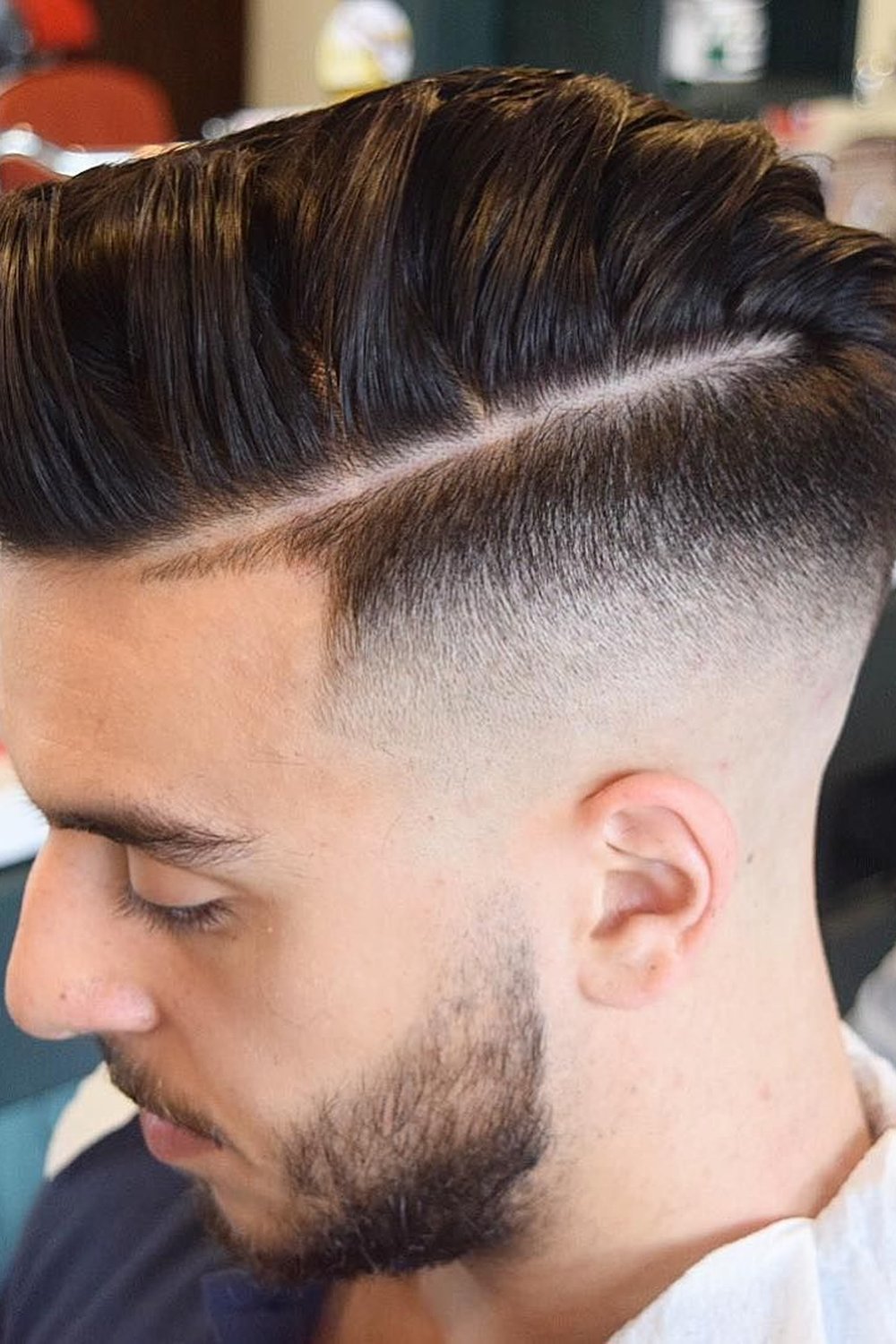
Photo via Pinterest — source
Crops, curls and texture
11. Faux Hawk
The faux hawk is the high skin fade’s natural partner, because both are about contrast. The centre strip of hair is left long and pushed up into a ridge, while the sides are shaved bare high up — so the mohawk shape reads clearly without a full shave. In the photo the faux hawk strip runs spiky down the centre with the fade climbing to meet it, and the cut has energy from every angle. It is a bold cut that still works in daylight, and it suits men who want edge without committing to a real mohawk.
Ask your barber for a high skin fade with a faux hawk strip left long down the centre, shorter at the back. Push the strip up with a strong-hold matte product and leave the sides alone — the fade is the frame. Best for: thick or straight hair; oval and round faces; men who like a bold look. Upkeep: fade every seven days; the strip needs a trim every two to three weeks.
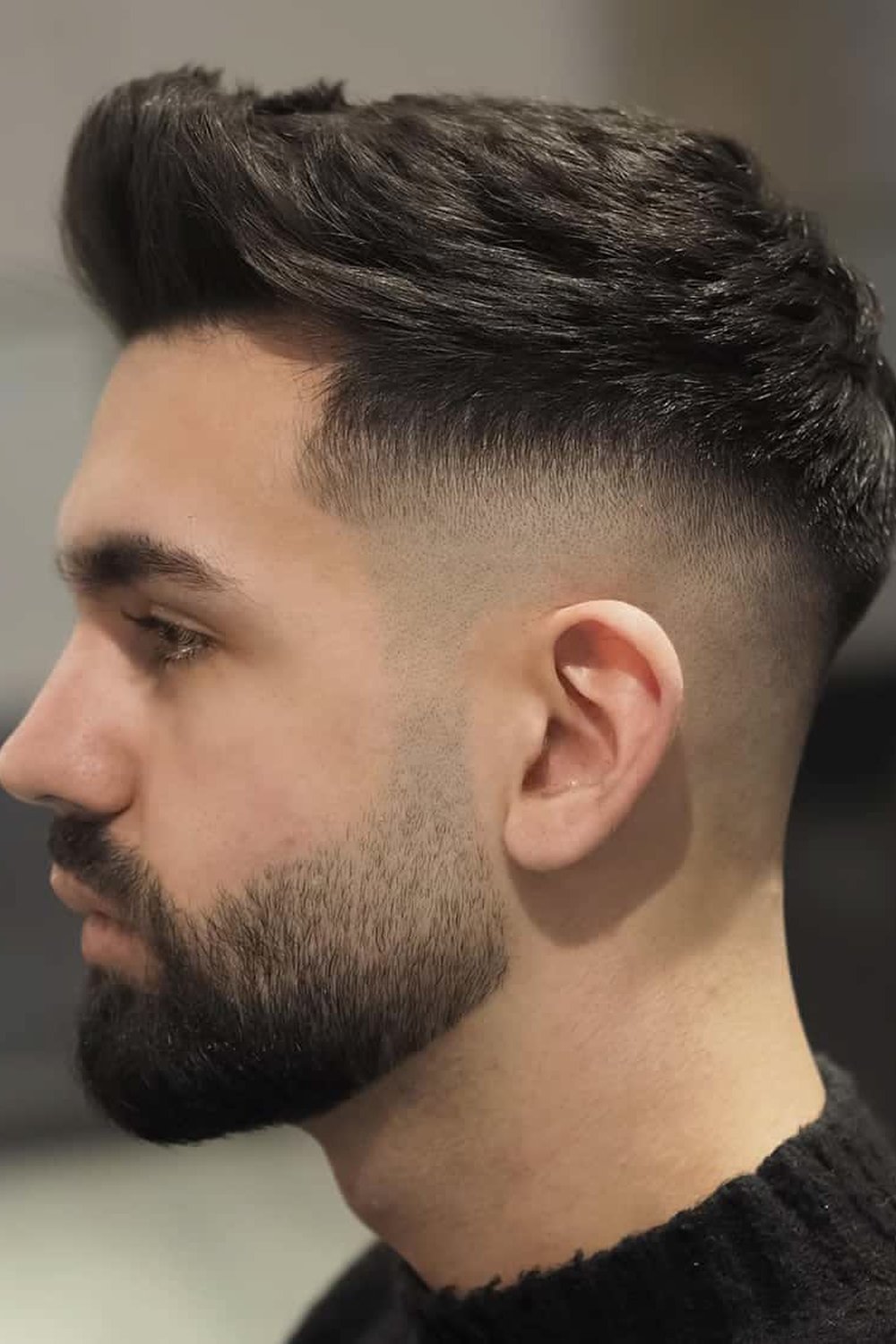
Photo via Pinterest — source
12. Spiky Top
The spiky top is the most energetic cut in this section: short, textured spikes pushed up all over the crown, with bare skin high on the sides to set them off. In the photo the spikes are messy and upright, the beard is full, and the high fade gives the whole head a sharp, sculpted outline. It is a young cut — it suits men who like their hair to look alive rather than arranged — and it works best on thick hair that holds a spike without much product.
Ask your barber for a high skin fade with a short spiky textured top, point-cut for piecey ends. Work a small amount of strong-hold clay through damp hair and push the spikes up with your fingers, leaving them uneven on purpose. Best for: thick, straight hair; oval and square faces; younger men. Upkeep: fade every seven to ten days; spikes need a trim every three weeks.
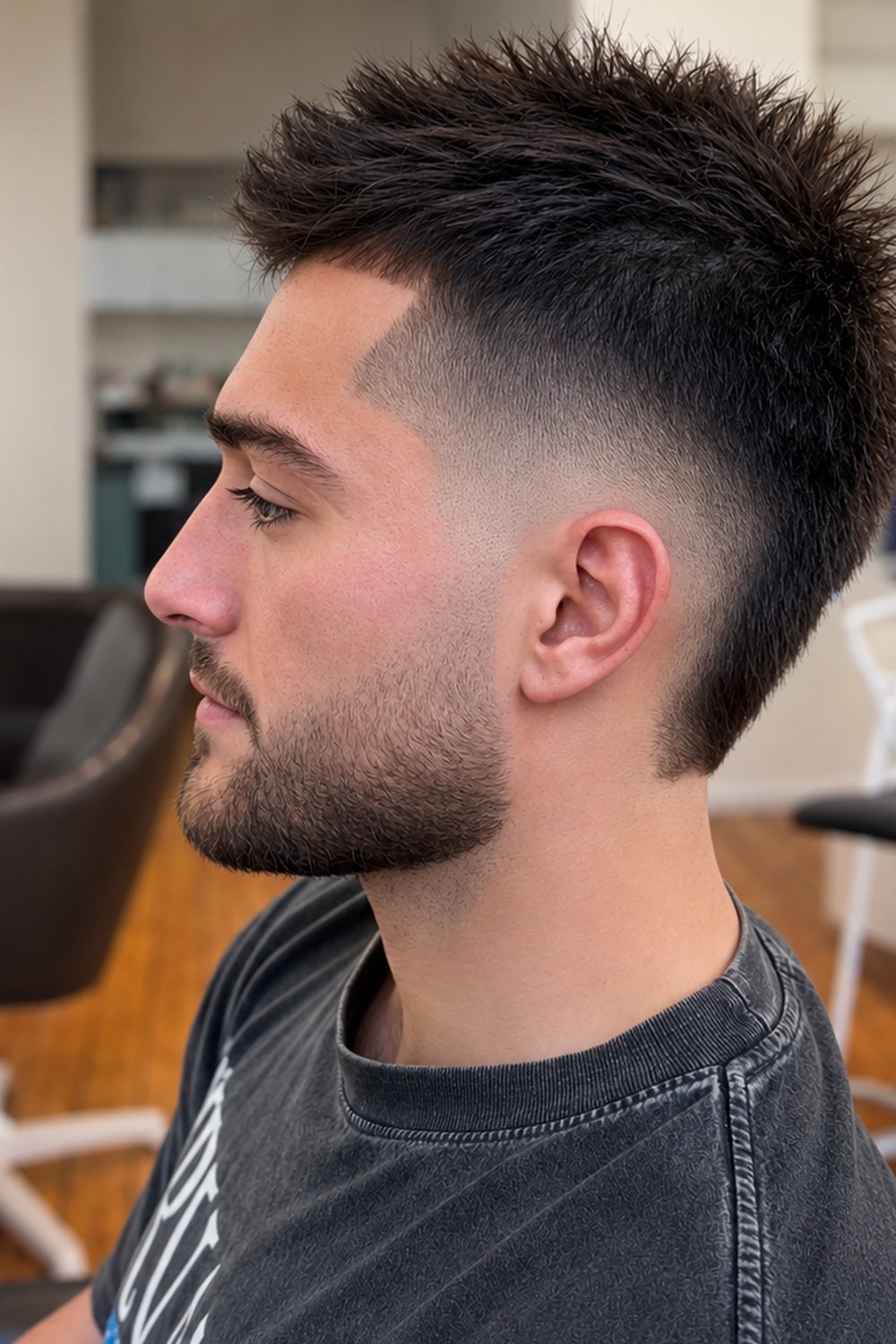
Photo: Fresha — source
13. Curly Top
Curly hair and a high skin fade are a perfect match, because the bare sides make the curls on top look taller and more defined. In the photo the tight curls sit high on the crown with a beard below, and the high fade frames them so cleanly that the curls become the whole feature of the cut. The trick is to keep the curls long enough to hold their shape — cut them too short and they lose their pattern — and to let the fade do the shaping instead of thinning the top.
Ask your barber for a high skin fade with the curls kept long on top and shaped, not thinned. Use a curl cream after washing, scrunch the curls into shape, and never brush them dry. Best for: curly and wavy hair; oval and round faces; men who want their curls to stand out. Upkeep: fade every seven to ten days; curls need shaping every three to four weeks.
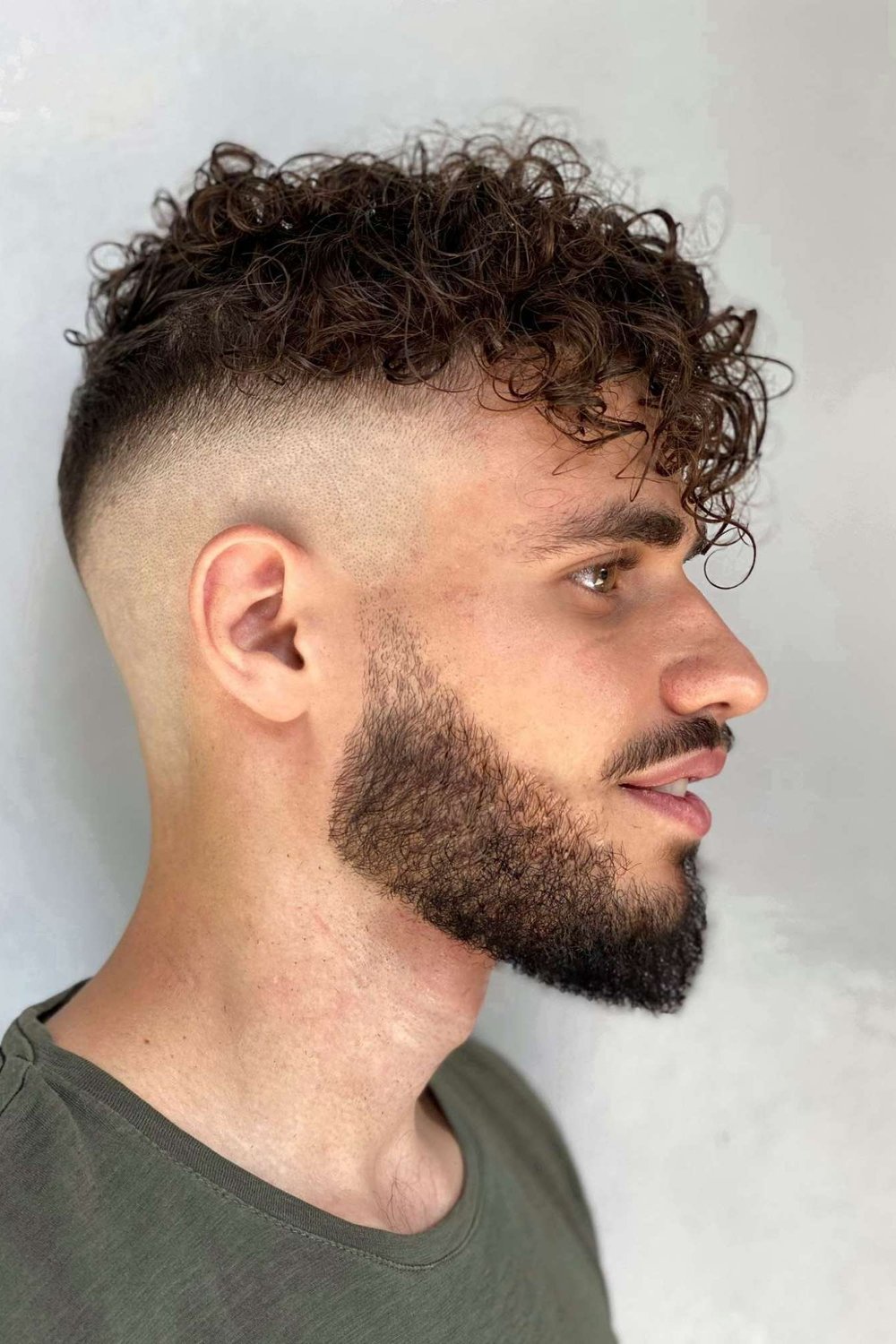
Photo: Iciao — source
14. Wavy Top
Wavy hair takes a high skin fade beautifully, because the wave gives the top natural movement that straight hair has to be styled into. In the photo the wavy top falls in loose, textured waves with the high fade climbing the side, and the cut looks relaxed rather than rigid — the wave softens the sharpness of the fade just enough. It is a good middle ground: bold sides, easy top, and a cut that still looks good when you skip the product entirely.
Ask your barber for a high skin fade with a wavy textured top, cut with the wave’s natural direction in mind. A sea-salt spray or a light cream brings out the wave without weighing it down, and the top can be left to air-dry. Best for: wavy hair; oval and square faces; men who want low-effort styling. Upkeep: fade every seven to ten days; wavy tops hold their shape for three to four weeks.

Photo: Beard Beasts — source
15. 360 Waves
360 waves with a high skin fade is a classic Black barbershop cut, and the combination is flawless: the waves ripple in a full circle around the head, the beard is full and shaped, and the high fade frames the waves with bare skin so the pattern reads from every angle. In the photo the wave pattern is deep and even, the beard is thick, and the fade climbs high enough that the waves sit like a crown. It is a cut that takes patience to build, but once the waves are trained, the fade keeps them looking sharp.
Ask your barber for a high skin fade with your waves kept on top, and keep brushing daily with a soft brush and a little wave pomade to hold the pattern. A durag at night protects the waves, and the fade needs its weekly tidy-up to keep the frame clean. Best for: coily and wavy Black hair; men who already have a wave routine. Upkeep: fade every five to seven days; brush daily to hold the pattern.
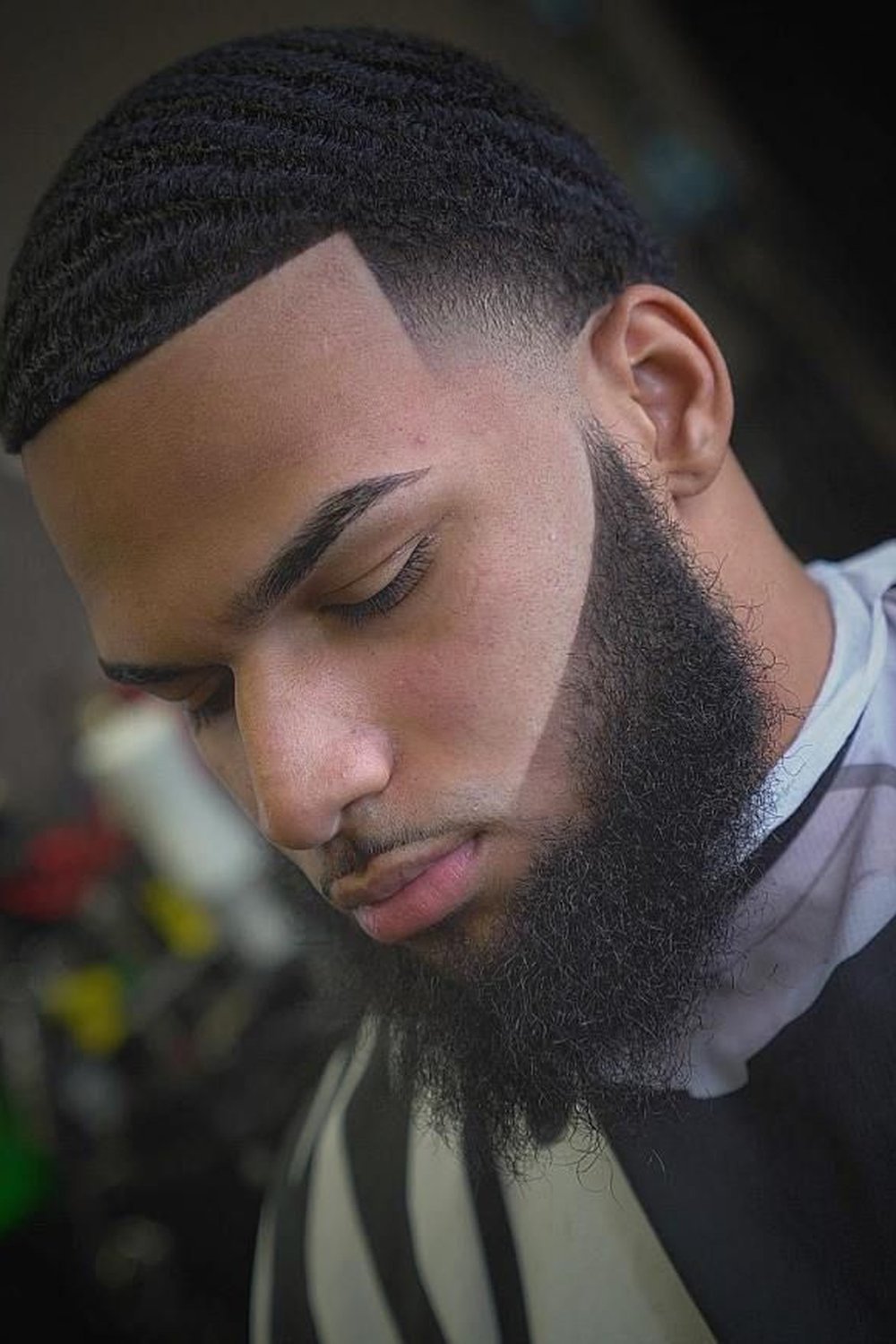
Photo via Pinterest — source
16. Short Afro
The short afro with a high skin fade is one of the sharpest cuts for coily hair: the afro keeps its round, natural shape on top while the sides go bare high up, so the silhouette is clean and architectural. In the photo the afro is short and rounded with a sharp hairline at the front, and the high fade gives the cut a crisp edge that a low fade cannot match. It is a proud, confident cut, and it suits men who want their natural texture to be the feature rather than something to manage down.
Ask your barber for a high skin fade with a short afro shaped round on top, keeping the length even so the shape holds. Moisturise the afro daily and pick it out gently to keep the shape full, and have the hairline shaped — not shaved back — at each visit. Best for: coily and afro-textured hair; oval and round faces. Upkeep: fade every seven days; afro shaping every two to three weeks.

Photo via Booksy — source
17. High Top
The high top is the tallest afro cut there is, and the high skin fade is its natural base. The top is cut flat and level, rising straight up from the head, while the sides are shaved bare high up — so the cut has a strong, geometric silhouette that reads from across a room. In the photo the high top is level and even with a sharp lineup, and the fade climbs to meet it so the whole head looks carved. It is a statement cut with history, and it suits men who want height and presence.
Ask your barber for a high top fade with the top cut flat and level and a high skin fade on the sides. Keep the top moisturised and pick it up daily so it holds its height, and have the flat top re-levelled every two weeks. Best for: coily hair with enough density to hold height; oval and square faces. Upkeep: fade every seven days; the flat top needs levelling every two weeks.
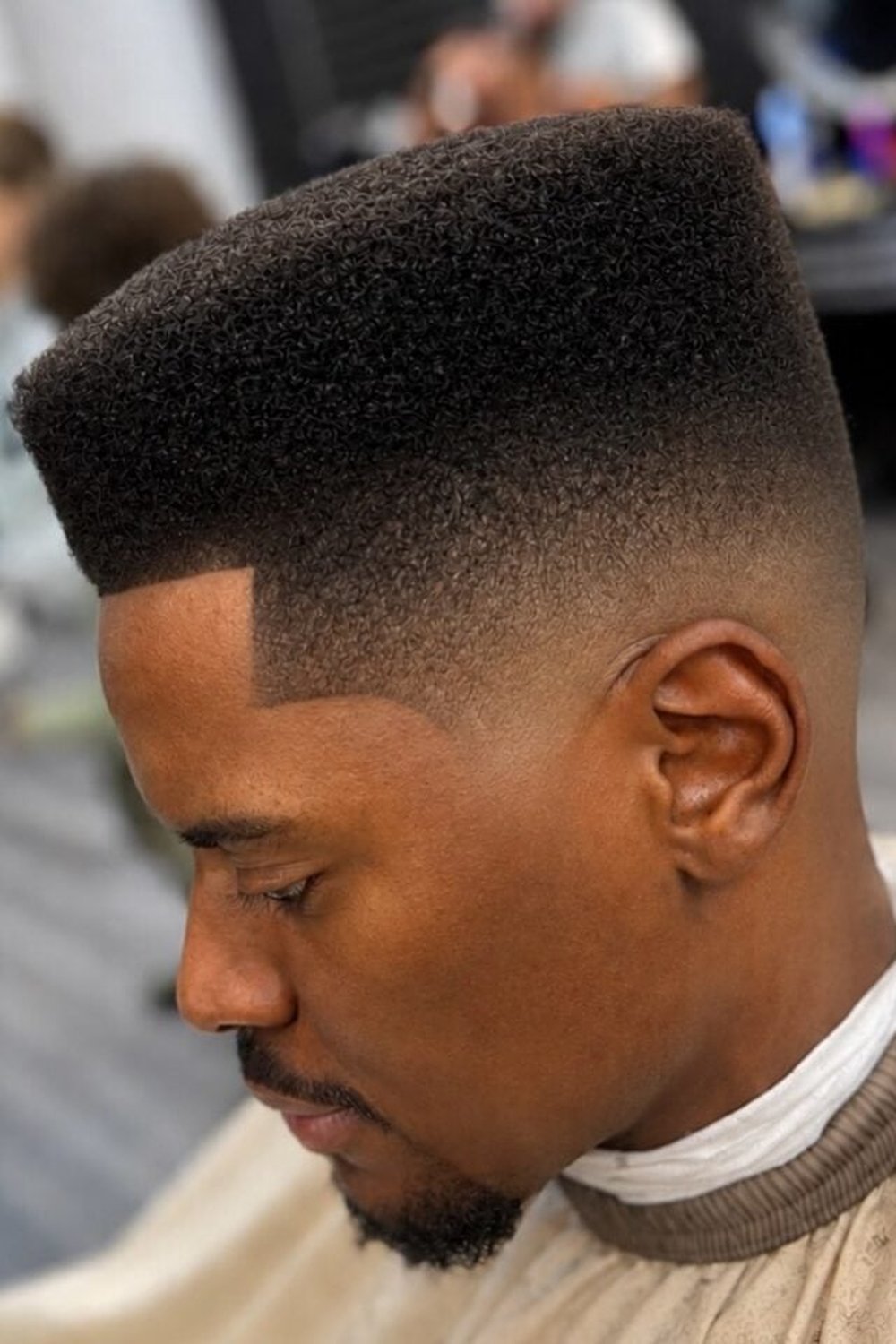
Photo: Hairstyle Camp — source
18. Caesar Cut
The Caesar cut is short, straight and honest: a short fringe combed forward, a uniform short top, and a high skin fade that makes the whole thing look razor sharp. In the photo the fringe sits straight across the forehead with a beard below, and the high fade gives the cut a clean frame that turns a simple short cut into something deliberate. It is the best choice in this guide for a man who wants a short cut with a strong hairline, and it suits thinning hair well, because the forward fringe covers a receding hairline naturally.
Ask your barber for a Caesar cut with a high skin fade, the fringe cut straight across and the top kept short and even. Comb the fringe forward with a little matte paste and leave it there — the cut needs no styling beyond that. Best for: straight hair; thinning or receding hairlines; oval and square faces. Upkeep: fade every seven to ten days; fringe trim every two weeks.
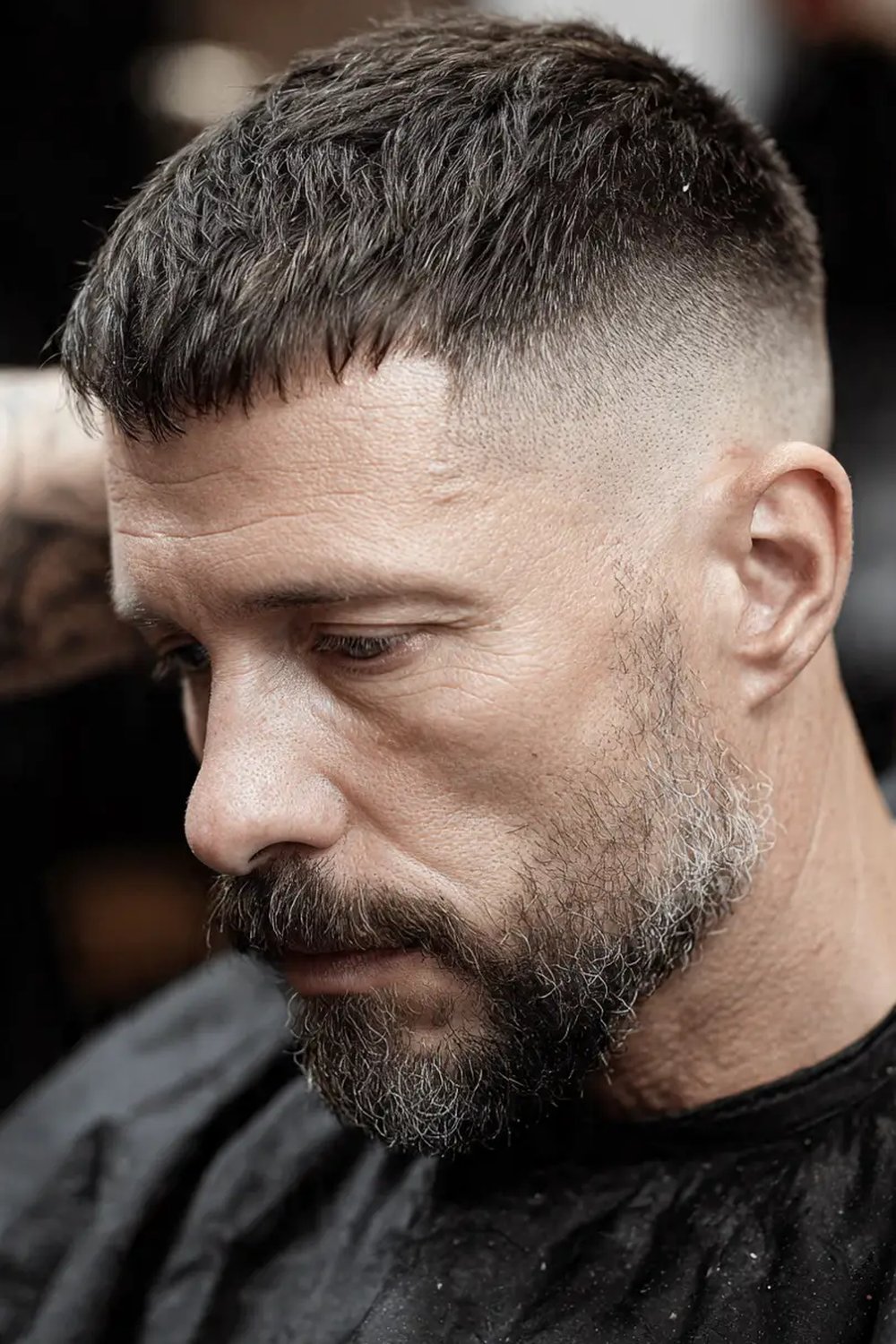
Photo: Taper Fade Pro — source
19. Ivy League
The Ivy League is the polished, grown-up cut in this section: a side-parted top with just enough length to sweep, a neat shape, and a high skin fade that keeps it modern. In the photo the Ivy League sweeps to the side with a beard underneath, and the fade climbs high toward the temple, so the cut reads classic from the front and bold from the side. It is the high fade for men who want to look sharp without looking loud, and it is one of the few cuts in this guide that works in a boardroom as well as it does on a night out.
Ask your barber for an Ivy League cut with a high skin fade, the top side-parted and left long enough to sweep. A little pomade keeps the sweep in place, and the part can be cut in softly if your natural part is faint. Best for: straight or wavy hair; oval faces; professional settings. Upkeep: fade every seven to ten days; the top holds for three weeks.
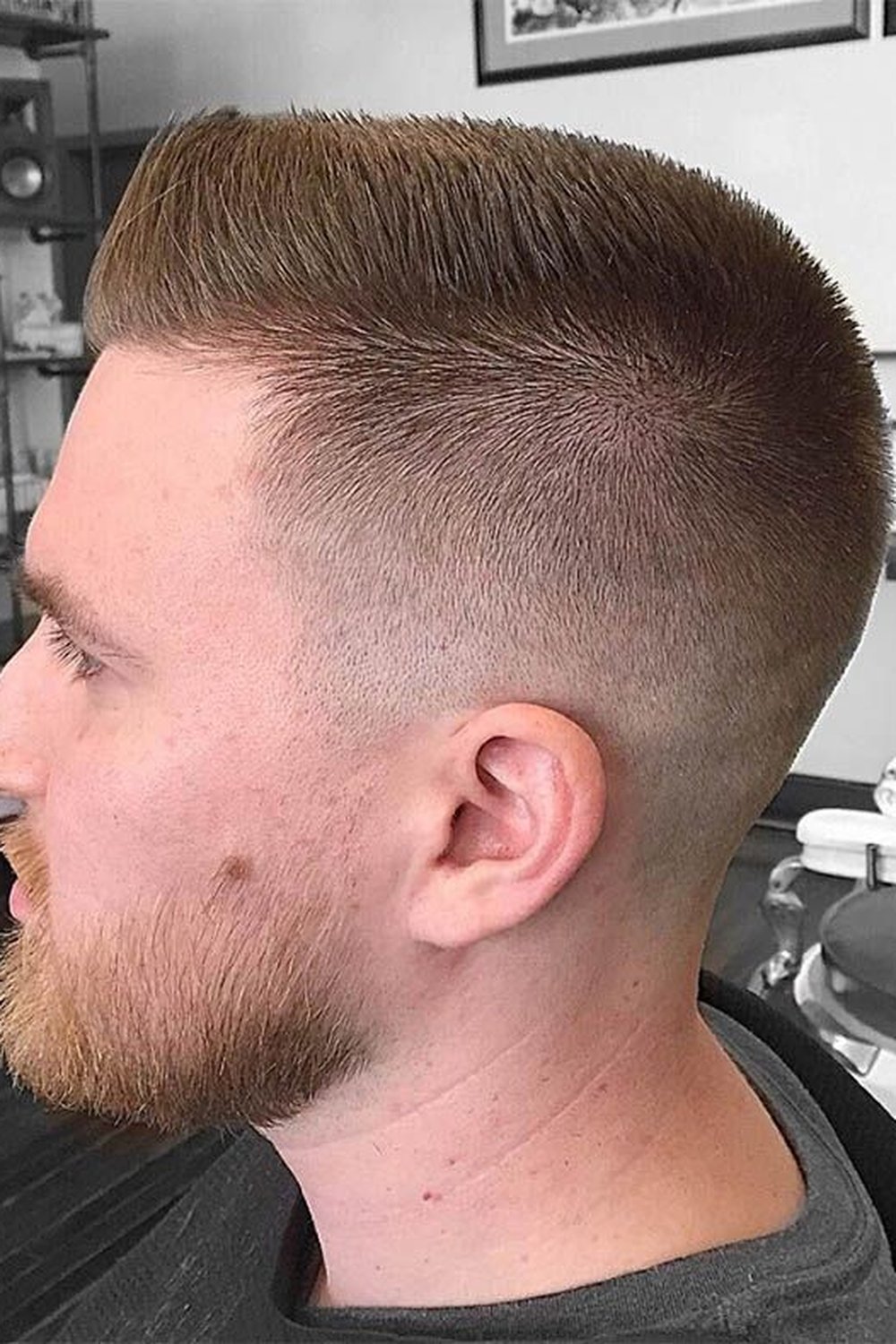
Photo via Pinterest — source
20. Brush Up
The brush up is the textured top pushed forward and up, and the high skin fade gives it a sharp frame. In the photo the top is brushed up into loose, piecey texture with the fade climbing high on the side, and the cut looks effortless — like the hair just falls that way. It is a good choice for men who want volume without the formality of a quiff, and it works on straight, wavy and thick hair alike, because the texture hides the hair’s natural direction.
Ask your barber for a high skin fade with a brushed-up textured top, point-cut so the ends stay piecey. Push the front up with your fingers and a dab of matte clay, and let the sides do the framing. Best for: straight, wavy or thick hair; oval and round faces; men who want easy volume. Upkeep: fade every seven to ten days; brush up trims every three weeks.
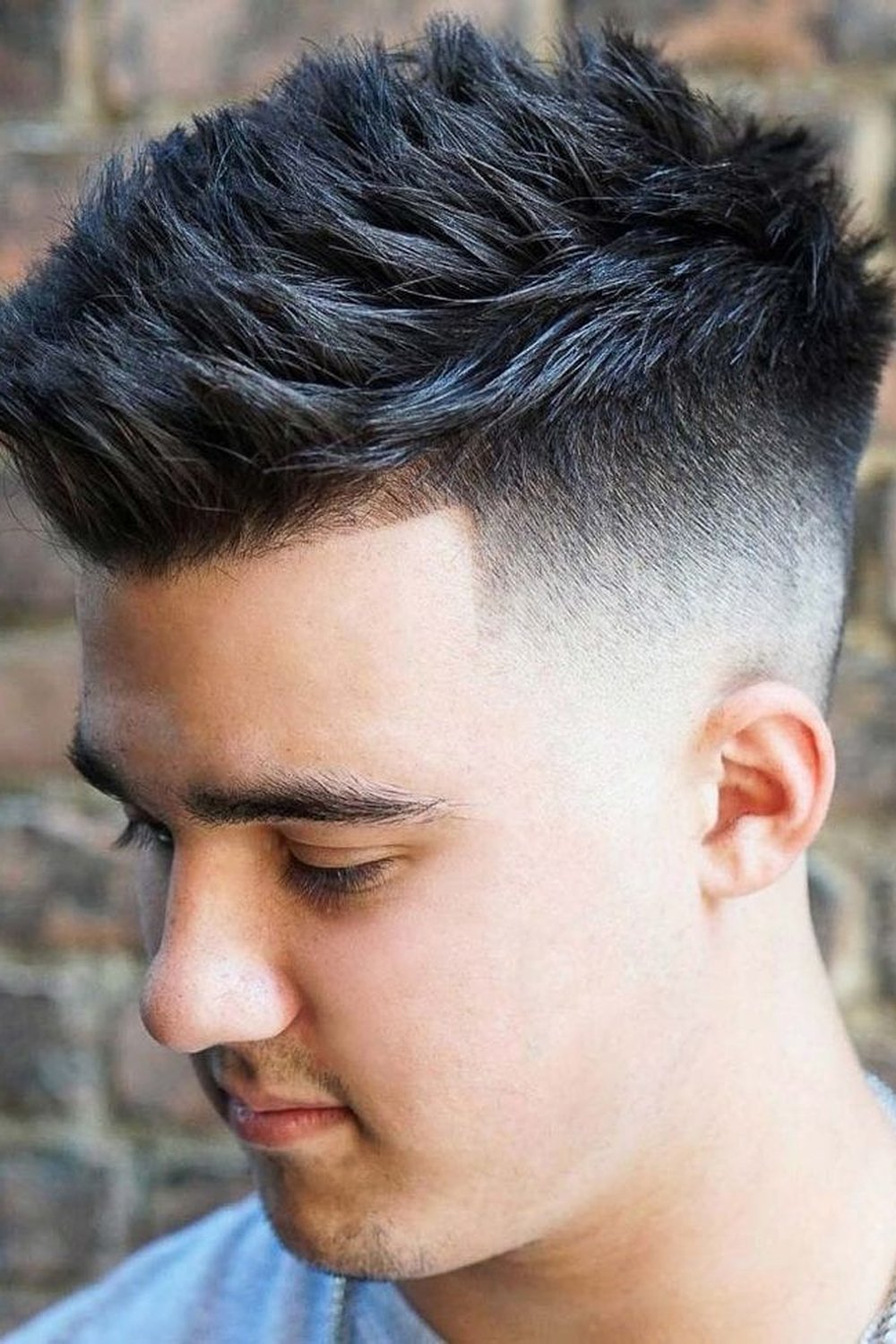
Photo via Pinterest — source
Longer tops and statement cuts
21. Messy Textured Top
The messy textured top is the most relaxed cut in this guide: the top is left choppy and uneven on purpose, with pieces falling in different directions, while the high skin fade keeps the sides brutally tidy. The contrast is the point — messy on top, sharp on the sides — and it works because the fade gives the mess a frame. In the photo the top is tousled with a beard underneath, and the cut looks like it took thirty seconds to style, which is exactly the appeal.
Ask your barber for a high skin fade with a messy textured top, point-cut and thinned at the ends so the pieces separate. A little matte paste scrunched through damp hair is all the styling it needs, and it looks better slightly undone. Best for: thick or wavy hair; oval and square faces; men who hate styling. Upkeep: fade every seven to ten days; the top holds its shape for three to four weeks.
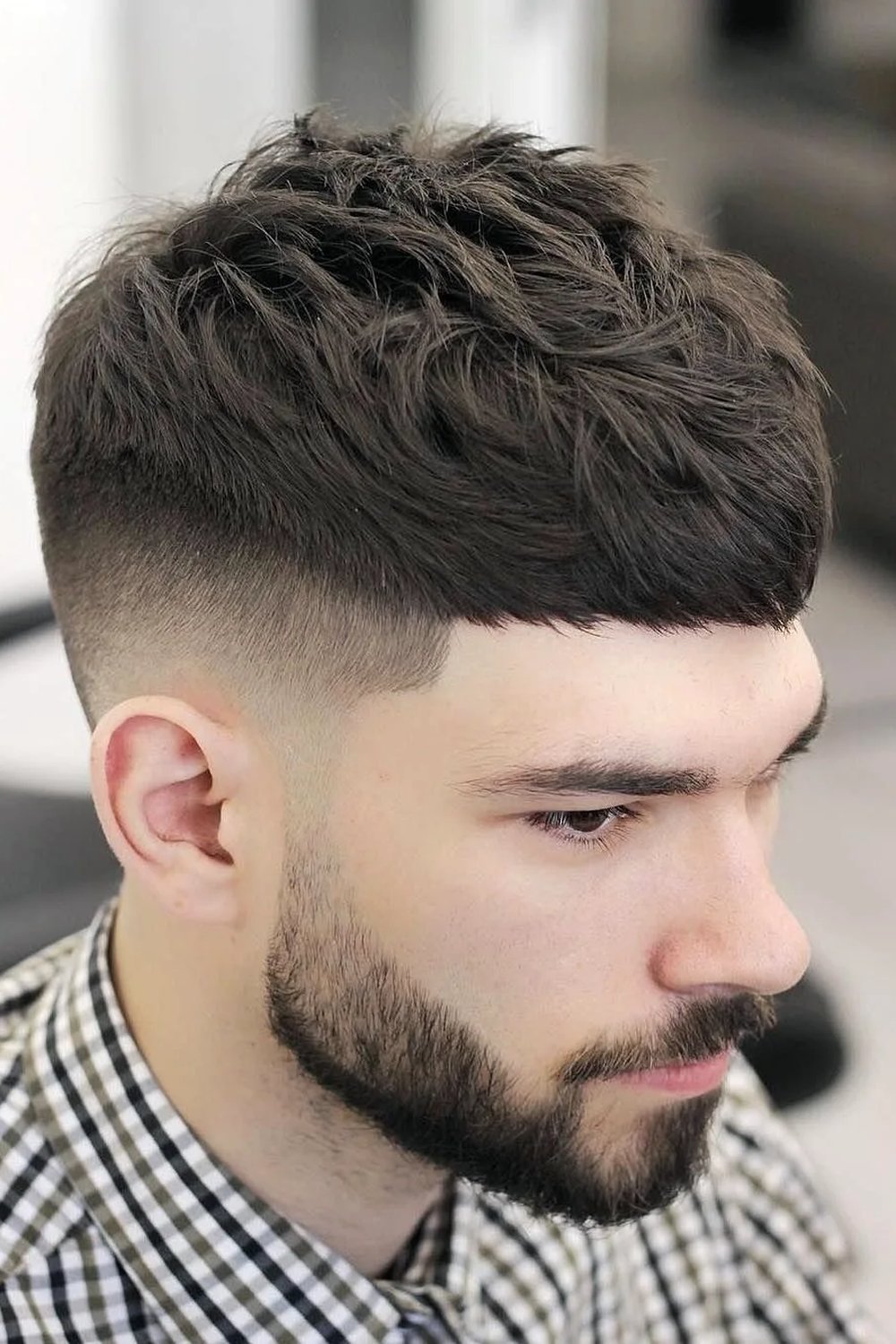
Photo: Pixfeast — source
22. Textured Fringe
The textured fringe is the fringe with attitude: choppy, piecey ends falling across the forehead, a textured top behind it, and a high skin fade framing the whole thing. In this black-and-white shot the fringe reads even sharper, because the contrast between the dark fringe and the bare skin is the whole picture — the cut is all about the line where hair meets skin. It suits men with a high forehead or a long face, because the fringe shortens the face, and it is one of the most fashionable cuts in this guide right now.
Ask your barber for a high skin fade with a choppy textured fringe, point-cut so the ends stay uneven. Push the fringe forward with a little matte paste and let the pieces fall where they want. Best for: long faces and high foreheads; straight or wavy hair. Upkeep: fade every seven to ten days; fringe trim every two weeks.
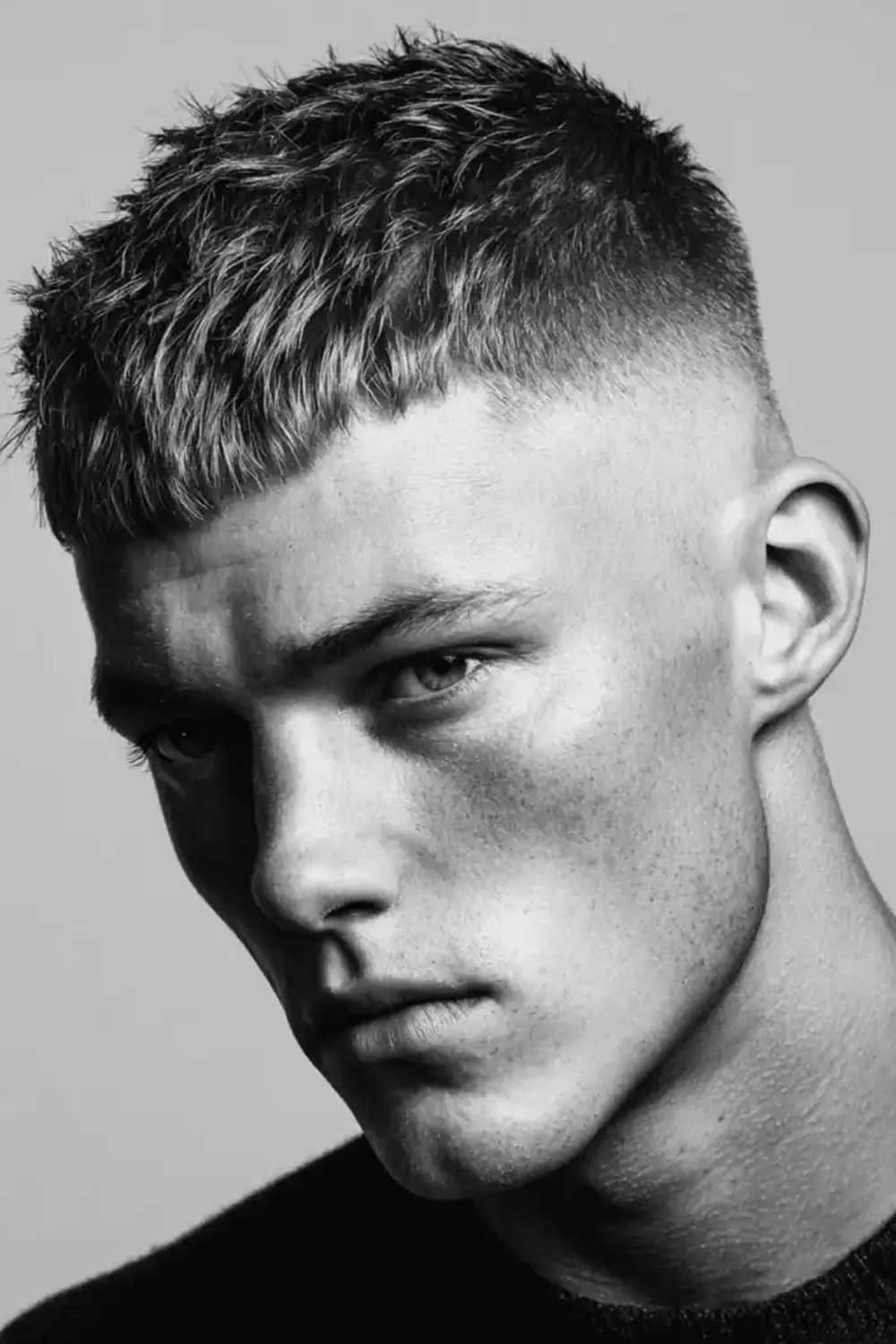
Photo: Beard Beasts — source
23. Modern Mullet
The modern mullet is the comeback cut of this guide, and the high skin fade makes it wearable instead of a joke. The top is textured and short, the back keeps its length, and the sides go bare high up — so the mullet reads as a deliberate style, not an accident. In the photo the mullet is clear from the side: short textured top, longer length flowing at the back, and the high fade tying the two together. It is a bold cut, and it suits men who like their hair to have a point of view.
Ask your barber for a modern mullet with a high skin fade, the top textured and the back left long enough to sit on the collar. Keep the back tidy with regular trims and use a little texture spray to keep the top piecey. Best for: thick or wavy hair; oval faces; men who want a statement cut. Upkeep: fade every seven to ten days; the mullet length needs shaping every three weeks.
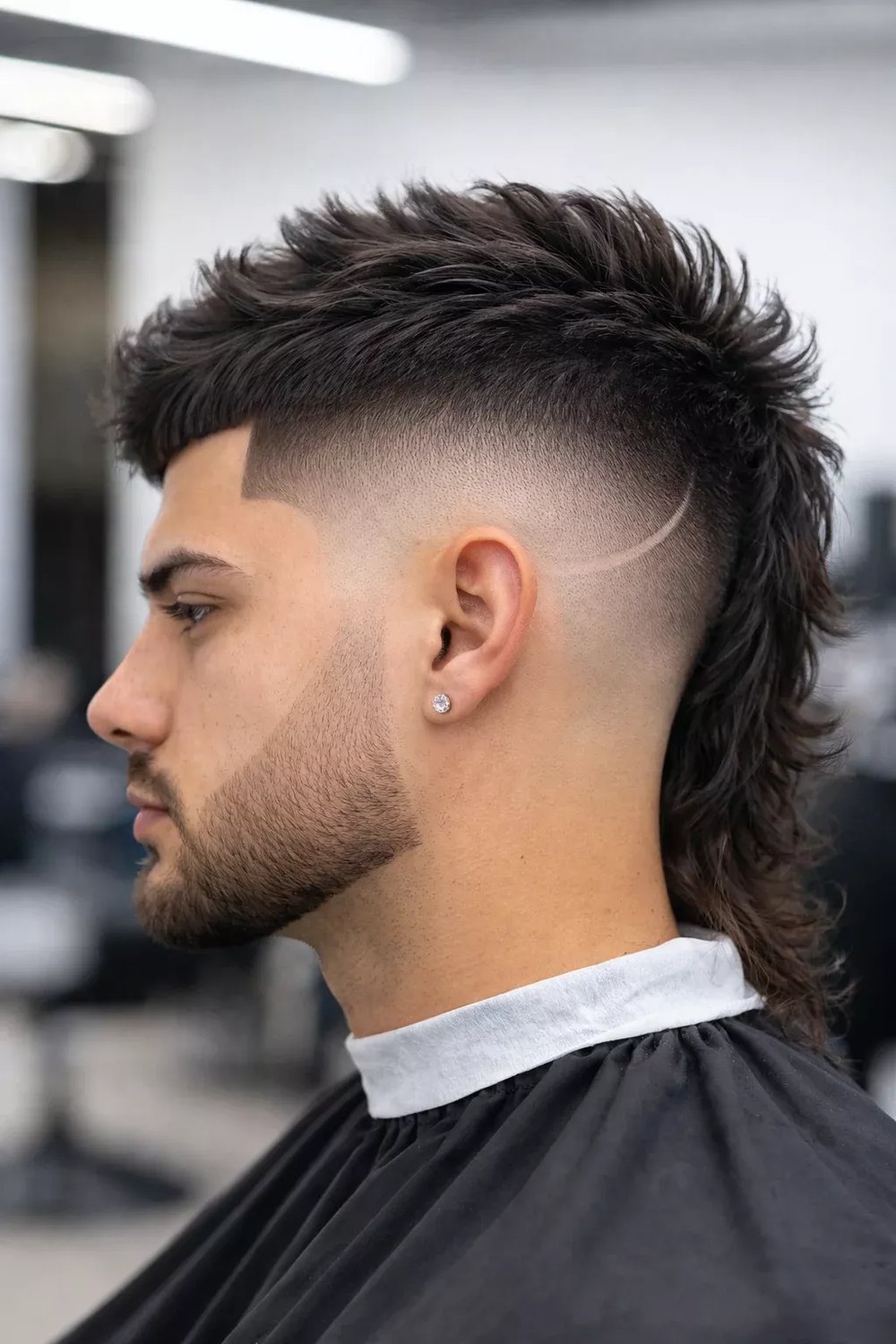
Photo via Pinterest — source
24. Beard Pairing
A high skin fade with a full beard is one of the strongest combinations a man can wear, because the cut has three clear layers: beard below, bare skin in the middle, and hair on top. In the photo the brushed-up top sits above a clean high fade, and the full beard below is shaped so the fade flows into it without a gap — the beard and the fade meet at a sharp line, and that line is what makes the whole look work. It suits men with a good beard, and it makes the jaw look stronger.
Ask your barber for a high skin fade with a full beard, and have the beard shaped so it connects to the fade cleanly — the cheek line and the neckline matter as much as the fade itself. Oil the beard daily and keep the cheek line sharp between visits. Best for: men with a full, even beard; square and oval faces. Upkeep: fade every seven days; beard shaping at every visit.
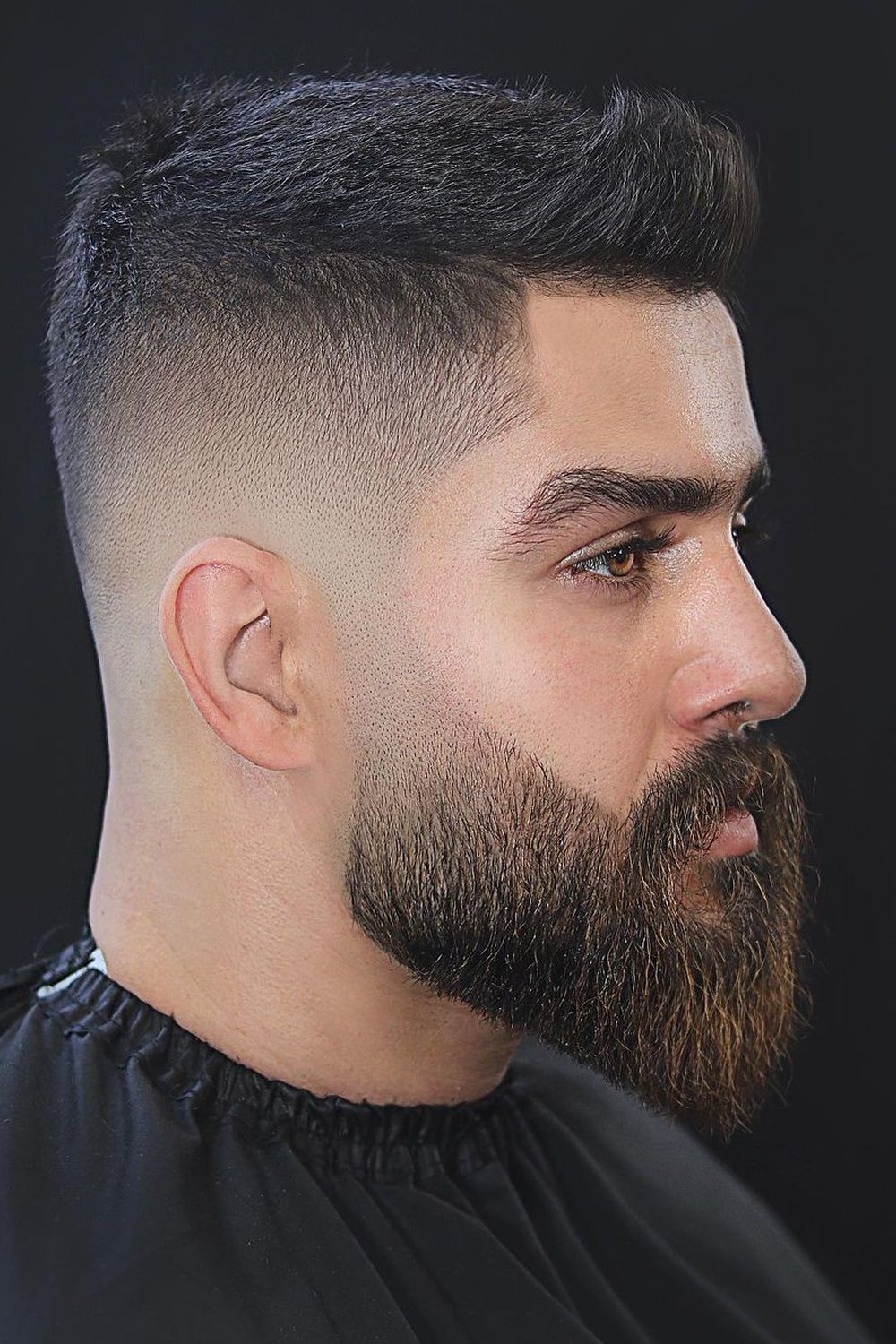
Photo via Pinterest — source
25. Line-Up
The line-up is the detail that makes a high skin fade look razor sharp: the hairline at the front and the temples is cut into a crisp, straight edge, and the high fade runs back from it so the whole head looks drawn with a ruler. In the photo the cut is seen from the back and side, where the lineup edge and the fade are the subject — the sharp corner where the hairline meets the bare skin shows exactly why the line-up matters. It is a small detail with an outsized effect, and it is what separates a good fade from a great one.
Ask your barber for a high skin fade with a sharp line-up, and be clear about the shape: a straight hairline, squared temples, or a slightly rounded corner. The line-up grows out fastest of any part of the cut, so it needs refreshing at every fade tidy-up. Best for: straight and coily hair; men with a strong hairline. Upkeep: line-up refreshed every five to seven days.
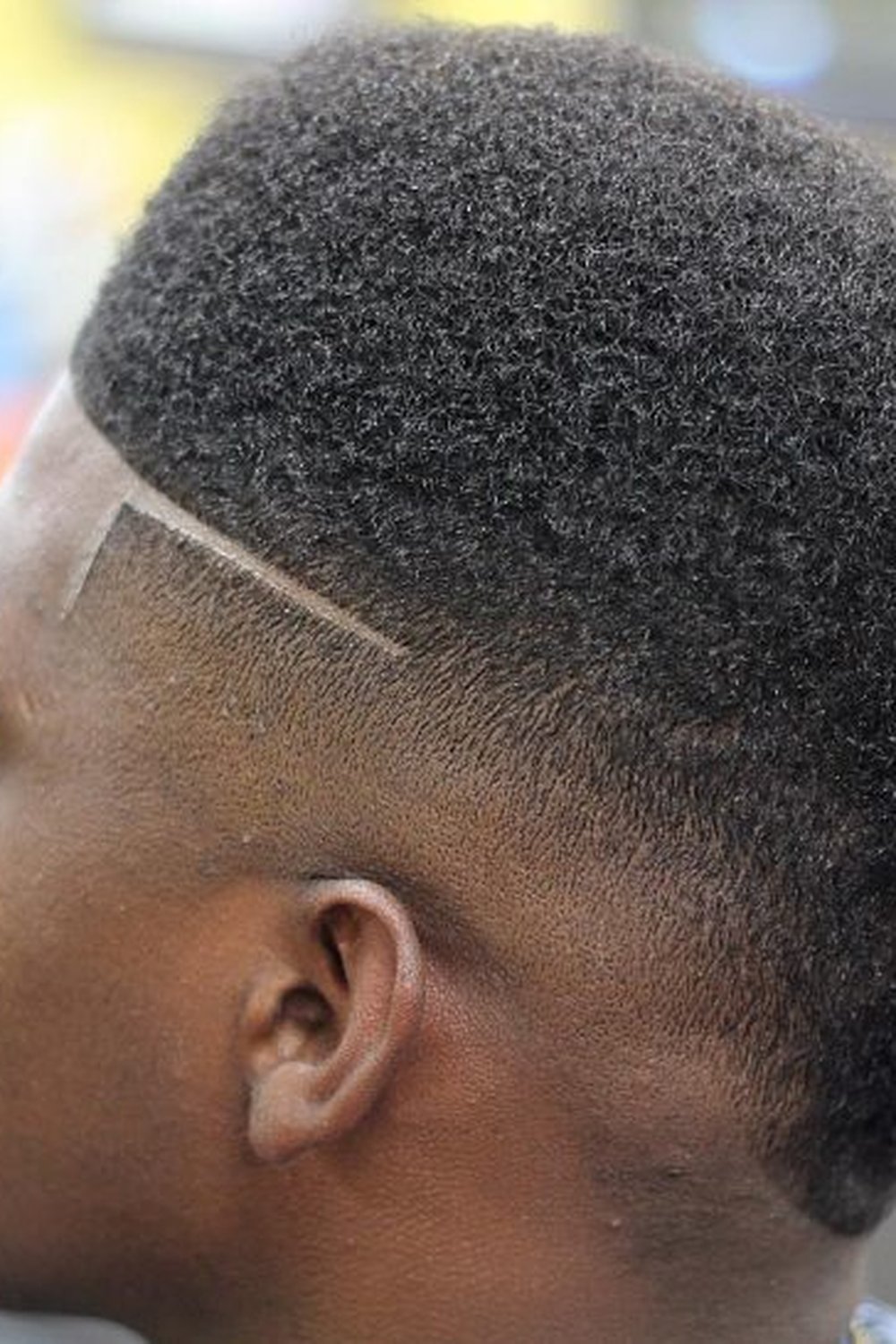
Photo: Macho Hairstyles — source
26. Design Line
The design line is the high skin fade as art: a curved line shaved into the fade, usually above the ear, that turns the blend into a pattern. In the photo a single curved line sweeps across the side, cutting through the gradient from skin to hair, and the effect is subtle from the front and striking from the side. It is a small, cheap addition — the barber cuts it with a trimmer in a minute — and it makes a standard fade look custom. It suits men who want their cut to have a signature without committing to a full design.
Ask your barber for a high skin fade with a single curved design line shaved above the ear. Keep it simple: one clean curve reads better than a complicated pattern, and it needs re-cutting at every fade tidy-up, because it grows out in about a week. Best for: straight or wavy hair; men who want a signature detail. Upkeep: design line re-cut every five to seven days with the fade.
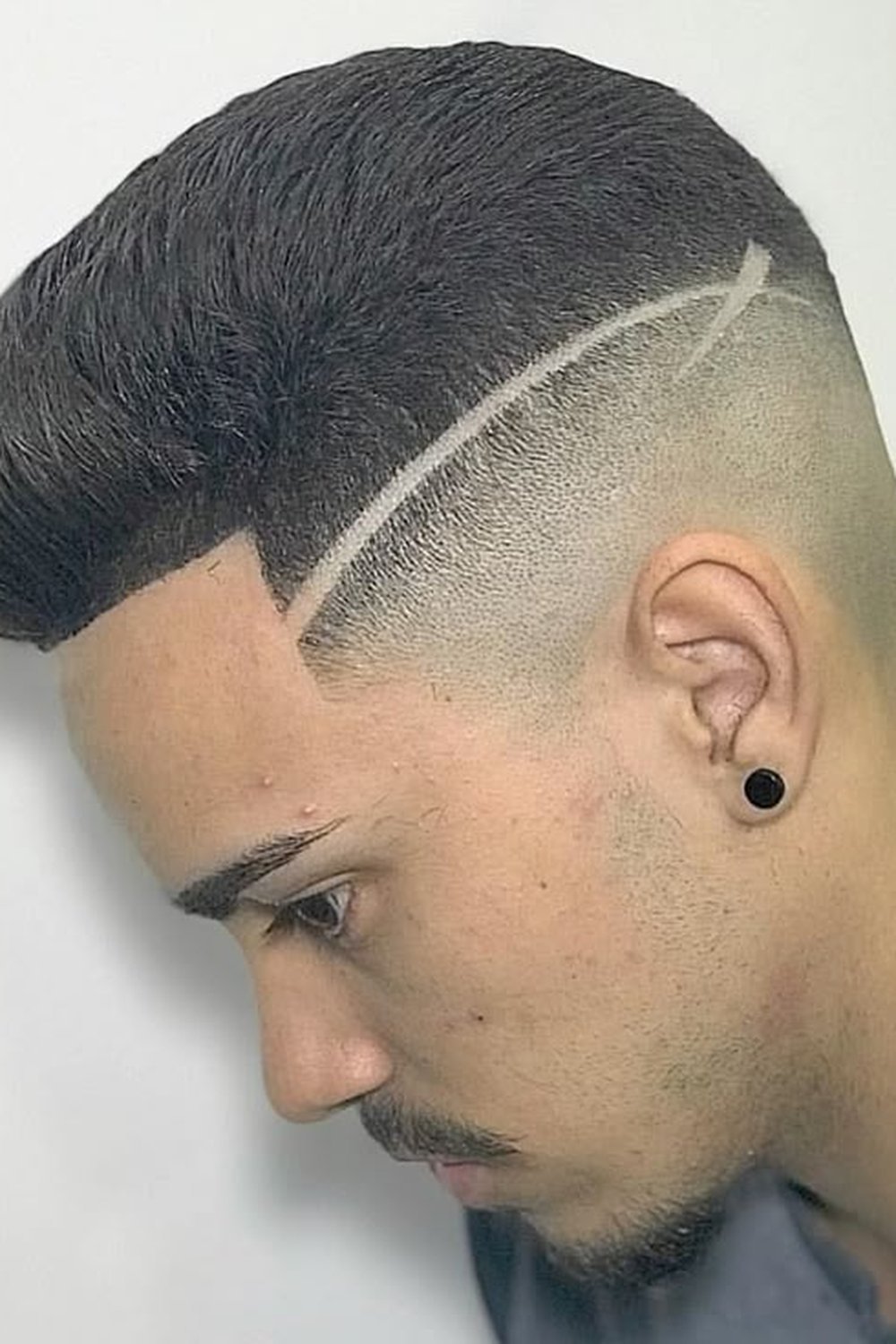
Photo via Pinterest — source
27. Long Top
The long top is the most dramatic version of the high skin fade: three or more inches of hair swept back over a high, bare fade, so the top looks long and heavy against skin. In the photo the long top is slicked back with a beard underneath, and the contrast between the length on top and the bare sides is the strongest in this guide — the hair looks like it is floating above the fade. It suits men with thick hair who can grow the top long, and it is the best choice for anyone who wants the fade to be a frame rather than the feature.
Ask your barber for a high skin fade with a long top, three inches or more, slicked back. Use a medium-hold pomade and comb the top straight back, keeping the sides tight so the length reads cleanly. Best for: thick, straight or wavy hair; oval and square faces; men growing their hair out. Upkeep: fade every seven days; the long top needs a trim every four weeks.
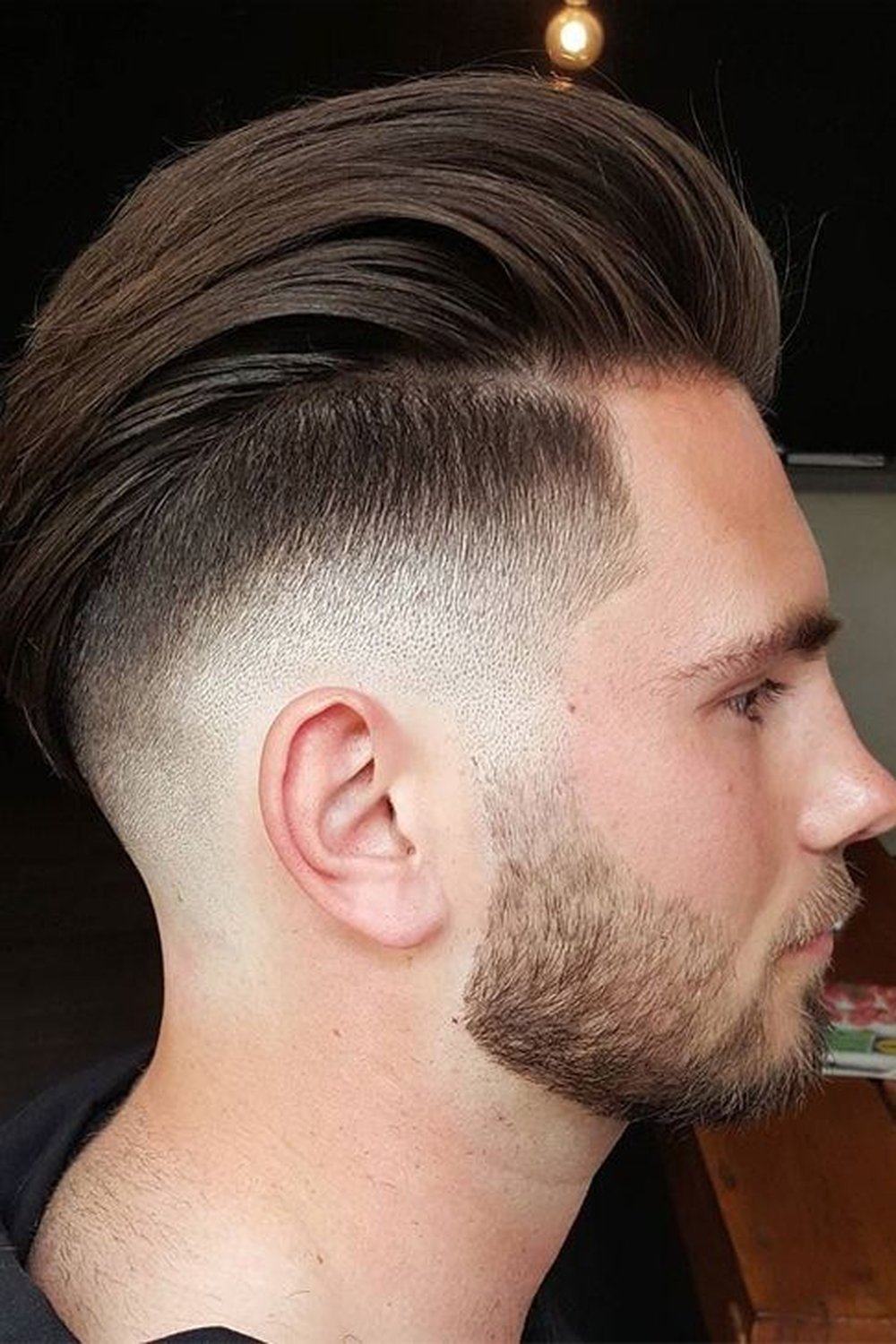
Photo via Pinterest — source
28. Braids
Braids with a high skin fade combine two strong styles into one cut: cornrows on top, bare skin on the sides, and a sharp line where the two meet. In the photo the cornrows are seen from above, braided in neat, even rows toward the back, and the high fade frames them so the pattern is the feature of the cut. It is a protective style as well as a fashionable one — the braids keep the hair tidy for weeks — and the fade keeps the sides sharp while the braids grow out.
Ask your barber for a high skin fade with cornrows on top, braided back in the pattern you want. Keep the scalp moisturised and the braids tidy, and have the fade touched up weekly so the sides stay sharp while the braids last. Best for: coily and textured hair; men who want a protective style. Upkeep: fade every seven days; braids re-done every two to four weeks.
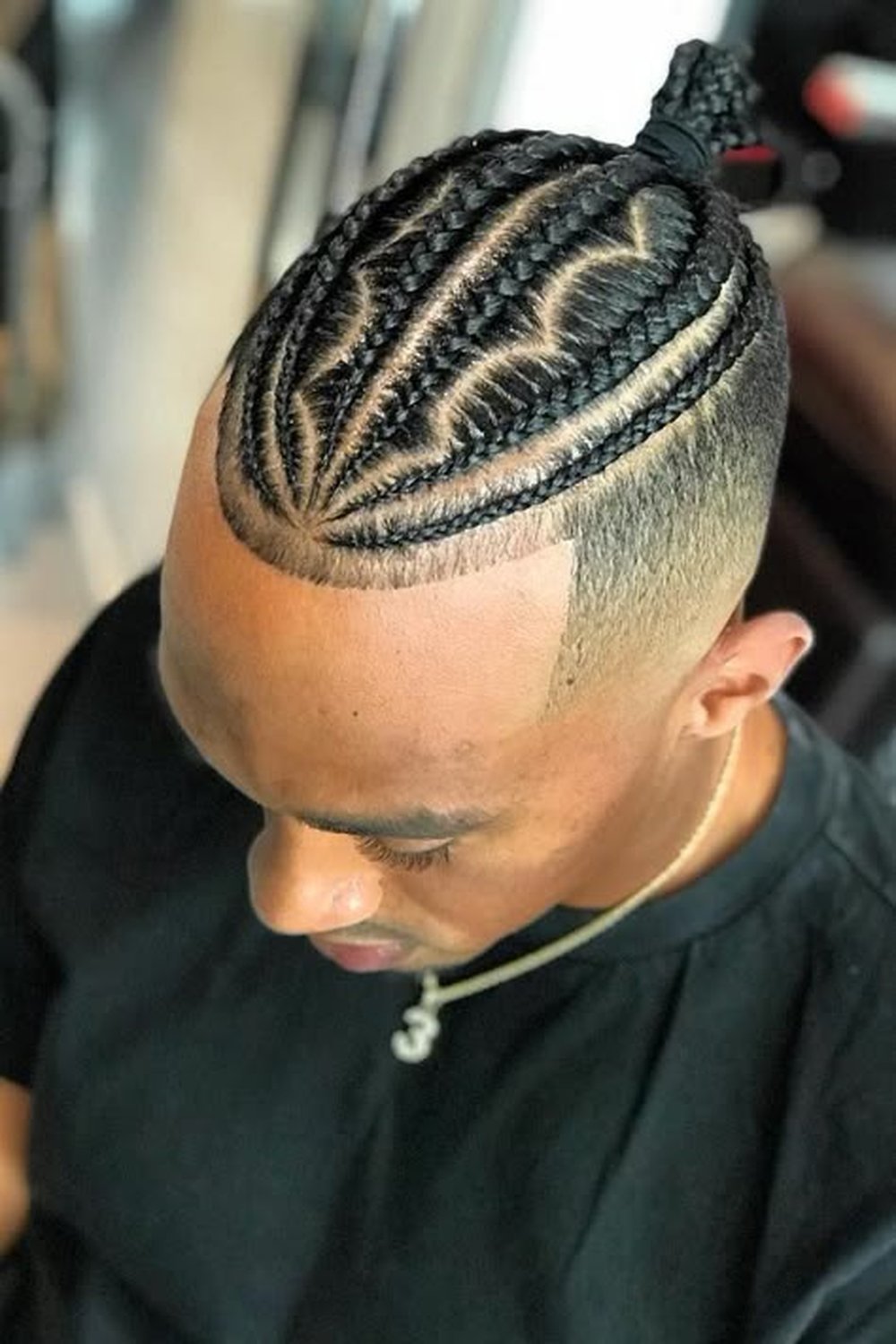
Photo via Pinterest — source
29. Disconnected Undercut
The disconnected undercut is the most architectural cut in this guide: the long top is swept to one side with no blend at all into the sides — a hard, visible line where the length ends and the fade begins. In the photo the long side-swept top sits over a faded side with the disconnection clearly visible, and the high skin fade makes the contrast even stronger. It is a fashion-forward cut, and it suits men who like their hair to look styled rather than natural.
Ask your barber for a disconnected undercut with a high skin fade, the top left long and swept to the side, with a hard line where it meets the fade. Style the top with a medium-hold product and keep the parting clean so the disconnection reads. Best for: thick, straight hair; oval faces; men who like a sharp, styled look. Upkeep: fade every seven days; the top needs a trim every three weeks.
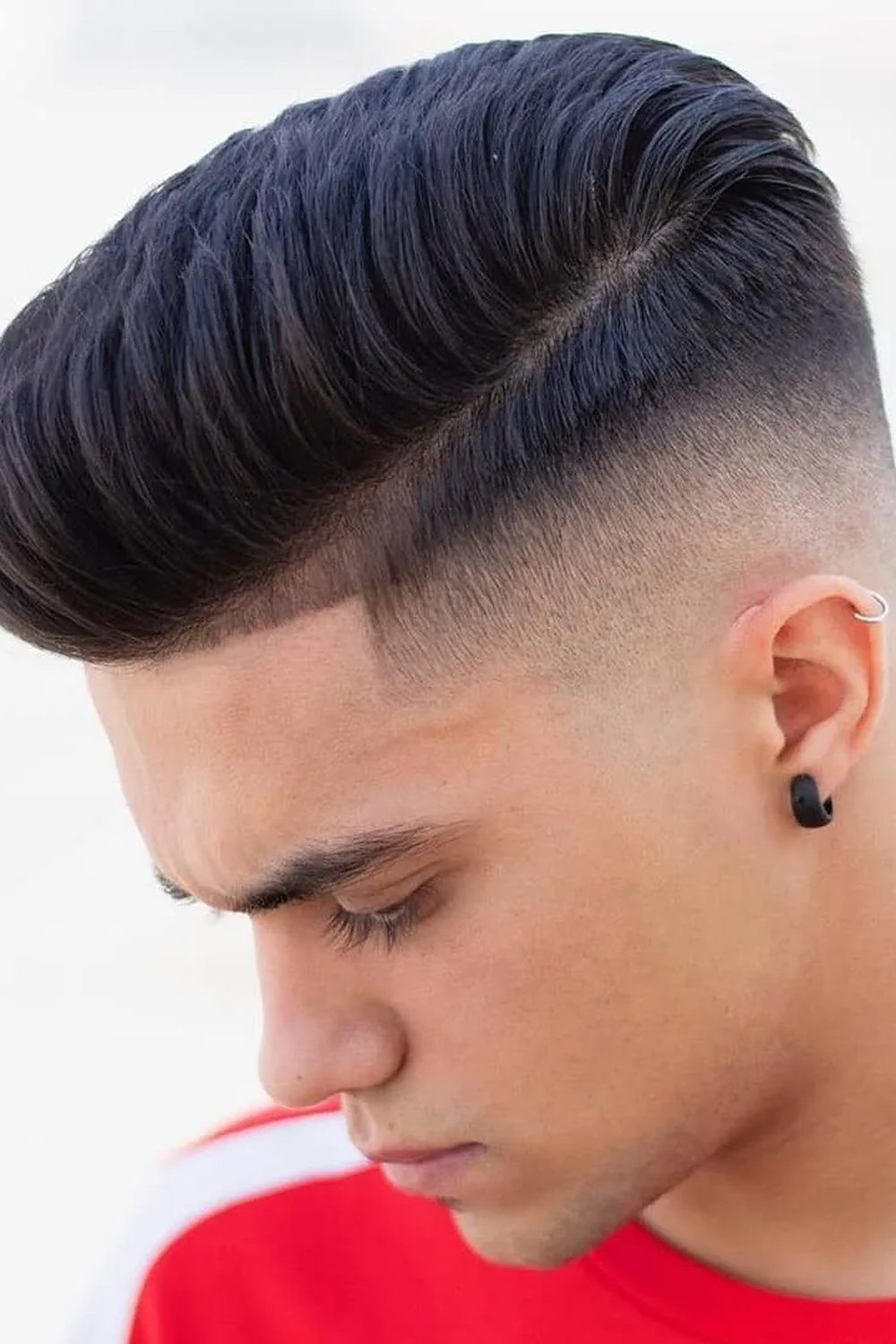
Photo: Elleman — source
30. Military High and Tight
The military high and tight is the shortest, sharpest cut in this guide: the top is clipped very short, the sides are taken to bare skin high up, and there is almost nothing left but clean lines. In the photo the high and tight is blond and tight, the top barely longer than the fade, and the whole head reads as one sculpted shape. It is the easiest cut to live with — no styling, no product, no bad hair days — and it suits men who want to look sharp with zero effort.
Ask your barber for a military high and tight with a high skin fade, the top clipped to a number one or two. There is no styling: wash it, dry it, and go. The only upkeep is the fade itself, which needs its weekly tidy-up to stay crisp. Best for: oval and square faces; men who want the lowest-maintenance cut there is. Upkeep: fade every five to seven days; the top holds for two weeks.
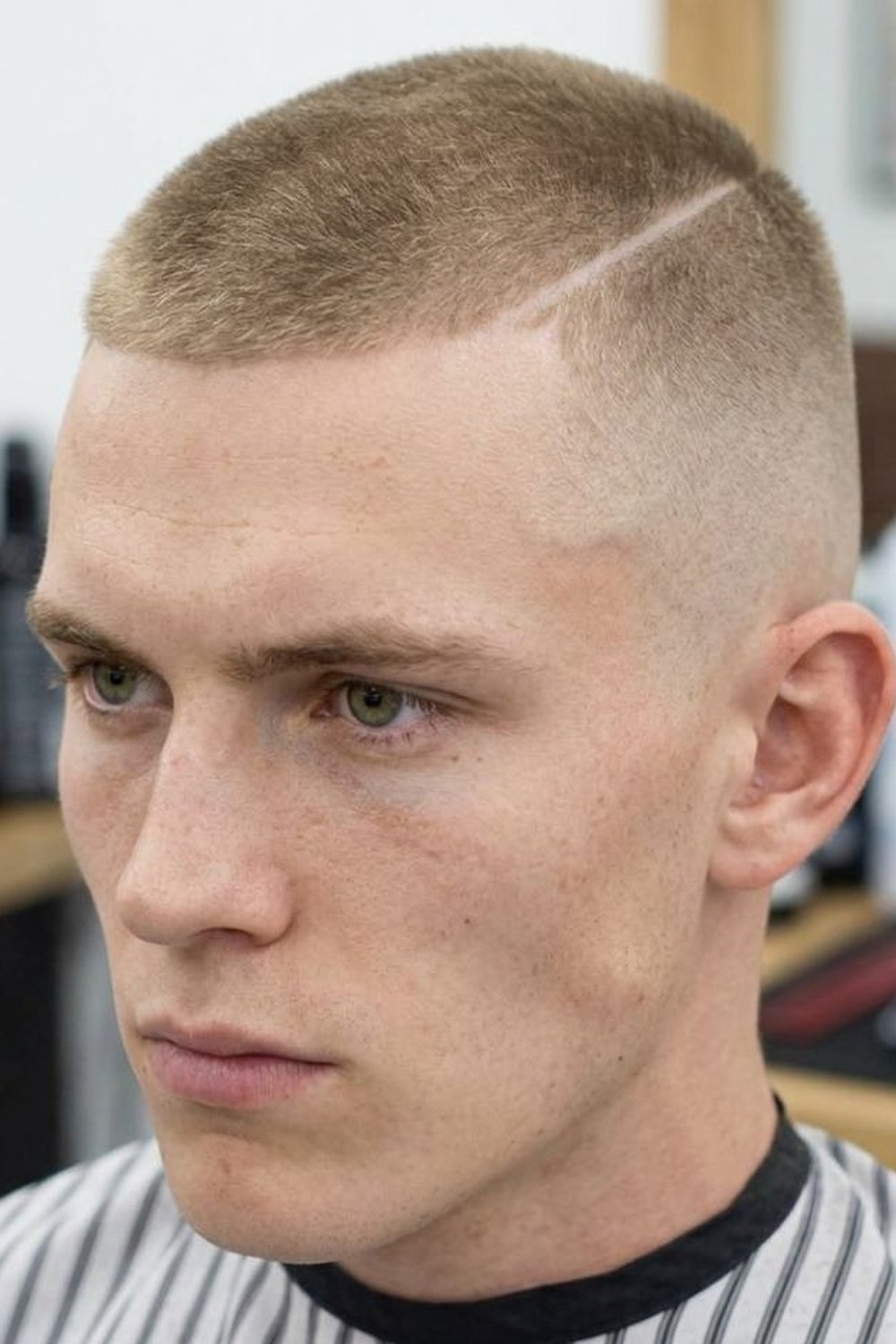
Photo: Haircut Trends — source
31. Mohawk
The mohawk is the boldest cut in this guide, and the high skin fade is what makes it wearable. The centre strip is left long and standing up, the sides are shaved bare high up, and the beard underneath balances the height — so the mohawk reads as a style, not a costume. In the photo the mohawk strip runs tall down the centre with a full beard below and the high fade on the sides, and the cut has presence from every angle. It is a statement, and it suits men who are comfortable being noticed.
Ask your barber for a mohawk with a high skin fade, the strip left long down the centre and the sides taken to skin. Push the strip up with a strong-hold product and keep the beard shaped so the cut stays balanced. Best for: thick, straight hair; oval faces; men who want the boldest cut in the guide. Upkeep: fade every five to seven days; the strip needs a trim every two weeks.
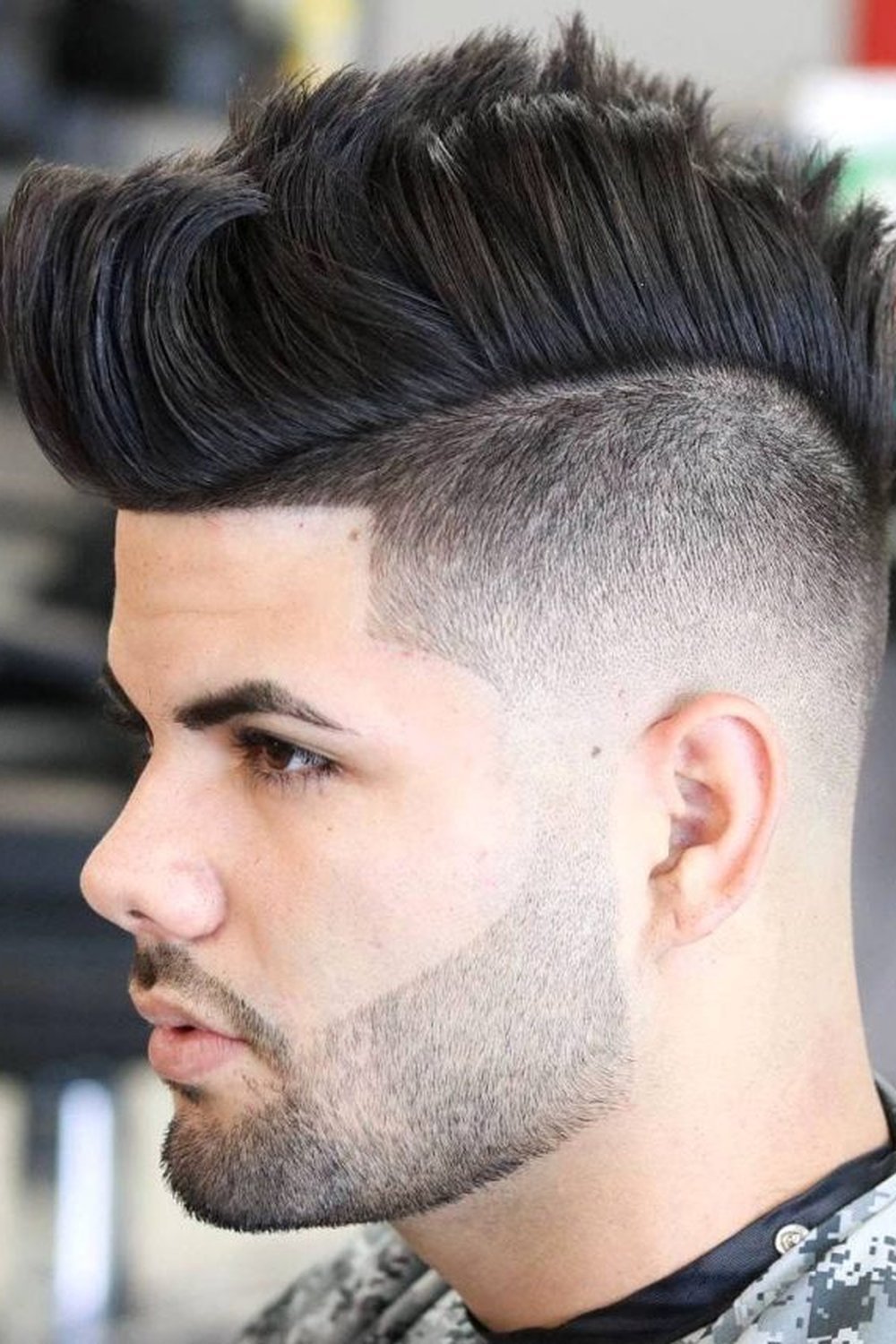
Photo: Men’s Hairstyles Web — source
High skin fade upkeep: keeping it sharp
A high skin fade looks its best for about a week. After seven days the bare skin starts to shadow over, after two weeks the blend softens into a taper, and after three weeks it reads as a grown-out fade rather than a skin fade. Book a tidy-up every seven to ten days to keep it crisp — a quick fade refresh takes about fifteen minutes at most barbers and costs less than a full cut. Between visits, keep the skin moisturised, wear sunscreen on the bare sides, and use the right product for your top: matte clay for texture, pomade for slick backs and pompadours, curl cream for curls. If you are growing the top out, let the fade do the work — the bare sides keep the cut looking deliberate even as the top gets longer. And if the upkeep ever feels like too much, step down to a low fade for a cycle; you can always go high again next time. For more styles in the same family, our taper fade styles guide has 36 more ideas.
High skin fade FAQs
Is a high skin fade good for work?
It depends on the workplace. A high skin fade is bold — the bare sides are the feature — so strict offices and formal dress codes may not suit it. Styles like the comb over, the Ivy League, the side part and the crew cut pass more easily, because the top reads neat even with a high fade. Avoid the mohawk, the design line, the faux hawk and the disconnected undercut for strict workplaces, and keep the beard neat if you pair the fade with one.
How long does a high skin fade last?
It looks its sharpest for about a week. After ten days the skin part starts to shadow over, and after two to three weeks it reads as a high taper rather than a skin fade. Book a tidy-up every seven to ten days to keep it crisp — the high placement means regrowth shows faster than on a low fade, so the window is shorter.
Does a high skin fade suit a round face?
Yes — it is one of the best fades for a round face. The bare sides take width away from the cheeks and jaw, and styles with height on top, like the quiff, the pompadour and the brush up, add length to the face. Avoid very flat tops, which can make a round face look wider, and keep some height in the top to balance the short sides.
Can I get a high skin fade with curly hair?
Absolutely — curly hair takes a high skin fade beautifully. Keep the curls long on top so they keep their shape, and let the fade frame them: the bare sides make the curls look taller and more defined. Ask your barber to shape the curls rather than thin them, use a curl cream after washing, and never brush the curls dry.
What should I ask my barber for a high skin fade?
Say the height, the skin, and the top, in that order: “A high skin fade, bare to the skin high up the sides, blended up through a zero and a one, with [your top style] on top.” Bring a photo from this guide on your phone — barbers cut better from a picture than from a description — and ask to see the blend in the mirror before the top is cut.
How much does a high skin fade cost?
Prices vary by city and barbershop, but a high skin fade typically costs the same as any other fade at your barber — the skin finish takes a little longer because of the foil shaver, so some shops charge a few dollars more. A quick fade tidy-up between full cuts is usually cheaper and takes about fifteen minutes.
Is a high skin fade better than a low skin fade?
Neither is better — they suit different men. A high skin fade is bolder, shows more contrast, and suits men who want the fade to be the feature. A low skin fade is subtler, more office-friendly, and grows out more gracefully. If this is your first skin fade, start low; you can always go higher next time. Our low skin fade guide has 29 styles if you want to compare.
Will a high skin fade suit thinning hair?
It can, if you pick the right top. Short tops like the buzz cut, the Caesar cut and the crew cut work well with thinning hair, because the high fade removes bulk from the sides and the short top does not try to hide anything. Avoid long, heavy tops that expose the scalp, and keep the fade clean — a sharp high fade with a short top looks deliberate, which is what matters most.
Conclusion
The high skin fade is the boldest way to wear a fade — bare skin high up the sides, a smooth blend into the top, and a cut that people notice. These 31 styles cover every version of that idea, from the office-safe comb over to the statement mohawk, and every one of them is built on the same high, clean fade. Pick the one that matches your hair and your life, bring its photo to your barber, and say the height, the skin and the top in plain words. If you want the quieter version of the same cut, our low skin fade guide has 29 more — and if you try one of these 31, the high skin fade will do the rest.
By Derek Nolan. All photos are real photographs with credit lines and source links under each image.